

Forget the traditional “study now, hope for a job later” route Ausbildung in Germany flips the script by paying you to train. It’s Germany’s dual vocational system, blending real workplace experience with classroom learning, and it’s opening doors for international students across nursing, IT, engineering, and more. In this guide, we break down everything you need to know: eligibility, costs, top-paying courses, and the pathway to permanent residency in Germany.
Table of Content
- What is Ausbildung in Germany?
- Benefits of Choosing Ausbildung in Germany?
- Types of Ausbildung Programs
- German Language Requirement
- Top In-Demand Ausbildung Courses
- Highest-Paying Ausbildung Programs
- Ausbildung Salary in Germany
- Cost of Living During Ausbildung
- Documents Required for Ausbildung
- Step-by-Step Application Process
- Can International Students Work During Ausbildung?
- Career Opportunities After Ausbildung
- Permanent Residency After Ausbildung
- Conclusion
- Frequently Asked Questions
What is Ausbildung in Germany?
Ausbildung is Germany’s dual vocational training system, which combines practical, hands-on training at a company with theoretical classes at a vocational school (Berufsschule), running concurrently over two to three and a half years depending on the profession chosen. It is regulated under the Berufsbildungsgesetz (BBiG) and covers more than 320 officially recognized professions, spanning fields such as healthcare, IT, engineering, hospitality, and skilled trades. Trainees earn a monthly stipend throughout the programme, and on completion the final assessment is conducted by the region’s chamber of commerce (IHK) or chamber of crafts (HWK), with the resulting diploma recognized federally across Germany. Unlike a university degree, Ausbildung is built for direct entry into a regulated skilled profession, giving trainees real workplace integration from day one rather than an academic or research-oriented path.
Benefits of Choosing Ausbildung in Germany?
- No tuition fees — training costs are funded by the employer and the state, so students pay nothing to enrol. (Very important — this is a key differentiator from university study abroad.)
- Earn while you learn — trainees receive a monthly stipend throughout the programme, typically ranging from around €800 to €1,500 or more depending on the profession and year of training.
- Wide choice of professions — Germany recognizes over 320 officially recognized occupations across healthcare, IT, engineering, hospitality, and skilled trades.
- Strong employability — Germany’s ongoing skilled-worker shortage means employers are actively recruiting internationally, giving graduates a high chance of retention with their training company.
- Globally recognized qualification — the certification issued is federally recognized throughout Germany and respected across the EU.
- Clear pathway to Permanent Residency — this is the biggest draw for most applicants. After completing Ausbildung in Germany and working in the trained field for 2 years, graduates are eligible to apply for a Niederlassungserlaubnis (settlement permit) under §18c of the German Residence Act, with standard requirements including B2 German, sufficient pension contributions, and adequate income.
- Path to German citizenship — after 5–6 years of total residence, including training time, German citizenship becomes an option.
- Family reunification — once settled with a qualifying visa/employment, trainees can generally bring a spouse and children to Germany.
- Further study options — graduates can go on to pursue a Meister/Techniker qualification or transition into a Bachelor’s degree.
- Legal worker protections — international Ausbildung students have the same rights as German trainees, including minimum wage guarantees, vacation time, and protection under German labor laws.
Types of Ausbildung Programs
1. Dual Vocational Training (Duale Ausbildung)
This is the most common and widely recognized form of Ausbildung. Training takes place at two locations: practical skills are learned on the job at a company, while theoretical knowledge is taught at a vocational school (Berufsschule). Trainees sign a training contract directly with their employer and are legally required to attend Berufsschule alongside their workplace training. The programme is regulated nationwide by the Berufsbildungsgesetz (vocational training act) and coordinated by the Chambers of Industry and Commerce (IHK) or Chambers of Crafts (HWK), which ensure standardized training plans and final examinations across employers. It typically runs two to three and a half years and ends with a state-recognized vocational qualification. Commercial and technical-industrial professions, such as retail, automotive mechatronics, and office administration, are commonly offered in this format. Trainees receive a training salary from the very first year.
2. School-Based Vocational Training (Schulische Ausbildung)
This form takes place entirely at a specialized vocational school (Berufsfachschule) rather than splitting time between a company and a school. Students receive full-time classroom instruction, with practical experience gained through integrated internships rather than a standing employment contract. This route is common for professions such as healthcare, education (e.g., childcare/Erzieher), and certain technical or design fields where standardized theoretical instruction is prioritized. It generally lasts one to three years. Because there’s no direct employer contract in most cases, students often do not receive a training wage in the same way dual-system trainees do, though this varies by state, school, and profession, some healthcare-related schulische programmes do pay a stipend.
German Language Requirement
For most Ausbildung programmes, applicants need at least B1-level German for the Ausbildung visa under §16a of the German Residence Act (AufenthG). This is the legal minimum, but it’s a low bar in practice — vocational school instruction is delivered entirely in German, and while B1 lets a candidate follow everyday conversation, technical vocabulary in the classroom typically needs B2-level comprehension, so most employers and chambers of commerce (IHK/HWK) recommend reaching B2 before starting.
Requirements vary by sector:
- General/technical/commercial professions: B1 is the standard minimum.
- Healthcare and nursing: B2 is usually required, given the need for direct patient communication.
- Non-qualified or assistant-level training : A2 may be accepted in line with Federal Employment Agency guidance.
Accepted certificates include Goethe-Institut, telc, ÖSD, and TestDaF. Self-taught or informal language skills without a recognized certificate are generally not accepted for the visa application.
Preparation time: with consistent, intensive study, most learners need roughly nine to twelve months to reach B1 from scratch.
Worth noting: a growing number of English-taught Ausbildung programmes have emerged for non-EU applicants in fields like IT, logistics, and digital media, typically requiring a minimum B2 English proficiency (IELTS 5.5–6.0 or TOEFL iBT 72+), with basic German (A1–A2) preferred but not always mandatory. Ausbildung in Germany is still a smaller, employer-dependent track compared to the standard German-language route, so worth mentioning as an alternative rather than the default path.
Top In-Demand Ausbildung Courses
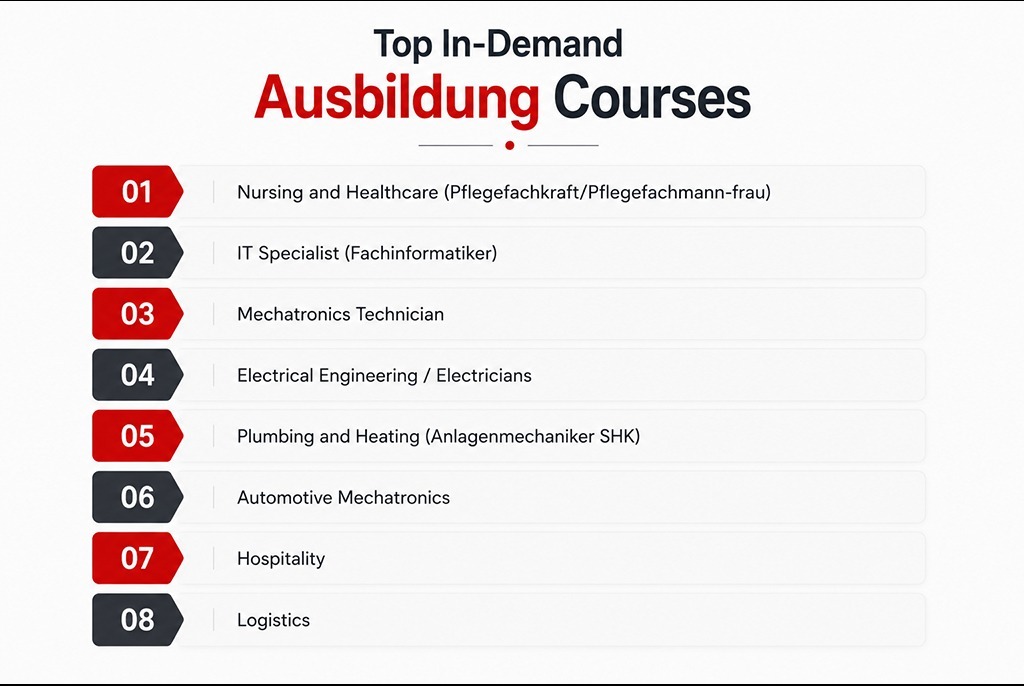
Based on Germany’s official shortage-occupation data and current market demand, these fields consistently offer the strongest prospects for international trainees:
1. Nursing and Healthcare (Pflegefachkraft/Pflegefachmann-frau)
The single most in-demand Ausbildung profession. Germany’s Federal Statistical Office projects a need for roughly 120,000 additional nursing staff by 2034 under its trend scenario. Many healthcare employers actively sponsor language courses and visa costs for international candidates. Post-training salaries typically range from €2,200–€2,800/month.
2. IT Specialist (Fachinformatiker)
Covers software development, system integration, and cybersecurity. Digitalization across industries keeps demand high, with strong post-training salary growth.
3. Mechatronics Technician
A multidisciplinary trade combining mechanical, electrical, and computer engineering — relevant to automation, robotics, and smart manufacturing. One of the trades with consistently high placement rates.
4. Electrical Engineering / Electricians
Essential-services trade with steady, long-term demand across residential, commercial, and industrial sectors.
5. Plumbing and Heating (Anlagenmechaniker SHK)
Includes HVAC and renewable-energy-adjacent systems work, an area growing alongside Germany’s energy transition.
6. Automotive Mechatronics
Covers vehicle diagnostics, maintenance, and increasingly EV systems — actively recruited by Germany’s automotive industry.
7. Hospitality
Comparatively accessible for international applicants, as some employers accept A2-level German initially, with structured on-the-job language support.
8. Logistics
Also relatively accessible due to lower language-entry requirements compared to healthcare or engineering roles.
Highest-Paying Ausbildung Programs
| Ausbildung program | Typical monthly stipend | Notes |
| Automation Technology Specialist | Up to €1,270 | Strong technical demand in industrial automation. |
| Materials Testing Specialist | Up to €1,270 | Common in manufacturing, quality control, and engineering sectors. |
| Tool & Die Specialist | Up to €1,260 | Precision-focused trade with solid pay during training. |
| IT Specialist | €1,060–€1,200 | One of the best-paid options because of strong demand in software and systems. goausbildungingermany+1 |
| Nursing | €1,050–€1,200 | High demand and stable career prospects in healthcare. |
| Mechatronics Technician | Up to €1,050 | Combines mechanics, electronics, and computer systems. |
| Food Technology Technician | Up to €1,190 | Good option for quality, hygiene, and production roles. |
| Professional Cook | Up to €1,200 | Hospitality-based option with decent stipend in larger employers. |
| Technical Product Designer | Up to €1,200 | Suitable for CAD and manufacturing-oriented learners. |
| Construction Industry professions | Up to €1,200 | Pay can be strong in infrastructure-related training. |
Ausbildung Salary in Germany
| Monthly Gross Salary | |
| Statutory minimum, year 1 (2026) | €724 (BIBB, up 6.2% from 2025) |
| National average, all years | €1,133 (BIBB, 2024 data) |
| Typical range by profession | €620–€1,350 |
Pay depends on profession, employer, and training year, rising each year. Nursing and IT sit toward the top of the range; hospitality and retail toward the lower end. Most trainees pay no income tax in year one, since earnings fall under the €12,348 tax-free allowance.
Cost of Living During Ausbildung
Monthly living costs for an Ausbildung trainee typically fall between €700 and €900, covering rent in a shared flat (€250–€450), groceries (€150–€250), transport with a trainee discount (€30–€60), and phone/internet plus the mandatory broadcasting fee (around €45 combined). This is comfortably covered by an average training stipend of €850–€1,300/month, though the balance is tighter in expensive cities like Munich or Frankfurt and more comfortable in affordable ones like Leipzig or Dresden.
Documents Required for Ausbildung
- Valid passport — valid well beyond the intended training start date.
- Signed Ausbildungsvertrag (training contract) with a German employer, or confirmed admission for school-based programmes.
- German language certificate — B1 minimum (Goethe-Institut or telc), B2 for healthcare roles.
- Educational certificates — school-leaving qualifications, apostilled and translated where required.
- German-style CV (Lebenslauf) and motivation letter (Bewerbungsschreiben).
- Proof of financial means — a blocked account (Sperrkonto) of around €11,904/year (~€992/month) if the training stipend is below that threshold; not required for most paid positions since the salary itself counts as proof.
- German health insurance.
- Completed national visa (Type D) application form, biometric passport photos, and the visa fee (around €75).
- Proof of accommodation in Germany.
- Birth certificate (apostilled if issued outside the EU).
Step-by-Step Application Process
Heres a step by step application process for Ausbildung in Germany:
- Reach B1 German (B2 for healthcare) with a recognized certificate — this is the single biggest gatekeeper, and reaching it from scratch typically takes 9 to 12 months of intensive study.
- Find a training position — search via arbeitsagentur.de, Make it in Germany, IHK Lehrstellenbörse, or Handwerkskammer apprenticeship boards, or apply directly to employers.
- Sign the Ausbildungsvertrag — the employer registers the signed contract with the relevant Chamber (IHK or HWK).
- Prepare and certify documents — CV, motivation letter, apostilled/translated academic certificates, language certificate, proof of funds.
- Book a national visa appointment at the German mission in your home country and submit the application.
- Attend the visa interview and biometrics appointment — expect questions on your chosen field, German level, and training plans.
- Wait for visa processing — commonly a few weeks to a few months.
- Arrange housing and travel, then relocate to Germany to begin training.
Can International Students Work During Ausbildung?
Yes — trainees can typically take on a part-time secondary job alongside their Ausbildung in Germany, as long as it doesn’t interfere with training and has employer/immigration approval. Earnings above the Minijob limit (€603/month in 2026) affect tax status. Exact weekly hour limits should be confirmed with the local Ausländerbehörde, as rules for the Ausbildung visa (§16a) differ from the standard student visa.
Career Opportunities After Ausbildung
Most graduates are hired directly by their training company, since the Ausbildung already builds employer familiarity and job-specific skills. Beyond direct employment, options include a residence permit to job-search in the trained field, the EU Blue Card for high-salary shortage occupations, further qualifications like Meister or Techniker, or progressing into a Bachelor’s degree. Post-qualification salaries vary widely by field, IT and banking often start around €2,700–€3,500/month, while healthcare and industrial roles can reach €2,800–€4,000/month.
Permanent Residency After Ausbildung
Several Germany immigration pathways can lead to a Settlement Permit (Niederlassungserlaubnis) after completing an Ausbildung in Germany:
- Skilled worker route (§18c AufenthG) — the standard path for Ausbildung graduates. After 2 years of qualified employment in the trained profession, graduates can apply, with requirements including B2 German, sufficient pension contributions, and adequate income. This is the most common route since Ausbildung itself is a vocational (not academic) qualification.
- EU Blue Card (§18g AufenthG) — available if a graduate later moves into a role meeting the salary threshold (€50,700 gross annually for general professions or €45,934.20 for shortage occupations and IT specialists in 2026). This route grants faster settlement: permanent residence eligibility in 21–27 months instead of the standard 5+ years. Less common straight out of Ausbildung since it usually requires a university degree, though shortage-occupation and IT exceptions exist.
- Standard long-term residence (§9 AufenthG) — the general fallback route requiring 5 years of legal residence, relevant if a graduate doesn’t meet the faster §18c or Blue Card conditions.
- German citizenship — a further step after 5–6 years of total residence (including training time), under the 2024 citizenship reform, which also permits dual nationality.
Conclusion
Ausbildung in Germany from UAE offers international students a rare combination: a debt-free route into skilled employment, a monthly income from day one, and a genuine pathway to permanent residency and long-term settlement in Europe. From nursing and IT to engineering and skilled trades, Germany’s dual training system continues to open doors for candidates who meet the language, educational, and documentation requirements outlined above. Aspiring applicants are strongly advised to begin preparation well in advance, particularly the German language requirement, and to verify all visa, salary, and residency details against official government sources before applying. For authoritative, up-to-date information on Ausbildung programmes, visa procedures, and life in Germany, applicants can refer to Make it in Germany, the official portal of the German Federal Government.
Frequently Asked Questions
Ausbildung is Germany’s dual vocational training system, combining practical, hands-on training at a company with theoretical classes at a vocational school (Berufsschule) over two to three and a half years, leading to a federally recognized qualification.
Applicants generally need a completed secondary school certificate, German language proficiency (B1 minimum, B2 for healthcare), and, for international applicants, must typically be at least 18 years old to sign a legally binding training contract.
Yes — there are no tuition fees. Training costs are covered by the employer and the state, and trainees earn a monthly stipend throughout the program.
There’s no strict legal upper age limit. Most international applicants fall between 18 and 35, as this range sees the smoothest visa processing and widest employer interest; nursing and healthcare programs are often more flexible, sometimes accepting applicants up to 40.
Yes. Most programmes require at least B1-level German for the visa (§16a AufenthG), with B2 typically required for healthcare and nursing roles, since training and workplace communication happen almost entirely in German.
Typically 2 to 3.5 years, depending on the profession and whether prior qualifications shorten the duration.
Nursing/healthcare tends to pay the most in year one (around €1,190–€1,350/month), followed by IT and technical trades like mechatronics and electrical engineering; post-qualification, IT and banking often lead with entry-level salaries of €2,700–€3,500/month.
Yes. Non-EU applicants need an Ausbildung visa (§16a AufenthG), a signed training contract, a recognized German language certificate, and proof of financial means (often waived since the training salary itself counts as proof).
Key documents include a valid passport, signed Ausbildungsvertrag, German language certificate, apostilled/translated educational certificates, a German-style CV and motivation letter, proof of financial means, health insurance, and proof of accommodation.
Yes. After 2 years of qualified employment in the trained profession, graduates can generally apply for a settlement permit (Niederlassungserlaubnis) under §18c of the German Residence Act, making Ausbildung one of the faster PR pathways in Germany.
It depends on priorities: major hubs like Munich, Frankfurt, and Berlin offer more openings (especially in IT and finance) but higher competition and cost of living, while smaller cities like Erfurt, Mainz, or Magdeburg often have less competition and a lower cost of living for trainees.




 WHATSAPP