

Highest paying jobs in Germany aren’t limited to some jobs with a skilled labour shortage touching nearly every industry, international professionals in IT, engineering, and even nursing can now earn well above the national average. Add to that faster visa routes like the EU Blue Card, and Germany has become one of the more realistic countries to build a high-paying career as a foreign worker. This guide covers the top-earning roles in 2026, what shapes their salaries, and what it actually takes to qualify.
Table of Content
- Highest-Paying Jobs in Germany for International Professionals
- Key Factors Affecting Salaries in Germany
- Best German Cities for High-Paying Careers
- Requirements for Skilled Professionals to Work in Germany
- Germany Immigration Pathways for Skilled Professionals
- Strategies to Increase Your Career and Salary
- Conclusion
- Frequently Asked Questions
Highest-Paying Jobs in Germany for International Professionals
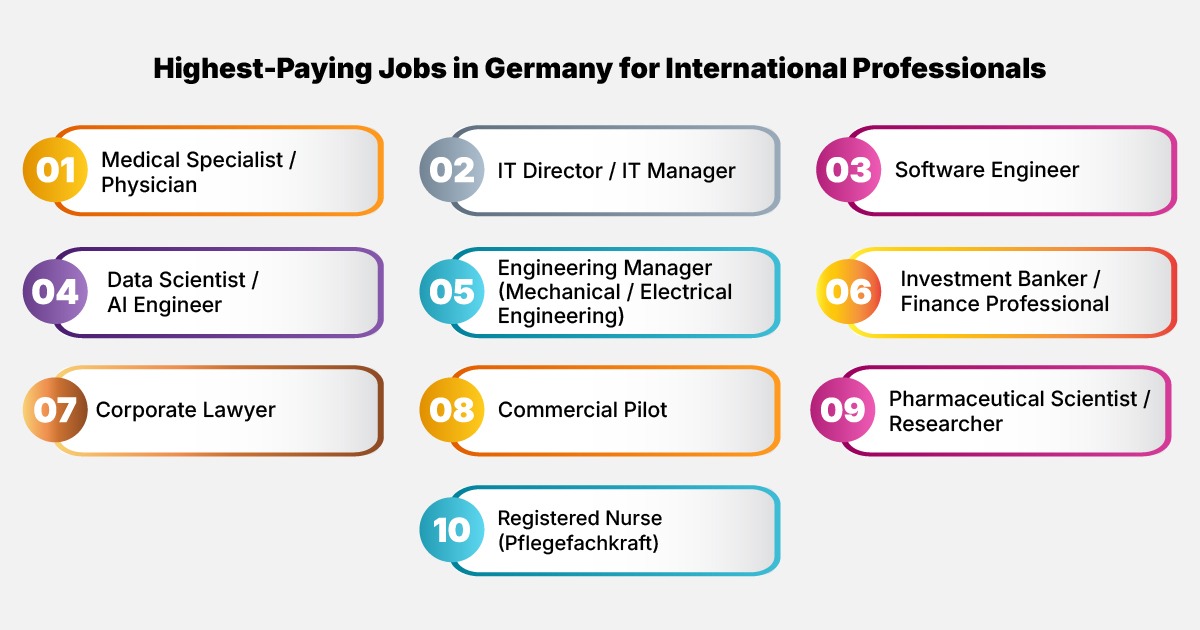
Germany’s skilled labour shortage has pushed salaries up across healthcare, technology, engineering, finance, and law. In 2026, the country has more than 630,000 unfilled skilled positions, and employers are increasingly open to hiring international talent through routes like the EU Blue Card. For most professionals, crossing the €45,000–€50,000 gross salary mark is also the threshold that opens up Blue Card eligibility.
Below are 10 of the highest-paying jobs in Germany for international skilled workers, with salary breakdowns by experience level.
1. Medical Specialist / Physician
Medical specialists are the highest-paid professionals in Germany, with senior consultants and specialists earning up to €303,000 a year in fields like surgery, radiology, and cardiology.
| Experience Level | Annual Salary (Gross) |
| Entry-level (resident/Assistenzarzt) | €72,000 – €90,000 |
| Mid-level (specialist, 5–8 years) | €90,000 – €150,000 |
| Senior (consultant/chief physician) | €150,000 – €303,000 |
Germany’s ageing population has created a critical healthcare shortage, and hospitals actively recruit foreign-trained doctors. Non-EU applicants need their medical qualification recognised by the relevant state authority and generally require German language proficiency of at least B2–C1 for patient-facing roles.
2. IT Director / IT Manager
IT managers and directors overseeing digital transformation projects earn between €90,000 and €166,000 a year, making IT leadership one of the most accessible high-paying routes for international tech professionals.
| Experience Level | Annual Salary (Gross) |
| Entry-level (IT team lead) | €70,000 – €90,000 |
| Mid-level (IT manager) | €90,000 – €120,000 |
| Senior (IT director) | €120,000 – €166,000 |
IT roles are considered among the easiest for expats to break into, since many teams operate in English. Germany’s ongoing digital transformation across manufacturing, finance, and public services keeps demand for experienced IT leadership consistently high.
3. Software Engineer
Software engineers in Germany earn between €55,500 at entry level and over €120,000 at senior level, with AI, cloud, and DevOps specialisation pushing pay toward the top of each band.
| Experience Level | Annual Salary (Gross) |
| Entry-level (0–3 years) | €55,000 – €65,000 |
| Mid-level (4–9 years) | €65,000 – €85,000 |
| Senior (8+ years) | €85,000 – €120,000+ |
Berlin and Munich pay the highest software engineering salaries, driven by a dense concentration of international tech companies. Engineers with cloud, AI, or DevOps expertise typically negotiate salaries at the upper end of each experience band.
4. Data Scientist / AI Engineer
Data scientists and AI engineers earn between €78,000 and €138,000 a year, reflecting the rapid growth of Germany’s AI sector, which is projected to reach a market value of around €30 billion by 2030.
| Experience Level | Annual Salary (Gross) |
| Entry-level | €55,000 – €65,000 |
| Mid-level | €65,000 – €95,000 |
| Senior | €95,000 – €138,000 |
Companies across automotive, finance, and manufacturing are competing for AI and machine learning talent as they digitise operations, making this one of the fastest-growing high-salary categories for international applicants.
5. Engineering Manager (Mechanical / Electrical Engineering)
Engineering managers in Germany’s manufacturing and automotive sectors earn an average of €97,450 a year, with senior technical leads at major firms earning more.
| Experience Level | Annual Salary (Gross) |
| Entry-level (design/process engineer) | €50,000 – €60,000 |
| Mid-level (senior engineer) | €65,000 – €85,000 |
| Senior (engineering manager) | €85,000 – €97,450+ |
Germany’s engineering sector remains globally competitive, with firms like Siemens and Volkswagen recruiting internationally for roles in automation, robotics, and sustainable manufacturing. Stuttgart, home to major automotive employers, is a key hub for engineering salaries.
6. Investment Banker / Finance Professional
Investment banking is Germany’s widest-ranging highest paying jobs in Germany, with total compensation from €72,000 at entry level to €675,000 for senior roles once bonuses are included.
| Experience Level | Annual Salary (Gross, incl. bonus) |
| Entry-level (analyst) | €72,000 – €100,000 |
| Mid-level (associate/VP) | €100,000 – €200,000 |
| Senior (director/managing director) | €200,000 – €675,000 |
Frankfurt, Germany’s financial capital, offers the highest average salaries in the country at around €66,529. It hosts the European Central Bank and major international banks, making it the primary destination for finance professionals relocating to Germany.
7. Corporate Lawyer
Corporate lawyers working with international firms and multinational clients earn between €80,000 and €150,000 a year.
| Experience Level | Annual Salary (Gross) |
| Entry-level (associate) | €80,000 – €95,000 |
| Mid-level (senior associate) | €95,000 – €120,000 |
| Senior (partner/counsel) | €120,000 – €150,000+ |
Foreign-qualified lawyers typically need their credentials recognised and often work as in-house counsel or in international law firm branches in Frankfurt, Munich, and Berlin, where corporate and M&A work is concentrated.
8. Commercial Pilot
Commercial pilots earn between €70,000 and €165,000 a year, with captains at major carriers commanding the highest end of the range.
| Experience Level | Annual Salary (Gross) |
| Entry-level (first officer) | €70,000 – €90,000 |
| Mid-level (senior first officer) | €90,000 – €120,000 |
| Senior (captain) | €120,000 – €165,000 |
Pilots require type-rating certification and licence conversion recognised by German aviation authorities. Demand remains strong, placing pilots among the high demand jobs in Germany, as airlines expand routes and face pilot shortages across Europe.
9. Pharmaceutical Scientist / Researcher
Pharmaceutical and biotech researchers earn between €60,000 and €120,000 a year, supported by Germany’s strong pharmaceutical manufacturing and research base.
| Experience Level | Annual Salary (Gross) |
| Entry-level (research associate) | €55,000 – €65,000 |
| Mid-level (scientist) | €65,000 – €90,000 |
| Senior (principal scientist/research lead) | €90,000 – €120,000 |
Germany’s healthcare and biotechnology sector benefits from an ageing population and strong public-private research infrastructure, with roles concentrated around pharmaceutical hubs in and near Frankfurt and Munich.
10. Registered Nurse (Pflegefachkraft)
Registered nurses in Germany earn between €30,000 at entry level and up to €70,000 a year for senior and specialised roles, with most public hospitals paying under the TVöD-P collective wage agreement.
| Experience Level | Annual Salary (Gross) |
| Entry-level (0–2 years) | €30,000 – €35,000 |
| Mid-level (3–7 years) | €35,000 – €50,000 |
| Senior (8+ years / specialist) | €50,000 – €70,000 |
Germany faces a severe nursing shortage driven by an ageing population, making it one of the fastest-growing recruitment pathways for international healthcare workers. Nurses recruited into public hospitals are typically paid under the TVöD-P grid, which sets pay by qualification and years of service and gives predictable, transparent salary growth. ICU, operating theatre, and anaesthesia specialists earn toward the top of the senior band. Recognition (Anerkennung) of the foreign nursing qualification and German language proficiency (usually B1–B2) are required before starting work.
Key Factors Affecting Salaries in Germany
Salaries vary widely across Germany, an important factor when comparing Germany jobs for skilled professionals. Here’s what makes the biggest difference.
Industry: IT, finance, engineering, pharma, and automotive consistently pay above the national average. Banking, insurance, and life sciences carry a premium across nearly all roles, not just specialist positions.
Experience level: Years of experience is one of the strongest salary drivers in Germany. The gap between entry-level and senior pay commonly exceeds 50% within the same profession.
Education and qualifications: University degrees, professional certifications (such as CFA, PMP, or SAP), and recognised foreign qualifications directly increase earning potential. Certifications alone can add 10–30% to a base salary in fields like finance and IT.
Location: Munich, Frankfurt, and Hamburg pay 10–15% more than smaller cities like Leipzig or Nuremberg for equivalent roles, largely to offset a higher cost of living. A lower salary in a cheaper city can still go further than a higher one in Munich or Frankfurt.
Company size and type: Large multinationals and DAX-listed companies typically pay 15–25% more than small and mid-sized (Mittelstand) firms for comparable roles, along with stronger benefits like company pensions and relocation support.
German language proficiency: Many international companies operate in English, but German fluency can unlock 10–20% higher pay by widening the pool of employers open to a candidate.
Best German Cities for High-Paying Careers
Six cities consistently offer the highest paying jobs in Germany and strongest job markets: Munich, Frankfurt, Stuttgart, Hamburg, Berlin, and Düsseldorf, each anchored by a different high-paying industry.
| City | Average Annual Salary (Gross) | Key Industries | Best For |
| Munich | €64,800 (up to €70,000+ in tech/engineering) | Technology, automotive, engineering, insurance | Highest overall salaries; global tech and engineering firms |
| Frankfurt | €64,000 (up to €66,500 in finance) | Banking, finance, fintech, law | Finance professionals; hosts the European Central Bank |
| Stuttgart | €63,800 | Automotive, mechanical engineering, manufacturing | Engineers, especially automotive and mechanical |
| Hamburg | €56,000 – €65,000 | Logistics, aviation, media, e-commerce, port trade | Logistics, supply chain, and media professionals |
| Berlin | €58,000 | Startups, IT, creative industries, SaaS | Tech and startup roles; most English-friendly job market |
| Düsseldorf | €58,000 – €64,000 | Finance, consulting, fashion, telecoms | Consulting and corporate roles; strong expat community |
Requirements for Skilled Professionals to Work in Germany
Most applicants need a recognised degree or vocational qualification, a valid job offer meeting the salary threshold, proof of health insurance, and either German or English language proficiency, depending on the visa route.
Recognised qualification: Your degree or vocational training must be recognised in Germany, either fully or partially, through the Anabin database or the relevant recognition authority. Regulated professions such as medicine, nursing, and law require additional licensing before you can practise.
Job offer or Opportunity Card: Most skilled worker visas require a binding job offer or signed employment contract. If you don’t have one yet, the Chancenkarte (Opportunity Card) allows entry for up to 12 months to search for work, and permits part-time jobs of up to 20 hours a week while you search, based on a points system covering qualifications, experience, language skills, and age.
Minimum salary threshold: For the EU Blue Card, the standard 2026 threshold is €50,700 a year, reduced to €45,934 for shortage occupations, recent graduates, and qualifying IT specialists. The general Skilled Worker visa requires a gross salary of at least €45,630.
Professional experience: Some routes, particularly for non-academic qualifications, require at least two years of relevant professional experience within the last five years.
Language skills: Requirements vary by visa and profession. Many roles, especially in international companies, only require English (B2), while others — particularly healthcare, nursing, and daily life outside major cities — expect German at B1–C1 level.
Health insurance: Proof of health insurance coverage is mandatory for all visa applications, either through statutory public insurance or private coverage.
Age condition (Blue Card): First-time Blue Card applicants over 45 must meet a higher salary threshold of €55,770 or provide proof of adequate pension provision.
Financial proof (Opportunity Card only): Applicants without a job offer must show financial self-sufficiency, typically through a blocked account holding at least €1,091 a month for the duration of the visa.
Germany Immigration Pathways for Skilled Professionals
Germany offers five primary routes for international professionals: the EU Blue Card, the Skilled Worker Visa, the Opportunity Card (Chancenkarte), the ICT Card, and the Freelance Visa, each suited to a different career stage and qualification type.
| Pathway | Best For | Key Requirement | Route to Permanent Residency |
| EU Blue Card | University degree holders with a qualifying job offer | Job offer of €50,700/year (€45,934 for shortage occupations, recent graduates, and qualifying IT specialists) | 21–27 months, depending on German level |
| Skilled Worker Visa (Fachkräftevisum) | Professionals with recognised vocational (Ausbildung) or academic qualifications | Recognised qualification plus job offer meeting salary threshold | Around 3–4 years |
| Opportunity Card (Chancenkarte) | Job seekers without a German job offer yet | Recognised qualification (Direct Route) or 6+ points on age, language, experience, and qualification criteria (Points Route) | Converts into a Blue Card or Skilled Worker Visa on job offer |
| ICT Card | Employees transferring within the same multinational company | Existing employment with a company that has a German entity | Tied to Skilled Worker Visa timelines after conversion |
| Freelance Visa | Self-employed specialists and consultants | Proof of sufficient income or contracts, relevant qualifications | Around 3 years, subject to business viability |
Strategies to Increase Your Career and Salary
Landing one of the highest paying jobs in Germany is only the start sustained salary growth also depends on ongoing certifications, negotiation, and career strategy.
Learn German: Fluency can unlock 10–20% higher pay and opens up roles beyond English-friendly hubs like Berlin and Frankfurt.
Get relevant certifications: Credentials like CFA, PMP, or SAP can add 10–30% to base salary, especially in finance and IT.
Target shortage occupations: IT, engineering, healthcare, and skilled trades offer faster hiring and lower EU Blue Card salary thresholds.
Negotiate with data: German employers respond to market research and measurable achievements, not personal financial circumstances.
Know the salary bands: Large companies often have structured pay scales — research them before negotiating.
Negotiate the full package: Training budgets, extra vacation days, a company car, or a transport ticket are often negotiable even when base pay isn’t.
Move to a higher-paying city or sector: Relocating to Munich, Frankfurt, or Stuttgart, or shifting into finance, engineering, or IT, directly boosts earning potential.
Build tenure: Salaries in Germany typically rise with time at a company, start realistic, then negotiate upward with experience.
Conclusion
Germany immigration for skilled professionals follows a clear, structured journey starting with a recognised qualification, moving through job search and a formal job offer, securing the right visa route, and progressing from employment into long-term career growth and eventual permanent residency. With a persistent skilled labour shortage across healthcare, IT, engineering, and finance, Germany continues to open more accessible pathways for international talent through routes like the EU Blue Card and the Opportunity Card. For professionals willing to navigate qualification recognition and language requirements, Germany PR remains one of Europe’s clearest routes to high salaries, strong career growth, and settled life abroad.
For official, up-to-date guidance on visas, recognition, and job search, refer to Make it in Germany, the German government’s official portal for skilled workers.
Frequently Asked Questions
Medical specialists, IT directors, corporate lawyers, investment bankers, and data scientists, with senior pay ranging from €100,000 to over €300,000 a year.
Nurses, doctors, IT specialists (software, cybersecurity, AI), and engineers face the sharpest shortages.
Typically €45,000–€65,000 at entry to mid-level, with the national average around €51,000–€58,000.
A recognised degree or vocational qualification, relevant experience, and often German language skills (B1–C1); regulated professions also need official licensing.
Shortage occupations like nursing, medicine, IT, and engineering, since they get reduced Blue Card salary thresholds and faster visa processing.
Banking and finance, IT, engineering, pharmaceuticals, and law highest in Munich, Frankfurt, and Stuttgart.





 WHATSAPP