


For skilled tech workers around the world, Canada has emerged as one of the most attractive places to build a career and settle long-term. Strong job demand, competitive pay, and a range of immigration options make Canada PR for IT professionals one of the more achievable routes to permanent residency today. This guide covers the tech roles currently in demand, the best cities for IT careers, expected salaries, and the step-by-step process to help you plan your move with confidence.
Table of Content
Why Canada Is an Attractive Destination for IT Professionals
Canada continues to draw IT professionals from around the world thanks to its strong demand for tech talent, competitive salaries, and multiple pathways to permanent residency. The country’s thriving tech hubs in Toronto, Vancouver, and Montreal offer opportunities across software development, data science, cybersecurity, and cloud computing, often at compensation levels that rival or exceed those in other major markets. Beyond career prospects, Canada’s Express Entry system and provincial programs give skilled IT professionals a clear route to PR, making it possible to build both a career and a long-term future in the country. Add to this a high standard of living, universal healthcare, safe cities, and a multicultural society, and it’s easy to see why Canada remains a top choice for tech professionals looking to relocate and grow their careers abroad.
In-Demand IT Careers in Canada
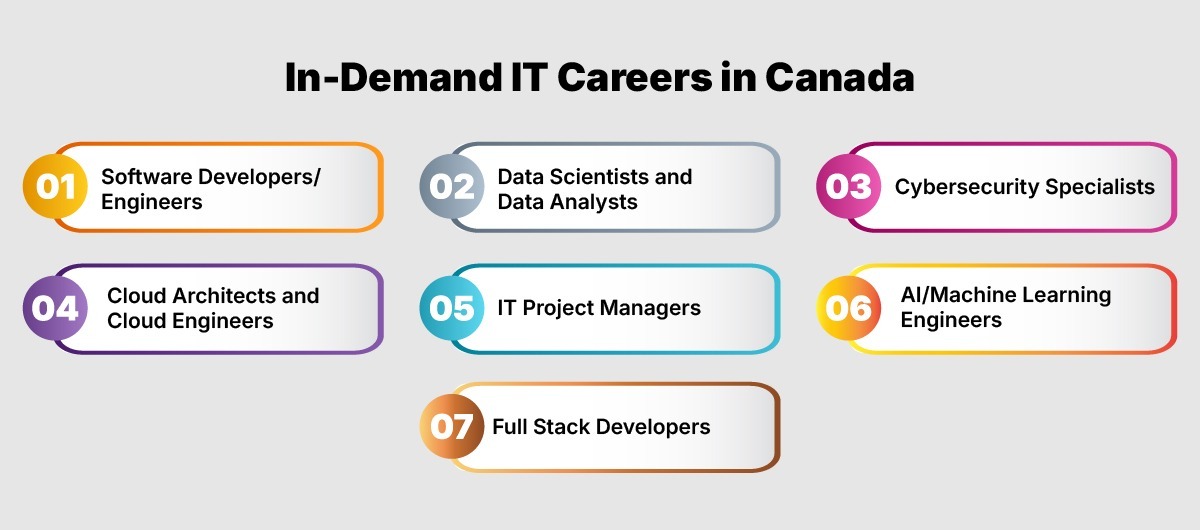
Software Developers/Engineers
Software developers remain one of the most sought-after roles across Canada’s tech industry, building applications, websites, and systems for businesses in nearly every sector.
- NOC Code: 21230/21232.
- Average Salary: Around $48/hour nationally, roughly $100,000 annually.
- Senior Range: 130,000–175,000 in cities like Toronto.
- Skills in Demand: Python, Java, JavaScript.
Data Scientists and Data Analysts
As businesses increasingly rely on data to guide decisions, data scientists and analysts who can interpret complex datasets and build predictive models are highly valued.
- NOC Code: 21211.
- Average Salary: 62,000–145,000 annually.
- Senior/AI Specialization: 115,000–175,000.
- Skills in Demand: SQL, Python, statistical modeling.
Cybersecurity Specialists
With rising cyber threats, organizations across banking, healthcare, and government sectors are prioritizing cybersecurity hires.
- NOC Code: 21220.
- Senior Salary: Up to $165,000.
- PR Advantage: Remains eligible for Canada’s STEM category Express Entry draws even after other IT NOCs were removed in 2026.
- Skills in Demand: Network security, threat detection, risk management.
Cloud Architects and Cloud Engineers
As more Canadian businesses shift operations to the cloud, professionals skilled in managing scalable infrastructure are essential.
- Solutions Architect Salary: 140,000–250,000+.
- DevOps Engineer Salary: Senior roles climbing past $175,000.
- Skills in Demand: AWS, Azure, Google Cloud.
IT Project Managers
IT project managers oversee the planning and execution of technology initiatives, coordinating between technical teams and business stakeholders.
- Core Skills: Leadership, stakeholder communication, agile/software development knowledge.
- Demand Driver: Steady need as Canadian companies scale digital operations.
- Career Path: Often a progression role for experienced developers or analysts.
AI/Machine Learning Engineers
With artificial intelligence transforming industries, ML engineers who can design and deploy intelligent systems are in high demand.
- Demand Level: Listed among the top in-demand tech roles for 2026 by Robert Half.
- Skills in Demand: Machine learning frameworks, advanced mathematics, algorithm design.
- Growth Area: One of the fastest-expanding specializations in Canadian tech.
Full Stack Developers
Full stack developers, capable of working on both front-end and back-end systems, offer versatility that many Canadian employers value.
- Core Skills: Front-end and back-end frameworks, database management.
- Employer Appeal: Adaptable across different projects and team structures.
- Demand Level: Consistently listed among Canada’s top in-demand tech roles.
Best Canadian Cities for IT Professionals
Canada’s tech opportunities aren’t spread evenly across the map, and choosing the right city can shape everything from salary potential to quality of life. Here’s how the top hubs compare:
| City | Tech Strength | Best For | Standout Fact |
| Toronto | Canada’s largest tech centre; enterprise, banking, and startup ecosystem | Career acceleration, highest salary ceilings | Added 88,900 tech workplaces over the past five years, the highest job growth of any Canadian city |
| Vancouver | Digital innovation, gaming, and clean tech | Lifestyle and career balance | Added 44,460 tech workplaces with a 63% growth rate, the highest in the rankings |
| Montreal | World leader in AI and game development, backed by strong research labs | Affordability plus career growth | Delivers the strongest overall balance of career, affordability, and lifestyle among major tech cities |
| Ottawa | Mature sector focused on telecommunications, cybersecurity, and government tech contracts | Stability and government-linked IT work | Has the highest concentration of IT workers in North America, at 11.6% of its employed population |
| Calgary | Diversifying from energy into cloud, clean tech, and AI | Lower taxes, growing opportunity | Lowest provincial income tax and no PST, easing take-home pay pressure |
| Waterloo Region | Startup-to-scaleup pipeline anchored by the University of Waterloo | Research-driven and startup careers | Ranks among North America’s top 10 tech talent markets alongside Toronto and Vancouver |
Average Salary by IT Job Role
Salaries for IT professionals in Canada can vary widely based on factors like province, years of experience, employer size, and specific technical skills. The figures below, sourced from Job Bank Canada, reflect national median wages and offer a useful benchmark, though actual compensation may differ depending on where you work and what you bring to the table.
| Job Role | Low (hourly) | Median (hourly) | High (hourly) | Median (annual, approx.) |
| Software Engineer/Developer | $35.00 | $56.49 | $91.35 | ~$117,500 |
| Data Scientist | $30.00 | $46.15 | $69.74 | ~$96,000 |
| Cybersecurity Specialist | $30.00 | $49.52 | $72.12 | ~$103,000 |
| Web/Full Stack Developer | $21.48 | $38.46 | $57.16 | ~$80,000 |
| IT/Computer Systems Manager | $43.75 | $66.67 | $103.37 | ~$138,700 |
Canada PR Pathways for IT Professionals
IT professionals have several established routes to permanent residency in Canada, each suited to different circumstances.
Express Entry
- Federal system managing the Federal Skilled Worker Program, Canadian Experience Class, and Federal Skilled Trades Program.
- Candidates ranked by CRS score based on age, education, work experience, and language ability.
- Category-based draws have included tech occupations like software engineers, data scientists, and IT project managers.
- STEM category has seen no draws for an extended period, so it shouldn’t be relied on as a guaranteed route.
Provincial Nominee Program (PNP)
- Each province runs its own PNP with distinct occupation lists, work experience, and language requirements.
- Ontario, BC, Alberta, and Saskatchewan all maintain tech-focused streams.
- A provincial nomination adds 600 points to a candidate’s CRS score, practically guaranteeing an ITA in the next Express Entry draw.
Atlantic Immigration Program (AIP)
- Employer-driven pathway for candidates settling in Canada’s Atlantic provinces.
- A designated AIP employer offers the candidate a job, connects them with settlement services, and submits an endorsement application to the province.
- Runs continuously throughout the year, though it depends on the availability of designated employers.
Employer-Sponsored (LMIA & Global Talent Stream)
- Standard route where a Canadian employer proves no qualified Canadian is available before hiring abroad.
- An LMIA-backed offer for roles like software engineers typically carries strong PR potential and counts toward CRS points.
- Global Talent Stream offers two-week work permit processing for high-skill positions and can add 50 to 200 CRS points depending on the occupation’s skill level.
- After 12 months of Canadian work experience, GTS holders become eligible for the Canadian Experience Class.
LMIA-Exempt (International Mobility Program)
- Covers categories such as intra-company transfers and CUSMA professionals.
- Bypasses the LMIA requirement entirely.
- Currently a stated federal priority, with nearly three times more admissions allocated to LMIA-exempt streams than to the standard LMIA-backed process.
Canada Immigration Process for IT Professionals
While the pathways differ, most IT professionals follow a similar sequence of steps from eligibility check to landing in Canada as a permanent resident. Here’s how the process typically unfolds:
- Determine Your Eligible NOC Code – Identify the National Occupational Classification code that matches your IT role (e.g., software engineer, data scientist, cybersecurity specialist). This determines which pathways and category-based draws you’re eligible for.
- Get an Educational Credential Assessment (ECA) – Have your foreign degree or diploma assessed by an approved agency to confirm it’s equivalent to a Canadian credential. Required for most Express Entry programs.
- Take a Language Test – Complete an approved English or French test (IELTS, CELPIP, or TEF) to prove language proficiency. Higher scores significantly boost your CRS points.
- Create an Express Entry Profile – Submit your profile with details on age, education, work experience, and language scores. The system calculates your CRS score and places you in the pool of candidates.
- Explore PNP or Job Offer Options – Apply to relevant Provincial Nominee Program streams or secure a job offer (LMIA-backed or Global Talent Stream) to boost your CRS score with additional points.
- Receive an Invitation to Apply (ITA) – Once your CRS score is competitive in a draw, IRCC issues an ITA, giving you 60 days to submit your complete PR application.
- Submit Your PR Application – Provide all required documents, including police certificates, medical exams, and proof of funds, within the given timeframe.
- Complete Medical and Background Checks – Undergo a medical examination with an approved panel physician and pass security and criminal background checks.
- Receive Confirmation of Permanent Residence (COPR) – Once approved, you’ll receive your COPR, which allows you to land in Canada and begin the process of becoming a permanent resident.
Conclusion
Canada immigration for IT professionals continues to offer some of the most accessible and rewarding pathways among skilled worker programs globally. With strong demand across software development, data science, cybersecurity, and cloud computing, backed by competitive salaries and multiple routes to permanent residency, tech talent has a genuine opportunity to build a long-term career and future in the country. Whether through Express Entry, provincial nomination, employer sponsorship, or the Global Talent Stream, choosing the right pathway depends on your specific profile, occupation, and goals. As eligibility criteria and category-based draws continue to evolve, staying informed and working with the right guidance can make all the difference in turning your Canada immigration plans into a successful outcome.
Frequently Asked Questions
Yes. Canada offers strong tech job demand, competitive salaries, universal healthcare, and multiple pathways to permanent residency, making it a top destination for IT talent worldwide.
Software developers, data scientists, cybersecurity specialists, cloud/solutions architects, DevOps engineers, AI/ML engineers, and full stack developers are among the most in-demand roles.
Software engineers earn a median of $56.49/hour nationally (roughly $117,500 annually), while other IT roles range from $38.46/hour for web developers to $66.67/hour for IT managers, depending on role and experience.
Yes. IT professionals can apply through Express Entry’s Federal Skilled Worker Program, Canadian Experience Class, or category-based draws, which have previously included tech occupations like software engineers and data scientists.
It depends on priorities: Toronto and Vancouver offer the highest salaries, Montreal delivers the best career-affordability balance, and Ottawa provides stability with government-linked tech work.
Skills in cloud platforms (AWS, Azure, Google Cloud), cybersecurity, AI/machine learning, and programming languages like Python, Java, and JavaScript are highly valued by Canadian employers.
Improving language test scores, gaining additional work experience, pursuing higher education, obtaining a provincial nomination, or securing a valid job offer are the most effective ways to boost CRS points.





 WHATSAPP