

Germany is short of skilled workers, and its current immigration rules reward qualifications and experience more than ever before. This guide explains Germany immigration pathways for UAE residents, including who can apply, what each route requires, and how to prepare your application. Whether you work in Dubai, Abu Dhabi or Sharjah, the German rules are the same as for any other non-EU applicant. The difference is that you apply through the German missions in the UAE and can use your Gulf work history as supporting evidence. Germany immigration from Dubai is now more accessible than it was a few years ago, especially for professionals in shortage occupations.
Table of Content
- Main Germany Immigration Pathways for UAE Residents
- In-Demand Jobs in Germany for UAE Residents
- Eligibility Requirements for Germany Immigration from UAE
- Germany Immigration Requirements and Documents
- How to Apply for Germany Immigration from UAE: Step-by-Step
- Common Challenges UAE Residents May Face When Applying for German Immigration
- Conclusion
- FAQs
Main Germany Immigration Pathways for UAE Residents
There are three main routes for skilled professionals. Each suits a different profile, so choosing correctly at the start saves months of delay.
| Pathway | Who can apply | Key requirements | Benefits |
| Germany Opportunity Card (Chancenkarte) | Skilled professionals who want to look for a job in Germany without a job offer | Recognised degree or vocational qualification, or at least 6 points on the points grid; basic German (A1) or English (B2); proof of funds of about €1,091 per month | Up to 12 months in Germany to search for work, part-time work alongside the search, and trial employment |
| Germany Skilled Worker Visa | Degree holders and vocationally trained professionals with a job offer in Germany | Qualification recognised in Germany; a concrete job offer matching that qualification; approval from the authorities where required | Right to work in your field, family reunification, and a settlement permit after about four years |
| Germany EU Blue Card | University graduates with a high-paying job offer | Recognised degree; job offer with a gross salary of at least €50,700 per year in 2026, or €45,934.20 for shortage occupations | Faster route to permanent residence, easier family reunification, and better mobility within the EU |
In-Demand Jobs in Germany for UAE Residents
A Germany work visa from Dubai is easiest to secure when your profession is on Germany’s shortage list. Employers in these fields actively recruit abroad, and many accept candidates with international experience. The main areas are:
- IT and software: developers, cybersecurity specialists, data engineers and cloud architects are consistently sought after, and many qualify for the lower Blue Card salary threshold.
- Engineering: mechanical, electrical, civil and automotive engineers are needed across Germany’s manufacturing and construction sectors.
- Healthcare: doctors, nurses and care workers face a long-term shortage, and hospitals and care homes sponsor foreign recruits.
- Skilled trades: electricians, plumbers, HVAC technicians and welders are in demand, particularly where vocational qualifications are recognised.
- Logistics and transport: supply chain managers, warehouse specialists and truck drivers help keep Europe’s largest economy moving.
- Finance and accounting: accountants, auditors and financial analysts with international exposure are valued by multinational firms.
- Hospitality and tourism: chefs, hotel managers and restaurant staff with Gulf experience can find openings in major cities.
UAE residents often bring strong advantages in these fields, including English-language workplaces, multinational experience and exposure to large projects. Highlight these points on your CV, and match your job search to the occupations where your qualification is recognised.
Eligibility Requirements for Germany Immigration from UAE
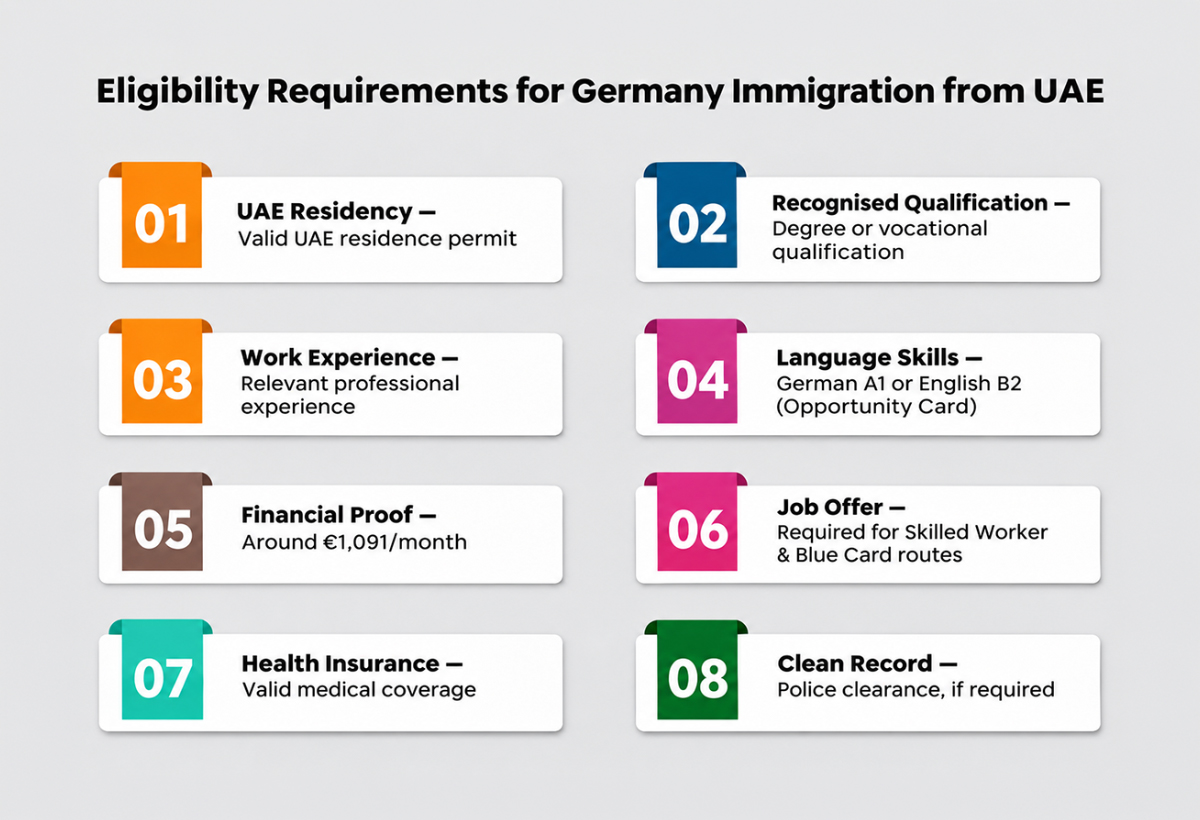
If you plan to move to Germany from UAE, check these core conditions before you start. Meeting them early makes the rest of the process much smoother, and it is the foundation of any realistic plan around Germany immigration pathways for UAE residents.
- Valid UAE residency: you should hold a valid UAE residence permit, since you will apply through the German mission responsible for the UAE.
- Recognised qualification: your degree or vocational training must be recognised in Germany, either fully or through a comparability check.
- Relevant work experience: most routes expect experience in your field, and some require a minimum period.
- Language skills: German is not always mandatory, but A1 German or B2 English is typically needed for the Opportunity Card, and higher German levels improve your points and your long-term prospects.
- Proof of financial means: you must show you can support yourself, usually through a blocked account with about €1,091 per month for the Opportunity Card route.
- Job offer, where required: the Skilled Worker and Blue Card routes need a concrete job offer that matches your qualification and meets the salary rules.
- Health insurance: valid coverage is required for your arrival and stay.
- Clean record: a police clearance certificate may be requested, and serious past offences can lead to refusal.
Not every item applies to every route, so match each requirement to the pathway you are targeting rather than trying to satisfy all of them at once.
Germany Immigration Requirements and Documents
German authorities check documents closely, and a single missing paper can delay the decision by weeks. Prepare the following in advance:
- Valid passport with at least two blank pages, plus copies of previous visas.
- UAE residence permit and Emirates ID copies.
- Completed national visa application form and recent biometric photographs.
- Degree certificates, transcripts or vocational diplomas, attested as required.
- Recognition proof, such as an assessment from the German database for foreign qualifications (anabin) or the relevant recognition authority.
- Updated CV in the German or Europass style.
- Employment contract or binding job offer, for the Skilled Worker and Blue Card routes.
- Experience letters from UAE employers, with salary slips or bank statements.
- Language certificates, such as IELTS or Goethe-Zertifikat results.
- Proof of funds, such as a blocked account confirmation, a formal declaration of commitment or a confirmed job.
- Travel health insurance valid for your arrival period.
- Police clearance certificate from the UAE and your home country, if requested.
- Marriage and birth certificates if family members will join you.
Documents issued outside Germany usually need legalisation or attestation, and those not in German or English may need certified translations. The exact list can vary by route and by the mission handling your case, so always confirm it on the official application portal before you submit.
How to Apply for Germany Immigration from UAE: Step-by-Step
The process looks long on paper, but it becomes manageable when you follow it in order. These steps reflect how Germany immigration pathways for UAE residents work in practice.
- Choose your pathway. Compare the Opportunity Card, Skilled Worker and Blue Card routes against your qualification, salary and job-offer status.
- Check your qualification. Confirm whether your degree or training is recognised in Germany, and start the recognition process if it is not.
- Get expert guidance. A Germany immigration consultant in Dubai can assess your profile, point you to the right route and review your file before submission. CanApprove, with over 25 years of immigration experience since 1998 and a branch in the UAE, supports applicants at this stage.
- Build your points or secure a job offer. Improve language scores, gather experience letters and, for work-based routes, apply to German employers.
- Arrange funds and insurance. Open a blocked account if needed and buy the required health insurance.
- Collect and attest documents. Gather every item from the checklist above, with translations where required.
- Apply online and book an appointment. Register on the Consular Services Portal of the German Federal Foreign Office and apply for your national visa, then attend your appointment at the German mission in the UAE.
- Wait for the decision. Processing times vary by route and workload, so apply well ahead of your planned move.
- Travel and register. After arriving in Germany, register your address and, if needed, convert your entry visa into a residence permit at the local immigration office.
For official guidance on each route, the German government’s Make it in Germany portal is the most reliable reference.
Common Challenges UAE Residents May Face When Applying for German Immigration
Most refusals and delays come from avoidable mistakes. Knowing the usual obstacles helps you plan around them, particularly when you apply under Germany immigration pathways for UAE residents.
- Qualification recognition delays: the recognition process can take weeks or months, so start it early.
- Language barriers: many roles and daily tasks in Germany require German, and low scores limit your points and job options.
- Salary thresholds: a job offer below the Blue Card or Skilled Worker salary rules can derail an otherwise strong application.
- Document attestation and translation: attestation in the UAE, certified translations and mismatched names across documents are frequent causes of rejection.
- Appointment availability: visa appointment slots at the German missions can be limited, especially in peak months.
- Proof of funds issues: blocked account setup, incorrect amounts or unclear fund sources create problems at the review stage.
- Competition for jobs: employers receive many applications, so a generic CV rarely stands out.
- Cost of relocation: visa fees, insurance, flights, deposits and the first months of rent add up quickly.
- Changing rules: salary figures, points criteria and processing steps are updated regularly, so outdated advice can mislead you.
Working with an experienced advisor reduces most of these risks, because a second review catches errors before the authorities do.
Conclusion
Understanding Germany immigration pathways for UAE residents helps you choose the route that fits your qualifications, salary and timeline. Start by checking your eligibility, preparing your documents and confirming current requirements on the official Make it in Germany portal, because rules and thresholds change often.
You do not have to handle the process alone. CanApprove has helped applicants with immigration since 1998, with offices across India, the UAE, Canada, Australia and Qatar. Our UAE team can help you assess your profile, choose the right pathway and prepare a complete application.
Contact the CanApprove UAE team for a personalised eligibility assessment today.
Frequently Asked Questions
The three main routes are the Opportunity Card for job seekers, the Skilled Worker Visa for professionals with a job offer, and the EU Blue Card for graduates with a high-paying job offer. Your qualification, salary and job-offer status decide which one fits.
Yes, through the Opportunity Card. It lets qualified professionals enter Germany to look for work, provided they have a recognised qualification or enough points, language skills and proof of funds.
First secure a job offer and confirm your qualification is recognised in Germany. Then gather your documents, apply for a national visa through the German Federal Foreign Office portal, and attend your appointment at the German mission in the UAE.
It is a job-seeker residence permit that allows up to 12 months in Germany to find skilled work. Non-EU professionals with a recognised qualification, or at least 6 points on the points system, can apply if they also meet the language and financial requirements.
No. Permanent residence is granted after you have lived and worked in Germany for a set period. You first move on a work-based visa or permit, then apply for a settlement permit from within Germany.
Not always. The Opportunity Card requires A1 German or B2 English, and many Blue Card jobs are English-speaking. German becomes more important for healthcare and trade roles, and it speeds up permanent residence.
Timelines depend on the route, your documents and appointment availability. Visa processing often takes several weeks, and qualification recognition or a job search can add months, so plan ahead.
Yes. Blue Card holders can qualify for a settlement permit after 27 months, or 21 months with B1 German. Skilled Worker Visa holders can generally apply after about four years.
A consultant can assess your eligibility, recommend the right pathway, check your documents and prepare your application. CanApprove’s UAE team offers this guidance to reduce errors and delays.





 WHATSAPP