


Healthcare Assistant Jobs in Australia are witnessing a steady rise in demand, driven by the country’s ageing population, expanding aged care services, and ongoing workforce shortages across the healthcare sector. For skilled individuals looking to build a stable and rewarding career abroad, this role offers an accessible entry point into Australia’s healthcare system, along with clear pathways for growth and long-term settlement. From qualification requirements and salary expectations to visa options and permanent residency prospects, this guide covers everything you need to know before starting your journey as a Healthcare Assistant in Australia.
Table of Content
- Why Healthcare Assistant Jobs Are in High Demand in Australia?
- Healthcare Assistant jobs in Australia
- Eligibility Requirements for Healthcare Assistant Jobs in Australia
- Healthcare Assistant Salary in Australia
- Best Australian States for Healthcare Assistant Jobs
- Visa Options for Healthcare Assistants
- Steps for Apply Healthcare Assistant Jobs in Australia
- Conclusion
- Frequently Asked Questions
Why Healthcare Assistant Jobs Are in High Demand in Australia?
Australia’s healthcare sector is under sustained pressure, and Best Healthcare Jobs Australia offers, particularly in support and assistant roles, sit right at the centre of that gap.. A government review of over 1,000 occupations found close to a third in national shortage, with healthcare marked as the clearest and most persistent shortage area, driven by an ageing population and low staff retention. This isn’t a short-term dip: 139 occupations have stayed in shortage every year since 2021, and healthcare roles are among them.
The ageing population is a major driver. Aged care and NDIS expansion is fuelling rapid demand growth for support roles, and the number of aged and disabled carer positions is projected to grow by around 28 percent, adding roughly 75,000 jobs. Aged care alone is expected to need about 17,000 new workers every year for the next decade.
The shortage also extends beyond aged care. Allied Health Assistant listings regularly number over 1,000 at any given time on major job platforms, with openings in both metro hospitals and regional facilities offering relocation incentives. Overall, Australia is on track to add close to 249,500 new healthcare jobs, giving healthcare assistants strong entry points into the sector and, in many cases, a pathway toward further qualifications and Australia PR.
Healthcare Assistant jobs in Australia
Healthcare assistant jobs in Australia come in several forms, each tied to a different care setting and scope of work. Here’s a quick breakdown:
| Job Title | Workplace | Main Responsibilities |
| Assistant in Nursing (AIN) | Hospitals, aged care homes, private clinics | Assists patients with personal care, mobility, and comfort needs, cleans and sterilises patient rooms and equipment, and relays patient concerns to registered nurses or doctors |
| Personal Care Assistant / Aged Care Assistant | Residential aged care facilities, home care | Supports ageing residents with showering, grooming, and toileting, and checks vital signs; assists with daily activity programs and documents resident care |
| Allied Health Assistant | Public and private hospitals, rehabilitation and community health centres | Supports allied health professionals (physiotherapists, occupational therapists) with therapy sessions, exercises, and patient mobility under supervision |
| Disability Support Worker | NDIS providers, community and in-home care settings | Assists clients with daily living activities, personal care, and community participation under an individualised support plan |
| Enrolled Nurse Assistant / Care Support Worker | Hospitals, aged care, community health | Provides practical nursing care under the supervision of registered nurses, including monitoring vital signs and offering social support |
Eligibility Requirements for Healthcare Assistant Jobs in Australia
Before applying, candidates should check that they meet the following requirements across qualifications, language, experience, health, and visa criteria.
Educational Qualification
- A Certificate III or IV in Individual Support, Aged Care, or Health Services Assistance is generally required.
- A formal skills assessment is usually not mandatory for this role, unlike for registered nurses, unless it’s specifically required for visa purposes.
English Language Proficiency
- Proof of English proficiency, typically through IELTS, is required.
- PTE and TOEFL scores are also accepted alternatives.
Work Experience
- At least two years of relevant work experience is generally expected for visa-sponsored roles.
- Some entry-level positions accept less experience.
Health and Character Checks
- A medical examination with a government-approved panel doctor is required.
- A National Police Check completed within the previous 12 months is commonly required by employers.
- Police clearance certificates are needed from any country lived in for more than 12 months.
Visa Requirements
- A minimum age of 18 years applies for most work visa categories.
- Employer-sponsored visas typically require a job offer along with proof of qualifications and English proficiency.
- A valid passport with at least 12 months’ validity, along with medical and police clearance reports, is required for the visa application.
Healthcare Assistant Salary in Australia
The average salary for a healthcare assistant jobs in Australia is $62,865 per year, though this varies significantly based on experience level. Here’s how it typically breaks down:
| Experience Level | Years of Experience | Average Annual Salary (AUD) |
| Entry-Level | 1–3 years | $49,301 |
| Mid-Level | 3–8 years | $62,865 |
| Senior-Level | 8+ years | $75,973 |
Top earners in the field have reported salaries of up to $94,427 per year, while the typical pay range falls between $65,204 and $86,601 annually, depending on the state, employer, and specific role. On top of the base salary, employers are also required to contribute superannuation, which adds further value to the overall package.
Best Australian States for Healthcare Assistant Jobs
Demand for healthcare assistants isn’t spread evenly across Australia, some states consistently offer more openings, better incentives, and stronger long-term growth. Here are the top states to consider:
- Queensland — Recorded the largest increase in health workforce numbers of any state, adding over 31,000 full-time equivalent roles, with strong demand across Brisbane’s city hospitals as well as regional healthcare services in areas like Cairns.
- Victoria — Recorded the second-largest health workforce growth, adding close to 27,800 full-time equivalent roles, and is highlighted as a key nomination state for healthcare professionals, though it draws a high volume of applicants.
- New South Wales — Australia’s largest economy, with healthcare listed among its key sectors for skilled migrants with competitive profiles, and the third-largest state for health workforce growth.
- Western Australia — Considered one of the most migrant-friendly states, with ongoing healthcare demand alongside sectors like mining and construction, and a comparatively affordable cost of living relative to Sydney and Melbourne.
- South Australia — Growing need for healthcare workers from Adelaide through to regional townships, particularly in aged care and specialised services.
Regional areas within these states often come with added perks. Regional and rural postings frequently include relocation support, housing assistance, and financial incentives to help address staffing gaps outside the major cities.
Visa Options for Healthcare Assistants
Several visa pathways allow international candidates to work as healthcare assistant jobs in Australia, each with different sponsorship and residency conditions. Here’s a breakdown:
| Visa | Type | Sponsorship Required | PR Pathway |
| Subclass 189 (Skilled Independent) | Permanent | No, does not require employer sponsorship or state nomination | Direct grant of PR |
| Subclass 482 (Skills in Demand) | Temporary | Yes, requires employer sponsorship, valid for up to four years | Yes, can transition to Subclass 186 through the Temporary Residence Transition stream |
| Subclass 494 (Skilled Employer Sponsored Regional) | Provisional | Yes, employer-sponsored, tied to a regional location | Yes, eligible for Subclass 191 permanent residency after three years |
| Subclass 186 (Employer Nomination Scheme) | Permanent | Yes, requires employer sponsorship and an eligible occupation | Direct grant of PR |
| Subclass 190 (Skilled Nominated) | Permanent | No employer sponsorship; requires nomination by a state or territory | Direct grant of PR |
| Subclass 491 (Skilled Work Regional Provisional) | Provisional | Requires state/territory nomination or family sponsorship in a regional area | Yes, pathway to permanent residency, commonly used by regional aged care workers |
Steps for Apply Healthcare Assistant Jobs in Australia
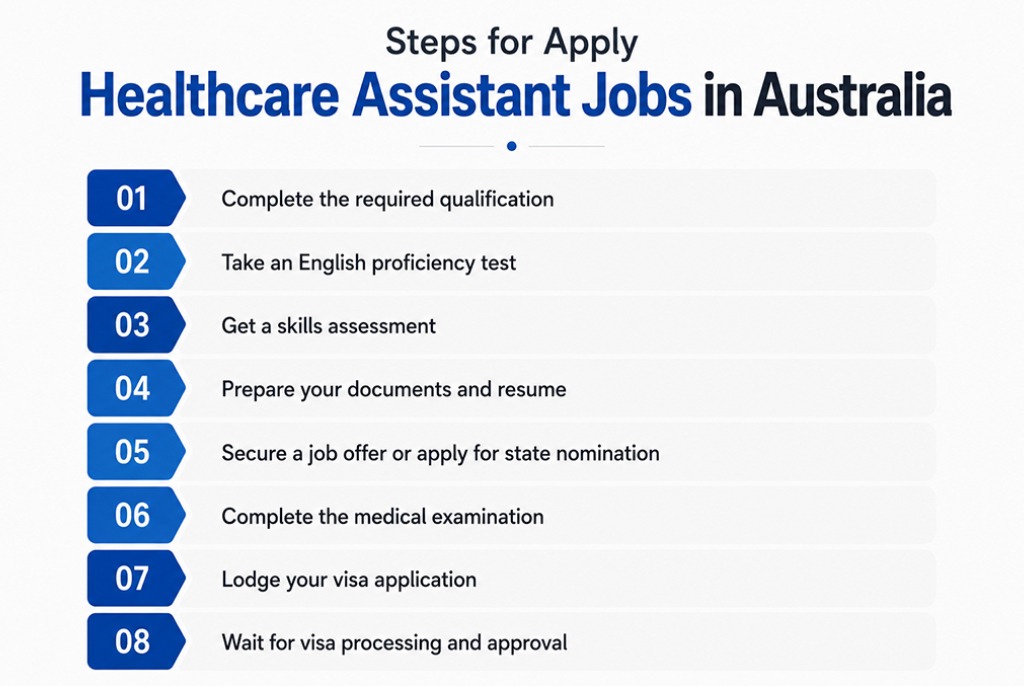
Applying for a healthcare assistant jobs in Australia typically follows a structured path, from qualifications through to visa approval. Here’s how it works:
- Complete the required qualification — Hold a relevant certificate, such as a Certificate III in Individual Support, aligned with the occupation you’re targeting (e.g., Personal Care Assistant).
- Take an English proficiency test — Sit a recognised test such as IELTS or the OET, ensuring you meet the specific score required by the assessing authority or visa subclass.
- Get a skills assessment — Apply through the relevant assessing authority, for example, the Australian Nursing and Midwifery Accreditation Council for Nursing Support Workers and Personal Care Assistants, or Community Work Australia for Aged or Disabled Carers.
- Prepare your documents and resume — Update your resume to clearly reflect relevant skills, care experience, and any specialised training, and prepare certified copies of your documents.
- Secure a job offer or apply for state nomination — For skilled visas such as subclass 189, 190, or 491, submit an Expression of Interest through SkillSelect; for employer-sponsored routes, secure a valid job offer from an approved sponsor.
- Complete the medical examination — Undergo a medical examination as part of the visa process to confirm you meet the required health standards.
- Lodge your visa application — Submit your visa application along with your qualifications, skills assessment outcome, English test results, and supporting documents.
- Wait for visa processing and approval — Healthcare occupations often receive processing priority, meaning applications may be finalised faster than in other occupations.
Conclusion
Australia’s healthcare sector continues to face persistent workforce shortages, and healthcare assistant roles remain one of the most accessible entry points into this growing industry. With competitive salaries, multiple visa pathways, and genuine opportunities for career progression, this profession offers a practical route for skilled individuals looking to build a long-term career abroad. For those aiming to settle permanently, several of these visa pathways can also lead toward Australia PR, making healthcare assistant jobs in Australia a strong option for candidates seeking both employment and long-term residency. Applicants are advised to keep track of qualification requirements, visa conditions, and processing timelines, and to refer to the Department of Home Affairs for the most accurate and up-to-date official information before beginning their application.
Frequently Asked Questions
The average salary is around $62,865 per year, ranging from $49,301 for entry-level to $75,973 for senior-level professionals with 8+ years of experience.
Yes, roles such as Personal Care Assistant and Nursing Support Worker are eligible for employer sponsorship under the Subclass 482 (Skills in Demand) visa.
Yes, many start on a temporary Subclass 482 visa and transition to permanent residency through the Subclass 186 visa after gaining employer-sponsored experience.
Shifts vary and often include evenings, weekends, and public holidays, which come with penalty rates that can add up to 50% above the normal hourly rate.
Clear pathways exist to progress into roles such as Enrolled Nurse or Registered Nurse, which come with significantly higher earning potential.
Most start with a Certificate III in Individual Support, specialising in Aged Care, Disability, or Home and Community Care, which typically takes 6 to 12 months to complete.
Generally no formal skills assessment is required unless specifically needed for visa purposes, unlike the more rigorous process required for registered nurses.





 WHATSAPP