


Trade Dubai traffic for a harbour-side commute? For thousands of UAE professionals, it’s not a daydream, it’s a plan in motion. Australia’s skills-driven economy and strong work-life balance make it a top destination for engineers, nurses, IT specialists, and tradespeople alike. But not every pathway looks the same, points-tested, state-nominated, or employer-sponsored? Getting your Australia Work Visa strategy right from the start makes all the difference. This guide breaks down the visa types, eligibility, points system, and application process, so you can move forward with clarity, not guesswork.
Table of Content
Types of Australia Work Visas
1. Skilled Independent Visa (Subclass 189)
Best For: Professionals who want full independence, no employer, no state, and no relative sponsorship required to move to Australia.
Benefits:
- Grants permanent residency straight away, from the day it’s approved.
- Freedom to live and work in any state or territory in Australia.
- Full access to Medicare and other Australia PR entitlements.
- No sponsor obligations or ongoing conditions to meet.
- Can bring partner and dependent children.
Requirements:
- Nominated occupation must be on the Medium and Long-Term Strategic Skills List (MLTSSL).
- A positive skills assessment from the relevant assessing authority.
- Minimum of 65 points on the points test (age, education, English, work experience).
- Competent English proficiency.
- Under 45 years of age.
- Submit an Expression of Interest (EOI) via SkillSelect and receive an invitation.
2. Skilled Nominated Visa (Subclass 190)
Best For: Professionals who are open to committing to a specific state or territory and need a points boost to qualify.
Benefits:
- Grants permanent residency on approval, same as the 189.
- State nomination adds 5 bonus points to the applicant’s score.
- Full Medicare access and eligibility to sponsor family members.
- Clear pathway to Australian citizenship.
- No employer sponsor needed.
Requirements:
- Occupation listed on the relevant state or territory occupation list (MLTSSL/STSOL).
- Nomination from an Australian state or territory government.
- Minimum 65 points before the state’s 5-point bonus is added.
- Positive skills assessment and competent English.
- Under 45 years of age.
- Commitment to live in the nominating state, typically for the first two years.
3. Skilled Work Regional Visa (Subclass 491)
Best For: Skilled workers willing to live and work in regional Australia in exchange for extra points and a faster path to PR.
Benefits:
- Adds 15 bonus points to the applicant’s score, well above the 189 and 190.
- Valid for five years, with partner and dependent children included.
- Clear transition to permanent residency through the Subclass 191 visa after three years.
- Access to regional communities with lower competition and genuine skill shortages.
Requirements:
- Occupation on the relevant skilled occupation list (MLTSSL, STSOL or ROL).
- Nomination by a state/territory government or sponsorship by an eligible relative living in a designated regional area.
- Minimum 65 points on the points test (before the regional bonus).
- Positive skills assessment and competent English.
- Under 45 years of age.
- Must live, work, and study in a designated regional area for the visa’s duration.
4. Skills in Demand (SID) Visa
Best For: Professionals who already have a job offer from an Australian employer and want a fast, employer-sponsored route to work and eventually get an Australia PR.
Benefits:
- Valid for up to four years, with a clear pathway to permanent residency.
- No maximum age limit, unlike the points-tested visas.
- Eligible spouses often receive full work rights.
- Faster PR transition, most holders can apply for the Employer Nomination Scheme (Subclass 186) after two years.
- Three streams (Specialist Skills, Core Skills, Labour Agreement) to suit different salary levels and occupations.
Requirements:
- A genuine job offer and nomination from an approved Australian sponsor.
- At least one year of relevant work experience in the nominated occupation.
- Salary must meet the relevant income threshold for the applicable stream.
- Occupation must meet the requirements of the chosen stream (Core Skills stream requires listing on the Core Skills Occupation List, along with a skills assessment).
- Competent English proficiency.
Most In-Demand Occupations in Australia
Skilled Migration Australia program continues to prioritise healthcare, engineering, ICT, education, and trades, based on the government’s Core Skills Occupation List (CSOL) and persistent shortages identified in the National Occupation Shortage List. Here are 20 of the most in-demand occupations for professionals in 2026:
- Registered Nurse – Aged care, hospitals, and community health services face ongoing shortages nationwide.
- Software Engineer – Consistently one of the strongest ICT occupations on the MLTSSL.
- Civil Engineer – High demand tied to Australia’s ongoing infrastructure projects.
- Mechanical Engineer – Sought after in manufacturing, mining, and construction.
- Electrical Engineer – Needed across energy, utilities, and construction sectors.
- Electrician – A trade in persistent shortage across metro and regional areas.
- Civil Engineering Draftsperson – Supports infrastructure and construction projects.
- Secondary School Teacher – Ongoing teacher shortages across several states.
- Early Childhood (Pre-primary School) Teacher – High demand in the education and care sector.
- General Practitioner (Medical Practitioner) – Critical shortage, particularly in regional Australia.
- Physiotherapist – Strong demand tied to Australia’s ageing population.
- Occupational Therapist – Consistently listed among high-priority healthcare roles.
- Aged and Disabled Carer – Reflects the growing care economy and NDIS-related demand.
- Cybersecurity Specialist – Rising demand as digital infrastructure expands.
- ICT Business Analyst – Needed to support digital transformation projects.
- Developer Programmer – Broad demand across the tech and software industry.
- Accountant (General) – Steady demand, though occupation ceilings can fill quickly.
- Carpenter and Joiner – Trade shortage linked to housing and construction demand.
- Chef – A long-standing shortage occupation, especially in regional areas.
- Hospitality Manager – In demand across tourism and hospitality, particularly in regional Australia.
Australia Work Visa Eligibility
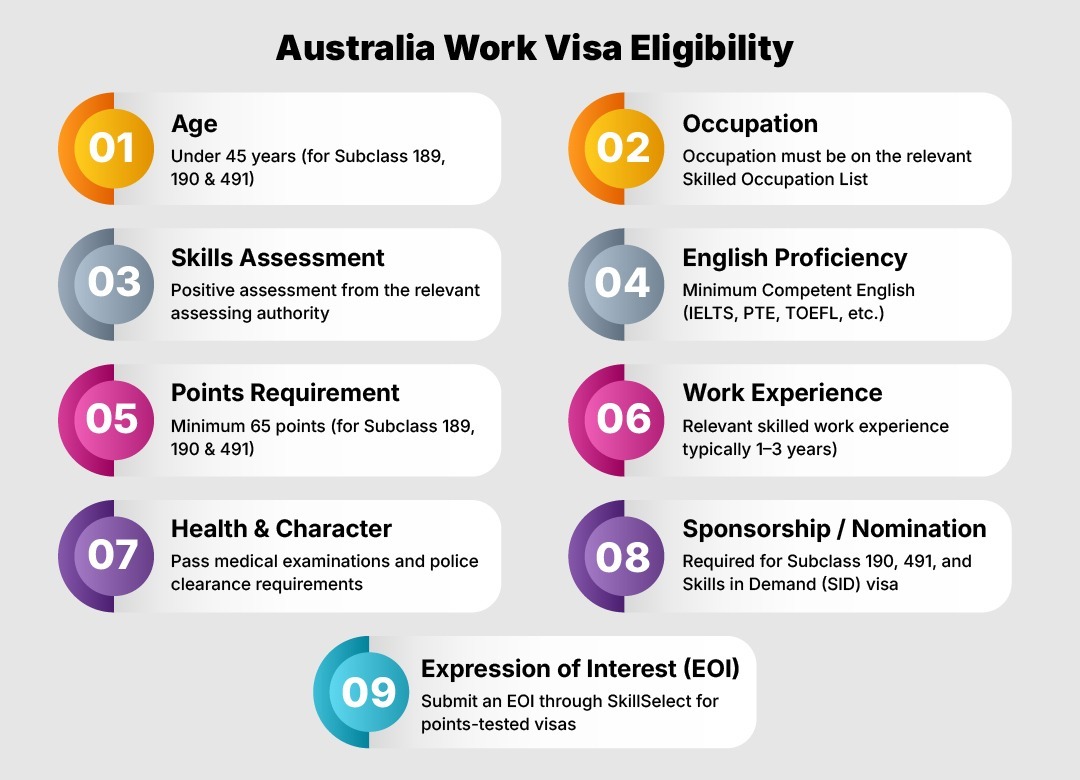
While each Australia work visa subclass has its own specific conditions, most skilled and employer-sponsored pathways to Australia share a common set of eligibility criteria. Here’s what professionals in the UAE need to meet before applying:
1. Age Limit
Applicants must generally be under 45 years old at the time of invitation for points-tested visas (Subclass 189, 190, 491). The Skills in Demand (SID) visa is an exception, with no maximum age limit, as eligibility is based on skills and employer sponsorship rather than a points test.
2. Occupation on the Relevant Skilled List
Your nominated occupation must appear on the applicable list:
- MLTSSL (Medium and Long-Term Strategic Skills List) – for Subclass 189, 190, and 491.
- CSOL (Core Skills Occupation List) – for the Skills in Demand visa.
- Regional Occupation List (ROL) – for regional pathways under Subclass 491.
3. Skills Assessment
A positive skills assessment from the relevant assessing authority is mandatory for most pathways. For example:
- Engineers Australia for engineering occupations.
- ACS (Australian Computer Society) for ICT roles.
- VETASSESS for a wide range of other professions.
- ANMAC for nursing and midwifery.
4. English Language Proficiency
Applicants must demonstrate at least Competent English (equivalent to IELTS 6.0 in each band) through an approved test such as IELTS, PTE Academic, or TOEFL. Higher English scores (Proficient or Superior) earn additional points on the points test.
5. Points Test (for Skilled Visas)
For the 189, 190, and 491 visas, applicants must score a minimum of 65 points, based on factors including:
- Age.
- English language ability.
- Skilled employment experience.
- Educational qualifications.
- Partner skills (if applicable).
- State nomination or regional bonus (5 or 15 points, where applicable).
6. Work Experience
Most pathways require at least one to three years of relevant, skilled work experience in the nominated occupation, gained either in Australia or overseas within a set period before applying.
7. Health and Character Requirements
All applicants (and accompanying family members) must:
- Meet Australia’s health examination standards.
- Provide police clearance certificates to satisfy character requirements.
8. Sponsorship or Nomination (Where Applicable)
- Subclass 190: Requires nomination from a state or territory government.
- Subclass 491: Requires nomination from a state/territory or sponsorship by an eligible relative in a regional area.
- Skills in Demand visa: Requires sponsorship by an approved Australian employer, along with a genuine job offer meeting the relevant income threshold.
9. Expression of Interest (EOI)
For points-tested visas, applicants must submit an EOI through SkillSelect and wait to be invited to apply. Meeting the minimum points doesn’t guarantee an invitation, competitive occupations often require higher scores.
Australia PR Points System
Australia’s skilled visa points test (used for Subclass 189, 190, and 491) requires a minimum of 65 points to submit an Expression of Interest. Here’s how points are allocated:
| Factor | Criteria | Points |
| Age | 18–24 years | 25 |
| 25–32 years | 30 | |
| 33–39 years | 25 | |
| 40–44 years | 15 | |
| 45 and above | 0 | |
| English Language | Superior (IELTS 8+ or equivalent) | 20 |
| Proficient (IELTS 7+ or equivalent) | 10 | |
| Competent (IELTS 6+ or equivalent) | 0 | |
| Skilled Employment (Overseas) | 3–4 years | 5 |
| 5–7 years | 10 | |
| 8–10 years | 15 | |
| Skilled Employment (Australia) | 1–2 years | 5 |
| 3–4 years | 10 | |
| 5–7 years | 15 | |
| 8–10 years | 20 | |
| Educational Qualification | Doctorate from an Australian or recognised institution | 20 |
| Bachelor’s degree or higher (including Master’s) | 15 | |
| Diploma or trade qualification (Australian) | 10 | |
| Skills assessment qualification recognised in the nominated occupation | 10 | |
| Australian Study Requirement | At least one degree, diploma, or trade qualification completed in Australia (min. 2 years) | 5 |
| Specialist Education Qualification | STEM Master’s or PhD in a relevant field completed in Australia | 10 |
| Partner Skills | Partner meets age, English, and skills criteria | 10 |
| Partner has Competent English only (no skills assessment) | 5 | |
| Single applicant (no partner) | 10 | |
| State/Territory Nomination | Subclass 190 nomination | 5 |
| Subclass 491 nomination or family sponsorship | 15 | |
| Professional Year in Australia | Completed in nominated occupation | 5 |
| Credentialled Community Language | NAATI accreditation | 5 |
Australia Work Visa Application Process
Applying for an Australia work visa follows a fairly structured process, though the exact steps vary slightly depending on whether you’re going through a points-tested pathway (189, 190, 491) or an employer-sponsored route (Skills in Demand visa). Here’s a general step-by-step breakdown:
Step 1: Check Your Occupation Eligibility
Confirm that your occupation appears on the relevant skilled occupation list MLTSSL, STSOL, CSOL, or ROL, depending on the visa you’re targeting. This determines which visa subclasses you can apply for.
Step 2: Get a Skills Assessment
Apply for a skills assessment through the relevant assessing authority for your occupation (for example, Engineers Australia, ACS, VETASSESS, or ANMAC). This confirms your qualifications and experience meet Australian standards and is a mandatory step for most skilled pathways.
Step 3: Take an English Language Test
Sit for an approved English test — IELTS, PTE Academic, or TOEFL and achieve at least Competent English. Higher scores improve your points test result.
Step 4: Calculate Your Points
Use the official points test to calculate your score across age, English ability, work experience, education, and other factors. Confirm you meet the minimum 65 points required to submit an EOI.
Step 5: Submit an Expression of Interest (EOI)
Lodge your EOI through SkillSelect, the Australian government’s online system. This is where you outline your skills, qualifications, and preferred visa subclass. For employer-sponsored visas, this step is replaced by securing a job offer from an approved sponsor.
Step 6: Receive a Nomination or Sponsorship (If Applicable)
- For Subclass 190, apply for nomination from a state or territory government.
- For Subclass 491, apply for regional nomination or secure sponsorship from an eligible relative.
- For the Skills in Demand visa, your employer must lodge a nomination proving a genuine need for the role.
Step 7: Wait for an Invitation to Apply
If your EOI is successful, you’ll receive an Invitation to Apply (ITA) through SkillSelect. You typically have 60 days to submit your full visa application after receiving the invitation.
Step 8: Lodge Your Visa Application
Submit your complete application through ImmiAccount, including all required documents, identity documents, skills assessment, English test results, employment references, and nomination or sponsorship evidence (where applicable).
Step 9: Complete Health and Character Checks
Undergo the required health examinations and submit police clearance certificates for yourself and any accompanying family members.
Step 10: Pay the Visa Application Charge
Pay the relevant visa fee, which varies depending on the subclass and number of accompanying applicants.
Step 11: Await Visa Processing
Processing times vary significantly by visa type and occupation, ranging from a few months for employer-sponsored visas to over a year for some points-tested pathways during peak periods.
Step 12: Visa Grant
Once approved, you’ll receive your visa grant notification, confirming your permission to live, work, and (for PR visas) settle permanently in Australia.
Why UAE Professionals Have a Strong Advantage?
Professionals based in the UAE are often better positioned than applicants from many other regions when applying for an Australia work visa from UAE. The UAE’s multicultural workforce means most professionals already work in English-speaking environments, making it easier to meet Australia’s Competent or Proficient English requirements. Many roles in high-demand sectors like engineering, healthcare, IT, and construction are also common across the UAE, giving applicants relevant, verifiable overseas work experience that translates well into Australia’s points test. The UAE’s strong regulatory and corporate documentation standards further help applicants prepare clean, well-supported employment references and offer letters, which are critical for skills assessments and visa applications.
On top of this, professionals in the UAE have easy access to experienced Australia migration consultants UAE, who understand both the local job market and Australia’s evolving visa system, helping applicants choose the right pathway, avoid common documentation errors, and strengthen their overall application. This combination of English proficiency, relevant experience, and access to expert guidance gives UAE-based professionals a genuine edge in Australia’s competitive skilled migration landscape.
Conclusion
Securing an Australia Work Visa remains one of the most rewarding pathways for UAE-based professionals looking to build a long-term career in a stable, high-growth economy. With multiple options available, from points-tested pathways like the Subclass 189, 190, and 491 to employer-sponsored routes like the Skills in Demand visa, there is a suitable option for most skilled professionals who meet the eligibility criteria and prepare their application carefully. Since occupation lists, points thresholds, and visa conditions are updated frequently, applicants are encouraged to verify the latest requirements through the Australian Department of Home Affairs before applying. With the right guidance, UAE professionals are well placed to make a successful move to Australia.
Frequently Asked Questions
It depends on your profile. The 189 suits high-points applicants, the 190 suits those open to state nomination, and the Skills in Demand visa suits those with a job offer.
Yes. Points-tested visas (189, 190, 491) don’t require a job offer. Only employer-sponsored visas like the Skills in Demand visa do.
The 189 and 190 grant PR immediately. The 491 leads to PR via the 191 visa after three years, and the Skills in Demand visa via the 186 after two years.
Generally: under 45 years, occupation on a skilled list, positive skills assessment, Competent English, minimum points score, and health and character clearance.
Not specifically IELTS, but proof of English proficiency is mandatory. PTE Academic and TOEFL are also accepted.
An evaluation of your qualifications and experience by an authority like Engineers Australia, ACS, or VETASSESS, confirming they meet Australian standards.
Points are awarded for age, English ability, work experience, education, partner skills, and nomination. A minimum of 65 points is needed to lodge an EOI.
Healthcare, engineering, ICT, education, and trades — including nurses, software engineers, civil engineers, electricians, and teachers.
It varies. Employer-sponsored visas process faster, while points-tested visas can take several months to over a year.





 WHATSAPP