

Canada immigration for healthcare professionals in Dubai has become a top pathway for medical experts seeking a long-term career abroad. With Canada facing ongoing healthcare staffing shortages, dedicated Express Entry categories and provincial streams now fast-track qualified professionals toward permanent residency. For those practicing in Dubai, this means a clear route to career growth, stability, and universal healthcare access. Here’s everything you need to know to get started.
Table of Content
- Why Choose Canada as a Healthcare Professional?
- Eligible Healthcare Occupations for Canada Immigration
- Canada Immigration Pathways for Healthcare Professionals in Dubai
- Canada Immigration Eligibility for Healthcare Professionals
- Healthcare Professional Licensing in Canada
- Dubai Work Experience Help With Canada Immigration
- Canada PR Process for Healthcare Professionals From Dubai
- How to Improve Your Canada PR Chances
- Conclusion
- Frequently Asked Questions
Why Choose Canada as a Healthcare Professional?
Canada has positioned itself as one of the most welcoming destinations for healthcare professionals seeking to build a career abroad, and the country’s ongoing labour shortages in the medical sector make this an especially opportune time to apply. The federal government continues to run Express Entry draws targeting candidates in healthcare and social services, including nurse practitioners, dentists, pharmacists, psychologists, and chiropractors, alongside newer categories introduced to address staffing shortages in specialized medical fields. Beyond immigration pathways, Canada offers healthcare workers a stable, high-paying job market, access to universal healthcare for themselves and their families, a strong work-life balance, and a clear route to permanent residency and citizenship. For healthcare professionals in Dubai looking to relocate, Canada combines career growth with long-term settlement security, making it a compelling choice over other options.
Eligible Healthcare Occupations for Canada Immigration
Here’s a list of high-demand healthcare occupations for Canada immigration for healthcare professionals in Dubai, drawn from the Express Entry Healthcare and Social Services category and related NOC classifications:
- General Practitioners/Family Physicians (NOC 31102) – Primary care doctors treating a broad range of illnesses; among the most in-demand roles nationwide.
- Specialists in Surgery (NOC 31101) – Surgeons across disciplines, badly needed in rural and underserved provinces.
- Specialists in Clinical and Laboratory Medicine (NOC 31100) – Pathologists and lab-based physicians supporting diagnostics.
- Registered Nurses (NOC 31301) – One of the most sought-after roles, with shortages across nearly every province.
- Nurse Practitioners (NOC 31302) – Advanced-practice nurses who can diagnose and prescribe, easing physician shortages.
- Licensed Practical Nurses (NOC 32101) – Support frontline patient care in hospitals, clinics, and long-term care.
- Pharmacists (NOC 31300) – Dispense medication and provide clinical guidance; strong demand in both retail and hospital settings.
- Dentists (NOC 31110) – General and specialized dental care providers, especially needed outside major cities.
- Dental Hygienists (NOC 32112) – Support preventive oral care alongside dentists.
- Physiotherapists (NOC 31202) – Rehabilitation specialists in high demand due to Canada’s aging population.
- Occupational Therapists (NOC 31203) – Help patients regain daily living skills after injury or illness.
- Psychologists (NOC 31200) – Mental health demand has surged, especially post-pandemic.
- Chiropractors (NOC 31201) – Musculoskeletal care providers, included in recent category-based draws.
- Medical Laboratory Technologists (NOC 32120) – Run diagnostic tests critical to patient care pipelines.
- Medical Radiation Technologists (NOC 32121) – Operate imaging equipment like X-ray, MRI, and CT scanners.
- Paramedics (NOC 32102) – Emergency responders in high demand amid ambulance service shortages.
- Respiratory Therapists (NOC 32103) – Manage breathing-related treatments, especially critical in ICUs.
- Veterinarians (NOC 31103) – Included under healthcare-adjacent occupations in category-based Express Entry draws.
- Social Workers (NOC 41300) – Support community and hospital-based patient welfare services.
- Counselling Therapists (NOC 41301) – Provide mental health and addiction counselling, a growing priority area.
Canada Immigration Pathways for Healthcare Professionals in Dubai
Here are the key pathways in Canada immigration for healthcare professionals in Dubai can pursue:
- Express Entry – Healthcare and Social Services Category – Canada Express Entry for healthcare workers has a category-based draw exclusively for occupations like nurses, pharmacists, dentists, and psychologists, offering faster invitations than general draws.
- Express Entry – Federal Skilled Worker Program (FSWP) – The standard points-based route for skilled healthcare workers with recognized qualifications and work experience.
- Provincial Nominee Program (PNP) – Healthcare Streams – Provinces like Ontario, British Columbia, Saskatchewan, and Nova Scotia run dedicated Canada PNP for healthcare professionals streams to nominate healthcare workers for local labour needs, adding valuable points to Express Entry profiles.
- Atlantic Immigration Program (AIP) – Targets Atlantic provinces (Nova Scotia, New Brunswick, PEI, Newfoundland) facing acute healthcare staffing shortages, with employer-driven job offers.
- Rural and Northern Immigration Pilot (RNIP) – Connects healthcare professionals with smaller communities that struggle to attract skilled workers, often with a smoother path to permanent residency.
- LMIA-Based Work Permits – Allows Canadian employers to hire foreign healthcare workers directly when no local candidate is available, often serving as a stepping stone to permanent residency.
Canada Immigration Eligibility for Healthcare Professionals
Here are the core eligibility requirements for Canada immigration for healthcare professionals in Dubai:
- Educational Credential Assessment (ECA) – Foreign degrees and diplomas must be assessed by an approved body (like WES) to confirm they match Canadian education standards.
- Work Experience – Most pathways require at least 1 year of continuous, paid, skilled work experience in the applicant’s healthcare occupation within the last 10 years.
- Language Proficiency – Applicants must prove English or French proficiency through IELTS, CELPIP, or TEF, with minimum scores varying by program (generally CLB 7 or higher for healthcare roles).
- Licensing and Credential Recognition – Regulated professions like nursing and medicine require registration with the relevant Canadian regulatory body (e.g., NNAS for nurses, MCC for physicians) before practicing.
- Age – While not a strict cutoff, Express Entry’s points system favors applicants between 20-29 years old, though older candidates can still qualify with strong offsetting factors.
- Proof of Funds – Applicants (except those with a valid job offer or already working in Canada) must show sufficient funds to support themselves and family members upon arrival.
- Comprehensive Ranking System (CRS) Score – For Express Entry, applicants need a competitive CRS score based on age, education, work experience, and language ability, though category-based healthcare draws often have lower cutoffs.
- Medical Examination – All applicants must pass an immigration medical exam conducted by a panel physician approved by IRCC.
- Police Clearance Certificate – Required to confirm no criminal history in any country the applicant has lived in for 6+ months.
- Job Offer (for certain pathways) – Not mandatory for Express Entry but required for LMIA-based work permits and boosts CRS scores when valid.
Healthcare Professional Licensing in Canada
Licensing in Canada is provincial/territorial, not federal, each province has its own regulatory body, so credentials must be assessed and approved separately in the province where the professional intends to work.
By Profession
- Physicians – Must go through the Medical Council of Canada (MCC), pass the MCCEE/MCCQE exams, complete credential verification via IMG-specific pathways, and often complete a period of supervised practice or residency matching (CaRMS) before full licensure.
- Registered Nurses – Apply through the National Nursing Assessment Service (NNAS) for credential evaluation, then register with the provincial nursing college (e.g., CNO in Ontario) and pass the NCLEX-RN exam.
- Pharmacists – Must clear the Pharmacy Examining Board of Canada (PEBC) evaluating exam and qualifying exams, then register with the provincial pharmacy regulatory authority.
- Dentists – Requires passing the National Dental Examining Board (NDEB) equivalency process, followed by provincial dental college registration.
- Physiotherapists – Credentials assessed via the Canadian Alliance of Physiotherapy Regulators, followed by the Physiotherapy Competency Examination (PCE) and provincial registration.
- Medical Laboratory Technologists – Certification through the Canadian Society for Medical Laboratory Science (CSMLS), plus provincial licensing where required.
- Paramedics – Provincial licensing bodies set specific certification and training requirements; credential recognition varies significantly by province.
Key Notes
- Licensing timelines can range from a few months to 2+ years depending on the profession and province.
- Some professionals may need bridging programs or supervised practice hours to meet Canadian standards.
- Provincial nominee healthcare streams often prioritize candidates who’ve already started or completed licensing steps, strengthening their application.
Dubai Work Experience Help With Canada Immigration
Healthcare work experience gained in Dubai (UAE) is generally recognized under Express Entry, provided it aligns with a valid NOC code and was full-time, paid, and skilled (TEER 0-3 level roles like nurses, physicians, pharmacists).
How It Strengthens an Application
- CRS Points – Foreign work experience adds points under the Comprehensive Ranking System, especially when combined with a Canadian ECA-equivalent education.
- Category-Based Draws – Dubai-based healthcare professionals with relevant experience can qualify directly for the Healthcare and Social Services Express Entry category, which often has lower CRS cutoffs than general draws.
- Credential Recognition Support – Experience in reputable UAE healthcare institutions (DHA, HAAD/DOH-licensed facilities) can strengthen licensing applications with Canadian regulatory bodies, showing consistent clinical practice.
- Job Offer Leverage – Professionals already working in Dubai often have strong resumes attractive to Canadian employers, useful for LMIA-based work permits or direct recruitment drives.
Important Considerations
- Experience must be document-backed (reference letters, pay stubs, contracts) to be verified by IRCC.
- Only work experience within the last 10 years counts toward Express Entry eligibility.
- Experience gained in a non-regulated role (e.g., admin healthcare roles) may not count toward occupation-specific points, even if it’s in a hospital setting.
- Dubai-based professionals should still complete Canadian licensing steps (NNAS, MCC, etc.), as UAE licensing alone doesn’t guarantee automatic recognition.
Canada PR Process for Healthcare Professionals From Dubai
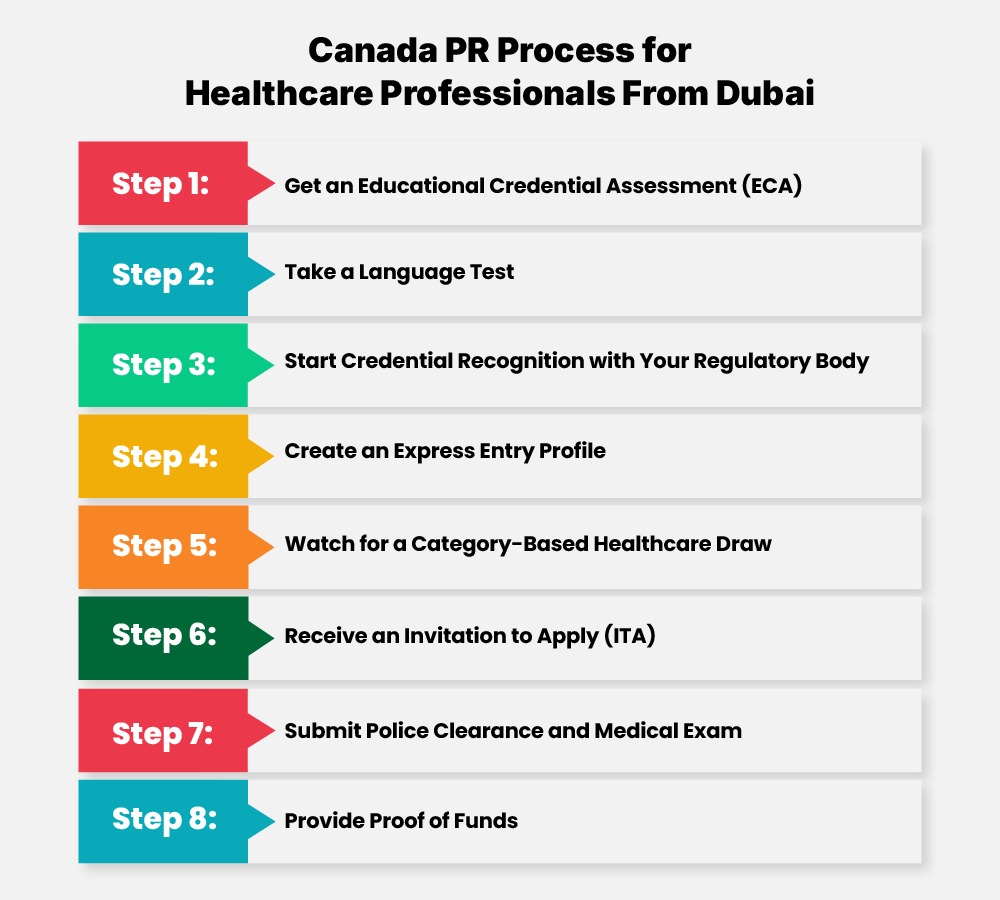
Canada immigration for healthcare professionals in Dubai follows a clear, structured path; here’s how it works, step by step.
1. Get an Educational Credential Assessment (ECA)
Have your degrees and diplomas assessed by an approved body like WES to confirm they’re equivalent to Canadian standards. This is required for Express Entry and most healthcare licensing pathways.
2. Take a Language Test
Sit for IELTS, CELPIP, or TEF and aim for CLB 7 or higher in English or French. Strong language scores boost your CRS score and are often required for provincial licensing too.
3. Start Credential Recognition with Your Regulatory Body
Begin the licensing process specific to your profession — NNAS for nurses, MCC for physicians, PEBC for pharmacists, NDEB for dentists. This can run in parallel with your immigration application and strengthens it.
4. Create an Express Entry Profile
Submit your profile with details on education, work experience, and language scores. Indicate your NOC code accurately, since this determines eligibility for the Healthcare and Social Services category.
5. Watch for a Category-Based Healthcare Draw
IRCC regularly runs draws specifically for healthcare and social services occupations, often with lower CRS cutoffs than general draws — giving Dubai-based professionals a faster route to an invitation.
6. Receive an Invitation to Apply (ITA)
Once invited, you’ll have 60 days to submit your complete application for permanent residency, including all supporting documents.
7. Submit Police Clearance and Medical Exam
Get a police clearance certificate from the UAE (and any other country lived in for 6+ months) and complete an immigration medical exam with an IRCC-approved panel physician.
8. Provide Proof of Funds
Show sufficient settlement funds unless you already have a valid job offer or are currently working in Canada. The amount depends on family size.
How to Improve Your Canada PR Chances
- Target Healthcare Category Draws – Lower CRS cutoffs than general Express Entry.
- Boost Language Scores – Aim for CLB 9+ for extra CRS points.
- Get Provincial Nomination – Adds 600 CRS points, near-guarantees an ITA.
- Secure a Job Offer – LMIA-backed offers add points and employer ties.
- Complete ECA Early – Confirms education equivalency without delays.
- Start Licensing in Parallel – Begin NNAS/MCC/PEBC steps alongside your application.
- Ensure Accurate Documentation – Reference letters and NOC match strengthen your profile.
- Include Spouse’s Credentials – Their education and language scores can add points.
- Explore Regional Pathways – AIP or RNIP often mean less competition.
- Track CRS Cutoffs – Time your application around favorable draws.
Conclusion
Canada immigration for healthcare professionals in Dubai has never been more accessible, with dedicated Express Entry categories, strong provincial nominee streams, and a healthcare system in genuine need of skilled talent. The opportunity to build a stable, rewarding career in Canada is well within reach. The key is preparation, getting your credentials assessed, your licensing process started, and your Canada immigration application optimized well ahead of time. For the latest updates on eligibility, draws, and application steps, always refer to the official IRCC Express Entry page. And if you’d like expert guidance tailored to your profile, CanApprove’s UAE team is ready to help you navigate every step of the journey.
Frequently Asked Questions
It depends on your points score and goals. Subclass 189 suits nurses with high points and no need for sponsorship, Subclass 190 suits those open to state nomination for extra points, and Subclass 491 works well for nurses willing to live and work in regional Australia.
Yes. Healthcare professionals can apply for Canada PR through Express Entry, Provincial Nominee Programs, and regional pilots like the AIP or RNIP.
Physicians, registered nurses, nurse practitioners, pharmacists, dentists, physiotherapists, psychologists, medical lab technologists, paramedics, and several other NOC-listed occupations qualify.
Yes, most pathways require proof of English or French proficiency through IELTS, CELPIP, or TEF, generally at CLB 7 or higher.
Yes. Several provinces, including Ontario, Saskatchewan, and Nova Scotia, run healthcare-specific PNP streams that add 600 CRS points if nominated.
Express Entry (Healthcare and Social Services category), Provincial Nominee Programs, the Atlantic Immigration Program, the Rural and Northern Immigration Pilot, and LMIA-based work permits.
CRS cutoffs vary by draw, but healthcare category-based draws typically have lower cutoffs than general Express Entry draws, often ranging between 430-500 points.
Yes, most regulated professions require licensing exams and credential recognition through bodies like MCC (physicians), NNAS (nurses), or PEBC (pharmacists) before practicing.
Key documents include ECA results, language test scores, work experience letters, police clearance certificates, medical exam results, and proof of funds.





 WHATSAPP