


Australia PR for Nurses in Dubai is becoming an increasingly popular pathway for healthcare professionals looking to build a long-term career abroad. With Australia’s growing demand for skilled nurses and its points-based immigration system, nurses working in Dubai are well-positioned to qualify, thanks to their clinical experience, English proficiency, and internationally recognized qualifications. This blog breaks down the eligibility criteria, visa pathways, application process, and common mistakes to avoid, helping nurses in Dubai understand exactly what it takes to move their careers to Australia.
Table of Content
Can Nurses in Dubai Apply for Australia PR?
Yes, nurses working in Dubai can apply for Australia PR through the skilled migration route, provided they meet the eligibility criteria set by the Australian government. Registered Nurses fall under the Medium and Long-term Strategic Skills List (MLTSSL), making them eligible for popular pathways such as the Subclass 189 (Skilled Independent), Subclass 190 (Skilled Nominated), and Subclass 491 (Skilled Work Regional) visas. To qualify, applicants need a positive skills assessment from ANMAC (Australian Nursing and Midwifery Accreditation Council), a minimum required score on the points test, and proof of English language proficiency through tests like IELTS or OET. Work experience gained in Dubai counts toward the points score, giving UAE-based nurses a genuine head start in the process.
Eligibility for Australia PR for Nurses
To apply for Australia PR, nurses in Dubai need to meet the following key eligibility requirements:
1. Occupation on the Skilled Occupation List
Nursing roles such as Registered Nurse (Aged Care, Medical, Mental Health, Surgical, etc.) must appear on the MLTSSL to qualify for skilled visa pathways.
2. Skills Assessment
A positive skills assessment from ANMAC is mandatory. This confirms that the nurse’s qualifications and experience meet Australian nursing standards.
3. AHPRA Registration
Nurses must also register with the Australian Health Practitioner Regulation Agency (AHPRA) to legally practice in Australia. This includes qualification verification, police clearance, and proof of professional indemnity insurance.
4. Age Limit
Applicants must be under 45 years of age at the time of invitation.
5. English Language Proficiency
A minimum proficient level in IELTS, OET, PTE, or TOEFL is required, with higher scores earning extra points.
6. Points Test Score
Applicants must score at least 65 points (the current minimum) on the points test, based on age, education, work experience, and English skills.
7. Work Experience
Relevant nursing experience, including time spent working in Dubai, adds points and strengthens the application.
8. State or Territory Nomination (if applicable)
For Subclass 190 or 491 visas, nurses may need a nomination from an Australian state or territory.
9. Health and Character Requirements
Applicants must clear medical examinations and provide police clearance certificates as part of the application.
Australia PR Pathways for Nurses
Nurses in Dubai have several visa options to secure Australia PR for Nurses in Dubai, depending on their points score, state demand, and long-term goals. The three main pathways under the skilled migration program are the Subclass 189, Subclass 190, and Subclass 491 visas. Each comes with its own nomination requirements, obligations, and benefits, making it important to choose the one that best fits your profile.
| Feature | Subclass 189 (Skilled Independent) | Subclass 190 (Skilled Nominated) | Subclass 491 (Skilled Work Regional) |
| Nomination Required | No | Yes, by a state/territory | Yes, by a state/territory or family sponsor |
| Visa Type | Permanent | Permanent | Provisional (pathway to PR) |
| Points Advantage | No extra points | 5 extra points | 15 extra points |
| Location Requirement | Live and work anywhere in Australia | May require living in nominating state | Must live and work in regional Australia |
| Validity | Permanent from grant | Permanent from grant | 5 years, with PR pathway via Subclass 191 |
| Best Suited For | High points scorers with in-demand occupation | Nurses open to state commitments | Nurses willing to work in regional areas |
How Nurses in Dubai Can Apply for Australia PR
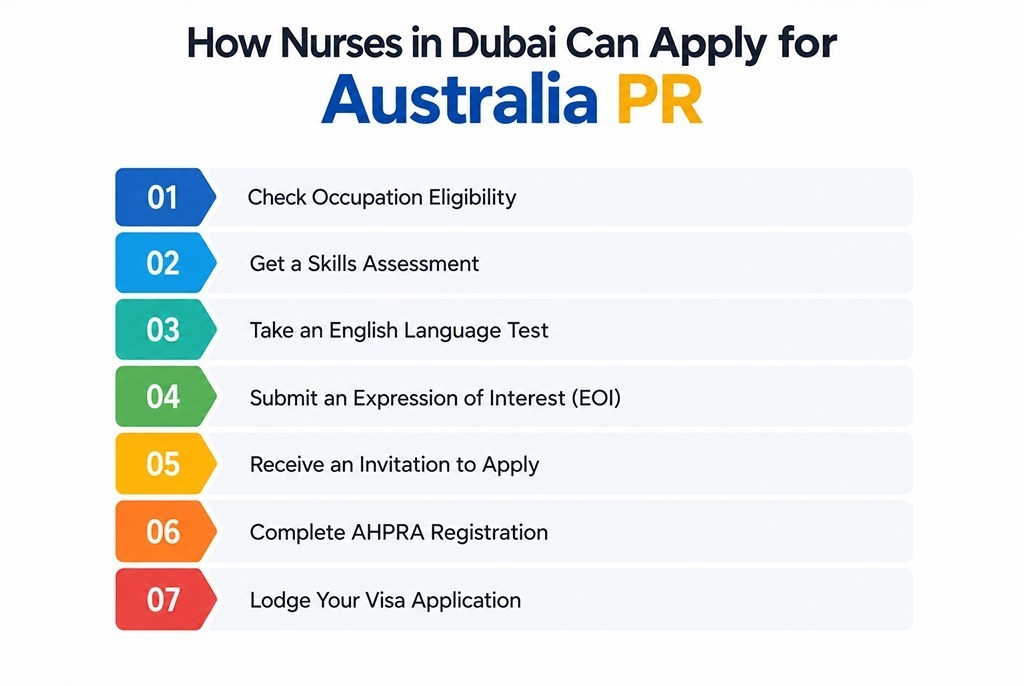
Applying for Australia PR as a nurse involves a step-by-step process, here’s how it works:
1. Check Occupation Eligibility
Confirm that your nursing role is listed on the MLTSSL and identify which visa subclass suits your profile.
2. Get a Skills Assessment
Apply to ANMAC for a skills assessment to verify that your qualifications and experience meet Australian nursing standards.
3. Take an English Language Test
Sit for IELTS, OET, PTE, or TOEFL and achieve the required score, as this also affects your points test result.
4. Submit an Expression of Interest (EOI)
Lodge an EOI through SkillSelect, detailing your skills, work experience, and points score.
5. Receive an Invitation to Apply
Based on your EOI ranking, wait for an invitation from the Department of Home Affairs or a state/territory nomination.
6. Complete AHPRA Registration
Apply for registration with AHPRA to ensure you’re eligible to practice nursing once you arrive in Australia.
7. Lodge Your Visa Application
Submit your PR visa application along with required documents, health checkups, and police clearance certificates.
How UAE Nursing Experience Can Help
Work experience gained in Dubai isn’t just valuable on your resume, it directly boosts your Australia PR for Nurses in Dubai application in several ways:
1. Relevant Professional Experience
Time spent working as a nurse in Dubai, particularly in roles matching the nominated occupation, counts as relevant experience for both the skills assessment and points test.
2. Employment References
Detailed reference letters from UAE employers, stating job title, duties, and duration of employment, are required to validate your work history during the ANMAC assessment.
3. Experience in Specialised Nursing Areas
Time spent in specialised units such as ICU, surgical, aged care, or mental health strengthens your skills assessment and aligns with in-demand nursing occupations in Australia.
4. Evidence of Duties and Employment
Payslips, employment contracts, and duty statements help verify your role and responsibilities, forming essential supporting documents for both ANMAC and visa applications.
5. Practical Clinical Exposure
Hands-on experience with diverse patient populations and healthcare systems in Dubai demonstrates adaptability, a plus during registration and job interviews in Australia.
6. Documentation Advantage
UAE healthcare employers often provide detailed employment references and payslips, which are useful for meeting Australian documentation standards.
7. Contribution to Skilled Migration Points
Where eligible, skilled employment of at least 3 years in a closely related occupation can add points under the work experience component of the points test.
Common Mistakes Nurses in Dubai Should Avoid
Even well-qualified nurses can face delays or rejections due to avoidable errors during the Australia immigration for nurses process. Here are common mistakes to watch out for:
1. Applying Without a Skills Assessment
Submitting an EOI before receiving a positive ANMAC assessment can lead to wasted time or an invalid application.
2. Incomplete or Inconsistent Documentation
Mismatched job titles, dates, or duties between reference letters, payslips, and resumes can raise red flags during assessment.
3. Underestimating English Test Requirements
Scoring just below the required band can significantly reduce points, so nurses often need to retake tests, delaying the process.
4. Ignoring State Nomination Requirements
Not researching specific state occupation lists and nomination criteria can result in missed opportunities for Subclass 190 or 491 visas.
5. Delaying AHPRA Registration
Leaving registration until after arrival in Australia can delay the start of employment and cause financial strain.
6. Overlooking Regional Visa Benefits
Dismissing Subclass 491 without considering the extra points and pathway to PR can limit options, especially for nurses with borderline points scores.
7. Not Keeping Track of Occupation List Changes
The MLTSSL and state lists are updated periodically; failing to stay updated may affect eligibility unexpectedly.
Conclusion
Australia PR for Nurses in Dubai remains a realistic and rewarding goal for nurses in Dubai who meet the skills, English, and points test requirements. With in-demand nursing occupations, points advantages for UAE work experience, and multiple visa pathways to choose from, the process is well within reach for eligible candidates. Staying updated on occupation lists, points test changes, and state nomination requirements is key to a smooth application. For the latest and most accurate information, refer to the official Department of Home Affairs points test page.
Frequently Asked Questions
It depends on your points score and goals. Subclass 189 suits nurses with high points and no need for sponsorship, Subclass 190 suits those open to state nomination for extra points, and Subclass 491 works well for nurses willing to live and work in regional Australia.
The minimum required to submit an EOI is 65 points, but competitive invitation rounds often require higher scores depending on occupation demand and visa subclass.
Yes, skilled nursing experience gained in Dubai can contribute to your points test score and strengthen your ANMAC skills assessment, provided it’s well-documented.
Yes, English language proficiency is mandatory, and IELTS is one of the accepted tests along with OET, PTE, and TOEFL.
Yes, a job offer isn’t required for points-tested visas like Subclass 189, 190, or 491. Eligibility is based on skills assessment, points score, and occupation demand.
The process involves checking occupation eligibility, completing a skills assessment, meeting English requirements, submitting an EOI, receiving an invitation, completing AHPRA registration, and lodging the visa application.





 WHATSAPP