


Australia’s technology sector keeps growing, and the country needs skilled workers in software, cybersecurity, data and systems roles. For many professionals in the UAE, Australia PR for IT Professionals is a realistic long-term goal, but it depends on choosing the right visa, meeting the points requirement and presenting a clean application. This guide explains Australia skilled migration for IT professionals: the main visa options, eligible occupations, the skills assessment and the steps to apply.
Table of Content
What Are the Australian PR Visa Pathways for IT Professionals?
Most IT professionals apply through the General Skilled Migration program. It is points-tested, and you submit an Expression of Interest (EOI) through the Department of Home Affairs’ SkillSelect system. The three main options are below.
Australia Subclass 189 visa for IT professionals (Skilled Independent)
- Permanent residency with no employer sponsor, state nomination or regional condition.
- You must be invited through SkillSelect, so applications are by invitation only.
- Your occupation must be on the relevant skilled occupation list.
- You must be under 45 at the time of invitation, have a positive skills assessment, show at least competent English and score at least 65 points.
- It is the most flexible option, but also the most competitive.
Australia Subclass 190 visa for IT professionals (Skilled Nominated)
- Permanent residency with nomination from an Australian state or territory.
- Nomination adds 5 points to your score.
- Each state sets its own criteria and occupation list, and often expects you to live and work in that state for an initial period.
- Suited to applicants whose profile matches a state’s labour market needs.
Australia Subclass 491 visa for IT professional (Skilled Work Regional, Provisional)
- A provisional visa valid for five years, with nomination by a state or territory, or sponsorship by an eligible relative living in a designated regional area.
- It adds 15 points, which makes it useful for candidates with a lower score.
- You must live and work in a designated regional area.
- After meeting the residence and income conditions, usually after three years, you can apply for permanent residency through the Subclass 191 visa.
Employer-sponsored routes also exist, such as the Skills in Demand visa (Subclass 482) and the Employer Nomination Scheme (Subclass 186). These suit professionals who already have a job offer from an Australian employer. The points-tested visas above remain the main route for those applying independently.
IT Occupations Are Eligible for Australian PR
Many ICT roles can lead to PR, and Australia PR for IT Professionals is most realistic when your job matches an ANZSCO occupation. Commonly assessed roles include:
- Software Engineer
- Developer Programmer
- Analyst Programmer
- ICT Business Analyst
- Systems Analyst
- ICT Security Specialist
- Database Administrator
- Systems Administrator
- Computer Network and Systems Engineer
- Network Administrator
- Web Developer
- ICT Project Manager
Being on a list does not guarantee eligibility. Three things decide it:
- Visa subclass. The Subclass 189, 190 and 491 visas draw on different occupation lists, and state nomination adds each state’s own list on top.
- Occupation list. Lists are updated regularly, and an occupation that was open last year may be restricted or removed.
- Current migration rules. Invitation numbers, points thresholds, state criteria and visa conditions change often, and some occupations are invited only at higher scores.
Always check your ANZSCO code against the latest official lists before you plan your application.
Eligibility Requirements for Australia PR
The main requirements across the skilled visas are:
- Age: under 45 when invited to apply.
- Occupation: a nominated occupation on the relevant skilled occupation list.
- Skills assessment: a positive outcome from the assessing authority, which is the Australian Computer Society (ACS) for most IT roles.
- English: at least competent English, shown through IELTS, PTE Academic, TOEFL iBT or another accepted test.
- Points: a minimum of 65 points on the points test.
- Nomination: needed for the Subclass 190 and 491 visas.
- Health and character: you and your family members must meet health and character requirements, including police certificates.
Meeting 65 points only makes you eligible to submit an EOI. Invitation scores are often much higher for competitive IT occupations and change from round to round.
Skills Assessment for IT Professional
A positive result from the ACS is the first formal step for most applicants. An Australia IT skills assessment confirms that your qualifications and work experience match your nominated occupation. ACS reviews three things:
- Your qualification. ACS checks how much ICT content your degree contains and classes it as an ICT major or minor. A degree with a high share of ICT content is easier to assess.
- Your work experience. ACS checks that your duties match the occupation you nominated. If your degree is not closely related to the role, the required experience is longer. The Skills pathway also requires you to document the relevant experience carefully.
- Your documents. Applications must be decision ready: employment references, payslips or tax records, qualification certificates and identity documents should all be complete when you apply.
A few practical points:
- ACS offers different pathways depending on whether you studied in Australia or overseas.
- Processing times and fees are published on the ACS website and can change, so check them before you apply.
- Employment references should describe your actual duties, dates and working hours, not just your job title.
- Check the validity period on your outcome letter, because an expired assessment cannot support an EOI.
How to Apply for Australia PR as an IT Professional
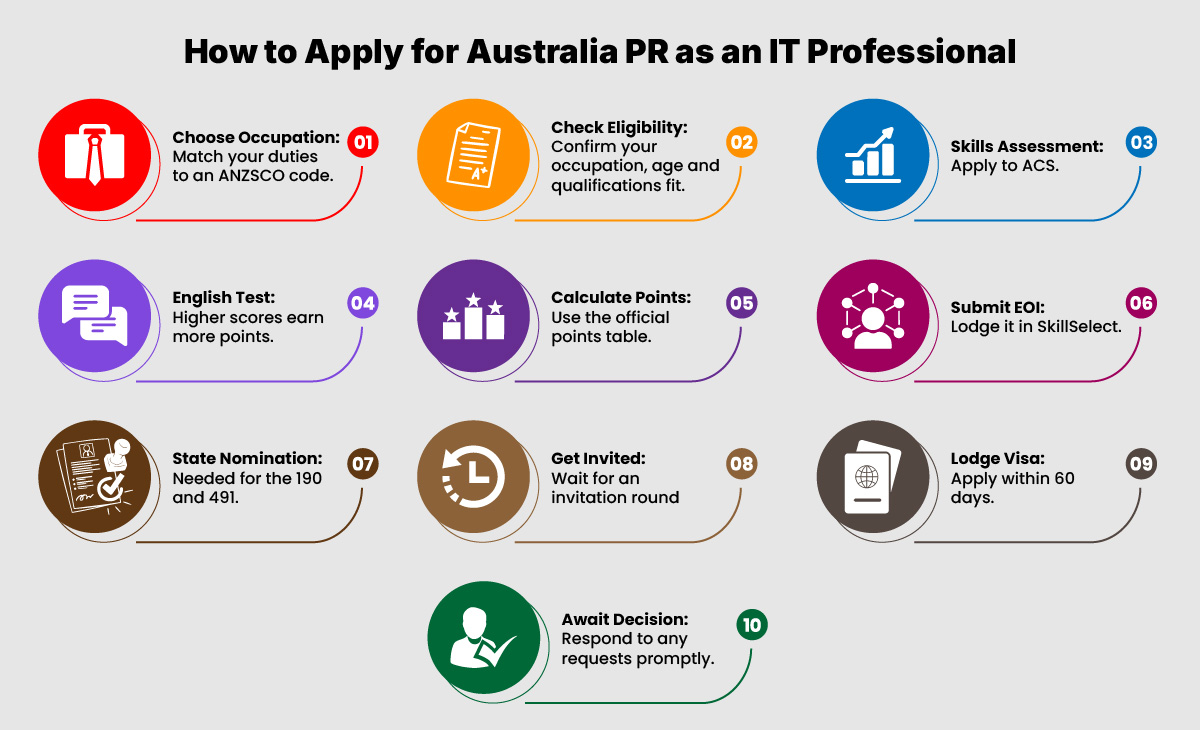
1. Choose your occupation.
Your nominated occupation must match your real work, not just your job title. Compare your day-to-day duties with the ANZSCO descriptions for roles such as Software Engineer, Systems Analyst or ICT Security Specialist, and pick the closest fit. This choice shapes your skills assessment, your list eligibility and your invitation chances, and a mismatch is a common reason for refusal.
2. Check eligibility.
Confirm that your occupation is on the relevant skilled occupation list for the visa you want, and that you are under 45 and meet the qualification and experience requirements. Lists and rules change, so check the current Home Affairs and state information instead of relying on older guides.
3. Complete your skills assessment.
Apply to the Australian Computer Society (ACS) with decision-ready documents, including your degree certificates, employment references, payslips or tax records and identity documents. Your references should clearly state your duties, employment dates and working hours. Incomplete files cause delays, so prepare everything before you lodge.
4. Take an English test.
Book IELTS, PTE Academic or another accepted test, and aim for the highest score you can reach. Competent English is the minimum, but proficient or superior English earns extra points that can decide whether you are invited. Allow time for a retake if needed.
5. Calculate your points.
Use the official Home Affairs points table to count points for age, English, work experience, education and any additional factors, such as partner skills or a Professional Year. Claim only what you can prove with documents, because over-claiming can lead to refusal.
6. Submit your EOI in SkillSelect.
Create your Expression of Interest with accurate details about your occupation, points and skills assessment. You can select more than one visa subclass, such as the 189, 190 and 491, in the same EOI. Your EOI stays in the pool until you are invited or it expires, and you can update it as your circumstances improve.
7. Seek state nomination if needed.
For the Subclass 190 and 491, apply to a state or territory whose occupation list and criteria match your profile. Each state has its own requirements, and some ask for a separate application or a minimum period of work experience. Nomination adds 5 points for the 190 and 15 for the 491.
8. Receive an invitation.
Invitations are issued in rounds, and higher-scoring candidates and in-demand occupations are generally invited first. Waiting times depend on your points, your occupation and the number of places available. If your score is below recent invitation levels, use the wait to improve it.
9. Lodge your visa application.
Once invited, you have 60 days to lodge the application. You will need to submit your supporting documents and complete health examinations and police certificates for yourself and any family members included. Make sure the details match your EOI exactly.
10. Wait for the decision.
Processing times vary by visa and by case, and the Department of Home Affairs may ask for more information. Respond to any request promptly, keep your contact details up to date, and avoid major life or job changes until the visa is granted.
How to Improve Your Australia PR Chances
Your Australia PR for IT Professionals application can be strengthened in several ways:
- Improve your English score. Moving from competent to proficient or superior English adds points.
- Build skilled work experience. Points increase with years of relevant experience, both overseas and in Australia.
- Gain a higher qualification. A master’s or doctorate can raise your score.
- Claim partner points. If your partner has a positive skills assessment, competent English and is under 45, you may gain extra points.
- Consider state nomination. The Subclass 190 adds 5 points and the Subclass 491 adds 15.
- Look at additional point options. These include a Professional Year in Australia, an accredited community language (NAATI) credential and study in a regional area.
- Keep your EOI current. Update your points whenever your circumstances change.
- Prepare documents early. Gather references, tax records and certificates well in advance to avoid delays.
- Never over-claim points. Inaccurate claims can lead to refusal, and in serious cases to a ban on future applications.
Conclusion
Permanent residency in Australia is achievable for IT professionals who plan carefully. The best route depends on your occupation, points score, English level and whether you are open to state nomination or regional living. Start with an honest points calculation, secure your ACS assessment and track occupation list and invitation updates. For official details, visit the Department of Home Affairs’ SkillSelect page. If you want personal guidance on your profile, an experienced Australia Immigration Consultant in Dubai can review your options and help you prepare a strong application. CanApprove’s team supports applicants through each step, from assessment to visa lodgement.
Frequently Asked Questions
It depends on your points score. The Subclass 189 needs no sponsor but is the most competitive, the 190 adds 5 points through state nomination, and the 491 adds 15 points for regional living.
The minimum is 65 points to submit an Expression of Interest. Invitations for IT roles usually go to candidates with higher scores, depending on the occupation and the round.
Yes. Software Engineer is a commonly assessed ICT occupation. You need a positive ACS assessment, competent English, to be under 45 and enough points.
Yes. The Subclass 189, 190 and 491 visas are points-tested and do not require a job offer.
Yes, if your occupation is on the relevant list and you meet the requirements. The 190 and 491 also need state or territory nomination.
From 1 July 2026, the main applicant’s government charge is about AUD 6,135 for the Subclass 189 and AUD 6,140 for the 190 and 491. Skills assessment, English test, medicals and nomination fees are extra.





 WHATSAPP