


Canada PR for pharmacists from Dubai is a realistic goal for UAE-based pharmacists. Canada has a steady demand for pharmacists, and the profession is eligible for Express Entry healthcare category draws and several provincial nomination programs. Your Dubai work experience counts toward PR, but you also need PEBC certification and a provincial licence to practise.
This guide covers the immigration pathways, PEBC requirements, licensing rules by province, job opportunities and the steps to follow from Dubai.
Table of Content
- Canada Immigration Pathways for Pharmacists From Dubai
- PEBC Requirements for International Pharmacists
- Pharmacy Licensing Requirements by Province
- Job Opportunities for Pharmacists in Canada
- Requirements for Canada PR for Pharmacists
- Steps to Become a Pharmacist in Canada From Dubai
- Does Dubai Pharmacy Work Experience Count for Canada PR?
- Conclusion
- Frequently Asked Questions
Canada Immigration Pathways for Pharmacists From Dubai
Pharmacists working in the UAE have several routes to Canadian permanent residence. Pharmacists fall under NOC 31120 (TEER 1), which makes them eligible for most skilled worker programs. The main pathways are below.
1. Express Entry (Federal Skilled Worker Program)
Express Entry is the main federal route. You create an online profile and receive a Comprehensive Ranking System (CRS) score based on age, education, language ability and work experience. The highest-ranked candidates receive an Invitation to Apply (ITA) in regular draws.
Pharmacists from Dubai usually enter through the Federal Skilled Worker Program, since their experience is outside Canada. You will need:
- An Educational Credential Assessment (ECA) for your pharmacy degree.
- A valid IELTS or CELPIP score (English) or TEF/TCF (French).
- Proof of settlement funds, which applicants under the Federal Skilled Worker Program must show to Immigration.
- Reference letters for your UAE work experience.
Best for: Pharmacists with strong language scores, a younger age profile and several years of experience.
2. Express Entry Healthcare and Social Services Category
Pharmacists are included in IRCC’s Healthcare and Social Services occupations category under NOC 31120. To qualify for an invitation through this category, candidates must meet the requirements of an eligible Express Entry program and the applicable category-based selection instructions.
Under the current published criteria, candidates need at least 12 months of full-time equivalent work experience in an eligible occupation within the preceding three years. This experience may be gained in Canada or abroad and does not need to be continuous.
Category-based selection does not guarantee an invitation. CRS cut-offs, invitation numbers and draw frequency vary by round.
Best for: Pharmacists whose CRS score falls short in general draws.
3. Provincial Nominee Programs (PNP)
Provinces can nominate workers whose skills match local shortages, and a nomination adds 600 CRS points. Pharmacist demand is high in several provinces, including Ontario, Saskatchewan and Alberta, where the job outlook is good to very good. Streams worth exploring include:
- Ontario (OINP): Human Capital and healthcare-focused streams.
- Alberta (AAIP): Streams for healthcare and in-demand occupations.
- Saskatchewan (SINP): Occupation In-Demand and Express Entry sub-category.
- British Columbia (BC PNP): Healthcare and skilled worker streams.
- Nova Scotia: The Nova Scotia Healthcare Professionals Immigration Pilot, designed to speed up immigration for qualified healthcare workers.
Some streams need a job offer, and some need provincial licensing progress. Requirements and quotas change often, so check the current criteria before applying.
Best for: Pharmacists who want a province-specific route or need extra CRS points.
4. Atlantic Immigration Program (AIP)
The AIP is an employer-driven route to permanent residence in New Brunswick, Nova Scotia, Prince Edward Island and Newfoundland and Labrador. You need a job offer from a designated employer in the region, who also helps with your settlement plan. It suits pharmacists who are open to living in smaller Atlantic communities.
Best for: Pharmacists who can secure an employer offer in the Atlantic provinces.
5. Canadian Experience Class (After Arriving in Canada)
This is a later-stage option rather than a direct route from Dubai. Once you hold a valid work permit and gain skilled Canadian work experience, you can apply through the Canadian Experience Class (CEC). Many pharmacists land first in a related role, such as a pharmacy assistant or technician position, while completing licensing, and then move to PR.
Best for: Pharmacists who plan to work in Canada first and apply for PR from within the country.
Licensing Comes First
Pharmacy is a regulated profession in Canada. To practise as a pharmacist, you must be licensed by the provincial regulatory authority in the province where you want to settle. The usual steps are the PEBC evaluation, the qualifying exams and a provincial registration process. You can start the immigration process in parallel, but you cannot work as a licensed pharmacist until licensing is complete.
PEBC Requirements for International Pharmacists
The Pharmacy Examining Board of Canada (PEBC) is the national body that certifies pharmacists in Canada. International pharmacists must be PEBC certified before they can apply for a provincial pharmacy licence.
What Is PEBC?
PEBC is the national certifying body for pharmacists in Canada. It assesses whether a pharmacist’s education and skills meet Canadian standards, using a document review and a set of exams. Certification from PEBC is accepted by most provincial pharmacy regulators.
Why Is PEBC Required for International Pharmacists?
Pharmacy is a regulated profession in Canada, and your UAE licence is not valid there. PEBC certification confirms that your training and knowledge match Canadian practice, and it is the basis for licensing in your chosen province. Without it, you cannot work as a licensed pharmacist.
PEBC Document Evaluation
You submit your pharmacy degree, transcripts, licence and identity documents through your PEBC account. PEBC checks whether your education meets its standards. The evaluation has a validity period, so you may need a re-evaluation if it expires before your exam.
PEBC Evaluating Exam
The multiple-choice Evaluating Exam was previously compulsory for international graduates. PEBC is discontinuing it effective January 2027, with the October 2026 sitting being the last one, and replacing it with a new certification pathway. Eligibility for the new pathway depends on PEBC’s rules, including holding a valid Document Evaluation. Candidates must confirm which pathway applies to their education and professional background before applying.
PEBC Qualifying Exam
The Qualifying Exam has two parts:
- Part I (MCQ): Tests the knowledge expected of an entry-level pharmacist in Canada, including Canadian practice standards and drug regulations.
- Part II (OSCE): Uses simulated patient and healthcare-provider stations to assess clinical skills, communication and decision-making.
After PEBC Certification
Once certified, you apply to the pharmacy regulator in your chosen province. Requirements such as jurisprudence exams, practical training and language tests vary by province.
Pharmacy Licensing Requirements by Province
Each province has its own pharmacy regulator, and requirements beyond PEBC certification differ. Enrolling in Pharmacists’ Gateway Canada is the mandatory first step in every province except Quebec.
| Province | Regulator | Key requirements |
| Ontario | Ontario College of Pharmacists (OCP) | PEBC Qualifying Exam, OCP jurisprudence exam, and the International Pharmacy Graduate (IPG) Program unless you passed both exam parts on your first attempt |
| British Columbia | College of Pharmacists of BC (CPBC) | PEBC certification, BC jurisprudence exam, and practical training through the 24-week Canadian Pharmacy Practice Program (CP3) |
| Alberta | Alberta College of Pharmacy (ACP) | Jurisprudence module and exam, practical training, and the University of Alberta DCPP program unless exempt |
| Saskatchewan | Saskatchewan College of Pharmacy Professionals (SCPP) | PEBC certificate, Appraisal and Assessment Program, jurisprudence exam, and certificates of standing |
| Nova Scotia | Nova Scotia Pharmacy Regulator (NSPR) | Both PEBC exam parts, jurisprudence exam, and 20-week structured practical training |
Common to all provinces: English or French language proficiency, a jurisprudence exam on provincial pharmacy law, supervised practical training and professional liability insurance. Fees, hours and intake limits change, so confirm them with the regulator and Pharmacists’ Gateway Canada before you plan your timeline.
Additional requirements may include jurisprudence examinations, supervised practical training, bridging education and practice assessments. Exemptions and registration pathways differ by province and individual circumstances.
PEBC certification does not automatically grant a licence to practise. Candidates should check the current requirements of their intended provincial regulator before planning their licensing timeline.
Job Opportunities for Pharmacists in Canada
Canada PR for pharmacists from Dubai opens the door to a strong job market. Pharmacists (NOC 31120) are in demand across the country, and the employment outlook for 2025-2027 is rated good in Ontario and in parts of British Columbia, where recent data shows more job openings than available workers. Most pharmacists work in retail pharmacies, followed by hospitals and other health care settings.
| Job role | What the role involves | Where you work |
| Community pharmacist | Dispenses prescriptions, counsels patients and works with other health care providers | Retail chains and independent pharmacies |
| Hospital pharmacist | Prepares and dispenses medications and advises doctors and nurses on drug therapy | Hospitals and health authorities |
| Clinical pharmacist | Reviews patient medications and supports care teams with treatment decisions | Hospitals, clinics and primary care teams |
| Industrial pharmacist | Works on research, development, promotion and manufacture of pharmaceutical products | Pharmaceutical and biotech companies |
| Pharmacy manager or supervisor | Leads pharmacists, technicians and assistants, and manages daily operations | Community and hospital pharmacies |
Pay varies by province, role and experience. National Job Bank data shows a median wage of about CAD 55 per hour, with the range running from roughly CAD 40 to CAD 67 per hour.
Requirements for Canada PR for Pharmacists
Canada PR for pharmacists from Dubai is mainly processed through Express Entry. The core requirements are below.
| Requirement | Details |
| Work experience | At least one year of continuous skilled work experience as a pharmacist (NOC 31120) within the last 10 years. Healthcare category draws also require recent experience in the occupation. |
| Education | A pharmacy degree with an Educational Credential Assessment (ECA) confirming it is equivalent to a Canadian credential. |
| Language ability | Valid IELTS or CELPIP (English) or TEF/TCF (French) results. The Federal Skilled Worker Program requires a minimum of CLB 7. |
| Eligibility points | A qualifying score on the Federal Skilled Worker Program grid, plus a competitive Comprehensive Ranking System (CRS) score. |
| Proof of funds | Settlement funds are required for applicants under the Federal Skilled Worker Program, unless they hold a valid Canadian job offer or are already working in Canada. Canadian Experience Class applicants are generally exempt from the settlement-funds requirement. |
| Admissibility | Police certificates from the UAE and any other country where you have lived, plus an immigration medical exam. |
A Canadian pharmacy licence is not required to enter the Express Entry pool, but you need it to work as a pharmacist in Canada. Most candidates begin the PEBC process alongside their PR application.
Steps to Become a Pharmacist in Canada From Dubai
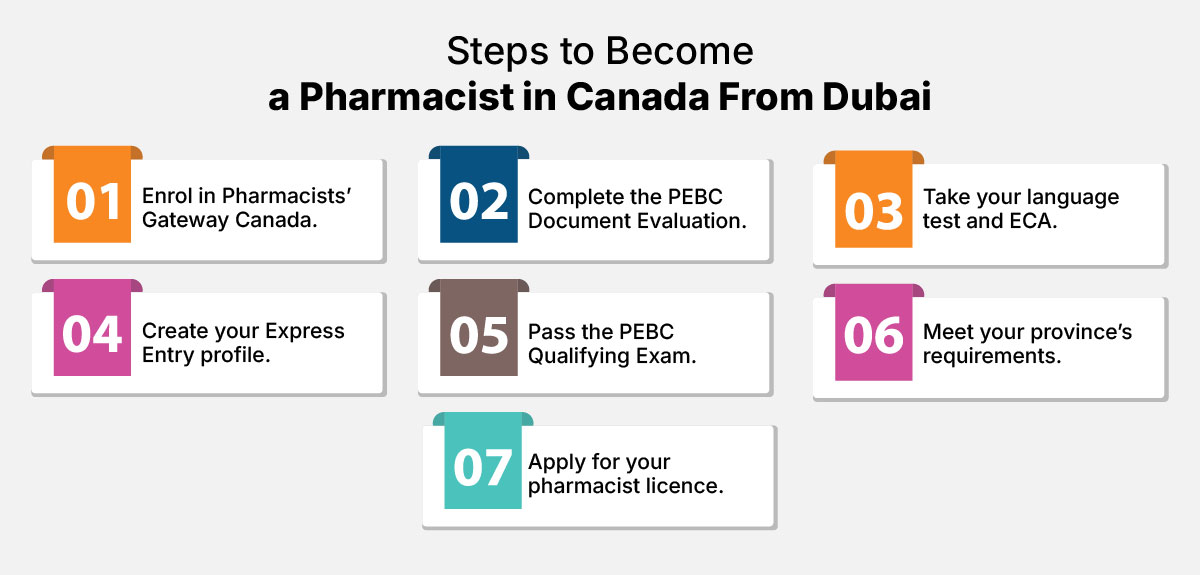
Becoming a licensed pharmacist in Canada involves both a licensing process and an immigration process. Most candidates run them in parallel.
- Enrol in Pharmacists’ Gateway Canada. This is the mandatory first step in every province except Quebec. You can begin it before you leave Dubai.
- Complete the PEBC Document Evaluation. PEBC reviews your pharmacy degree, transcripts and UAE licence.
- Take your language test and ECA. Book IELTS, CELPIP, TEF or TCF, and get your pharmacy degree assessed through an Educational Credential Assessment for immigration.
- Create your Express Entry profile. Pharmacists are eligible for healthcare category draws, which often have lower cut-offs than general draws. Provincial nominations are another option.
- Pass the PEBC Qualifying Exam. Part I is multiple choice and Part II is a clinical OSCE. From January 2027, international graduates with a valid Document Evaluation can go straight to Part I.
- Meet your province’s requirements. These include a jurisprudence exam, supervised practical training and, in some provinces, a bridging program.
- Apply for your pharmacist licence. After your provincial regulator approves your application, you can practise as a licensed pharmacist.
Does Dubai Pharmacy Work Experience Count for Canada PR?
Yes. For Canada PR for pharmacists from Dubai, your UAE work experience counts toward Express Entry, as long as it meets the Federal Skilled Worker Program rules. You do not need Canadian work experience to qualify.
To be accepted, your experience must meet these conditions:
- Occupation: Your duties must match pharmacists (NOC 31120), such as dispensing medications and advising patients and health care providers.
- Duration: You need at least one year of continuous, paid, full-time work (or an equal amount of part-time work) in the last 10 years.
- Proof: Reference letters from your employers should state your job title, duties, dates, hours and salary.
Experience from Dubai also earns Comprehensive Ranking System (CRS) points through foreign work experience and skill transferability. Canadian experience earns more points, but it is not required. For healthcare category draws, IRCC looks for recent experience in a listed occupation, and pharmacists qualify.
Conclusion
Canada PR for pharmacists from Dubai is achievable, and your UAE work experience counts toward it. Pharmacists qualify for Express Entry healthcare category draws, and provincial nomination programs add further options. Licensing is a separate process. You need PEBC certification and your province’s requirements before you can practise as a pharmacist.
Starting both processes together saves time. Enrol in Pharmacists’ Gateway Canada, begin your PEBC Document Evaluation, book your language test and build your Express Entry profile. Since PEBC rules and Express Entry draws change often, check the latest requirements before you apply.
Frequently Asked Questions
Yes. Pharmacists (NOC 31120) are eligible for Express Entry, including healthcare category draws, as well as provincial nominee programs. Canada PR for pharmacists from Dubai does not require Canadian work experience.
You need to complete PEBC certification, meet your province’s licensing requirements and apply for a licence with the provincial regulator. Most candidates also pursue PR through Express Entry or a provincial program at the same time.
Yes. PEBC certification is required before you can be licensed in most provinces. It includes a Document Evaluation and the Qualifying Exam. From January 2027, the Evaluating Exam is no longer required.
For Express Entry under the Federal Skilled Worker Program, you need at least CLB 7, which is roughly 6.0 in each IELTS General Training band. Provincial pharmacy regulators set their own language requirements, which can be higher, so check your chosen province.
It usually takes one to three years, depending on exam preparation, practical training, provincial requirements and any bridging program.
Yes, if it is paid, skilled experience as a pharmacist within the last 10 years, with at least one year of continuous work. Employer reference letters are needed as proof.
Ontario, British Columbia, Alberta, Saskatchewan and Nova Scotia are strong options. Job Bank rates the outlook as good in Ontario and parts of British Columbia, and Nova Scotia runs a healthcare professionals immigration pilot. The right choice depends on licensing requirements, nomination options and your own preferences.
Yes. Pharmacists qualify for Express Entry through the Federal Skilled Worker Program and are eligible for healthcare category draws, which often have lower cut-offs than general draws.




 WHATSAPP