

In-demand occupations in Canada 2027 are shaped by labour shortages in healthcare, skilled trades, technology, engineering and education, and skilled workers in the UAE are watching them closely. Knowing which roles are needed helps you decide which skills, qualifications and immigration route to focus on. This guide explains the sectors with the strongest demand, the provinces offering opportunities and the steps to apply for permanent residence. Since IRCC updates its occupation lists and Express Entry categories regularly, always confirm details on official government websites before applying.
Table of Content
- The Most In-Demand Occupations in Canada for 2027
- Why are These Occupations in Demand in Canada
- Best Canadian Provinces for Skilled Workers in 2027
- Best Immigration Pathways to Canada for Skilled Workers
- Eligibility Requirements for Skilled Workers Applying for Canada PR
- How to Apply for Canada PR as a Skilled Worker: Step-by-Step Process
- Conclusion
- FAQs
The Most In-Demand Occupations in Canada for 2027
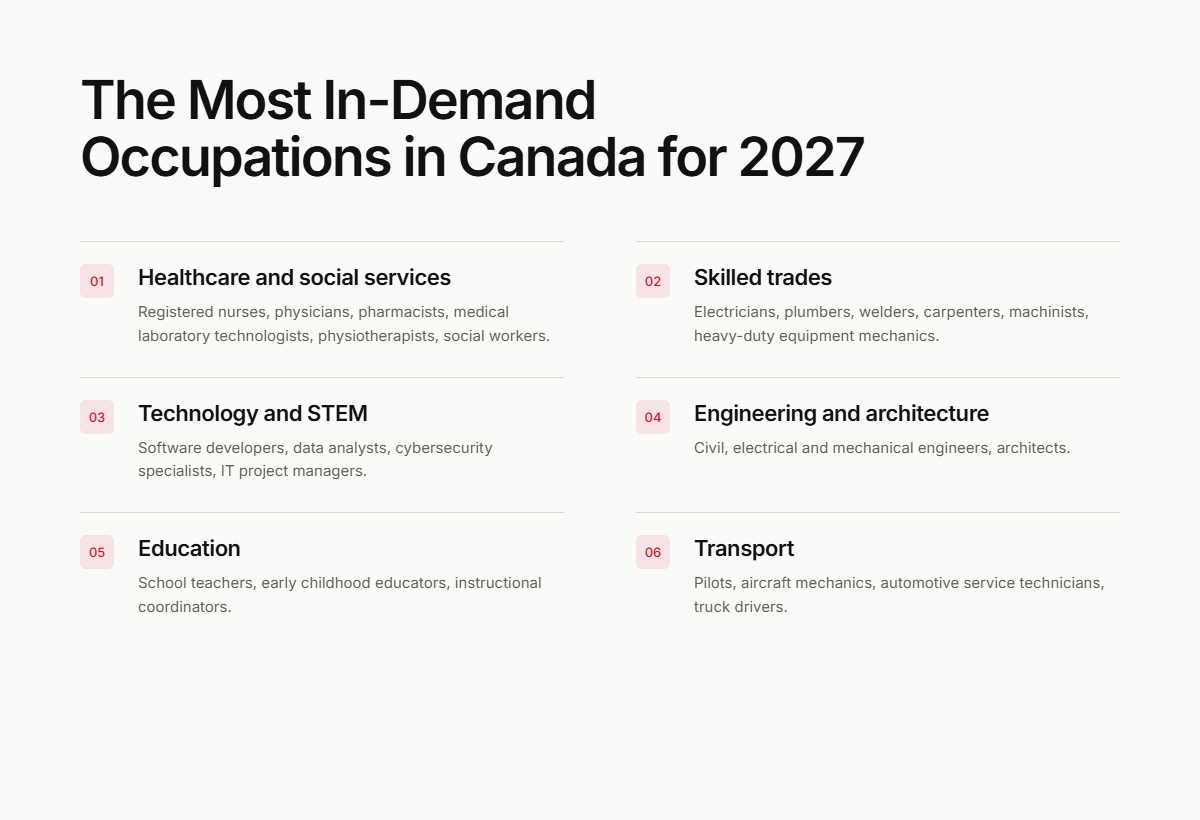
Canada’s labour shortages are concentrated in a few industries, and these are also the sectors IRCC has prioritised in recent Express Entry draws. IRCC announces its category list every year and had not published the 2027 list at the time of writing, so the sectors below follow the 2026 Express Entry categories. These are the in-demand jobs in Canada that skilled workers should watch.
Healthcare and social services
- Job roles: Registered nurses, physicians, pharmacists, medical laboratory technologists, physiotherapists, social workers.
- Basic qualification: A relevant degree or diploma, plus licensing from the provincial regulatory body.
Skilled trades
- Job roles: Electricians, plumbers, welders, carpenters, machinists, heavy-duty equipment mechanics.
- Basic qualification: Apprenticeship training or a trade certificate, with provincial certification where the trade is regulated.
Technology and STEM
- Job roles: Software developers, data analysts, cybersecurity specialists, IT project managers.
- Basic qualification: A bachelor’s degree in computer science, engineering or a related field, along with relevant work experience.
Engineering and architecture
- Job roles: Civil, electrical and mechanical engineers, architects.
- Basic qualification: An accredited degree. Licensing with the provincial engineering or architecture regulator is needed for regulated practice.
Education
- Job roles: School teachers, early childhood educators, instructional coordinators.
- Basic qualification: A bachelor’s degree or diploma and a teaching or early childhood certification from the province.
Transport
- Job roles: Pilots, aircraft mechanics, automotive service technicians, truck drivers.
- Basic qualification: Diploma or apprenticeship training, plus the required licences and certifications.
Candidates should match their own job to a National Occupational Classification (NOC) code and TEER category, because the in-demand occupations in Canada 2027 will be assessed on that basis.
Why Are These Occupations in Demand in Canada?
Several long-term pressures sit behind the shortages. Canada’s population is ageing, and large numbers of nurses, tradespeople and teachers are retiring, while demand for healthcare services keeps rising. Housing, transport and infrastructure projects need more skilled trades workers, and the growing digital economy needs technology and engineering talent. Rural and remote communities also struggle to attract workers locally. The federal government has responded by prioritising economic immigration. Under the 2026–2028 Immigration Levels Plan, permanent resident admissions are held at 380,000 a year, with the economic class reaching about 64 per cent of admissions in 2027. This is why the in-demand occupations in Canada 2027 remain closely tied to labour market gaps.
Best Canadian Provinces for Skilled Workers in 2027
Opportunities and nomination priorities differ by province, so the best fit depends on your occupation. The in-demand occupations in Canada 2027 are not equally needed everywhere.
- Ontario: The largest job market, with strong demand in technology, finance, healthcare and construction.
- British Columbia: Hiring in technology, healthcare and trades, with a high cost of living in Vancouver.
- Alberta: Demand in energy, construction, healthcare and skilled trades, with generally lower living costs.
- Saskatchewan: Needs healthcare workers, tradespeople and agriculture-related talent.
- Manitoba: Known for provincial nomination streams linked to skills and local work ties.
- Atlantic provinces: Employers in healthcare, trades and food processing seek workers, and these provinces have a smaller-city lifestyle.
- Quebec: Runs its own selection system, and French language ability is important.
Many of these roles are often counted among the best jobs in Canada for immigrants, but provincial requirements change, so check each program’s current criteria.
Best Immigration Pathways to Canada for Skilled Workers
Canada immigration for skilled workers runs through several routes, and not every occupation qualifies for every program. The right pathway depends on your occupation, experience, language ability and target province.
- Express Entry: The federal system for skilled applicants, covering three programs. The Federal Skilled Worker Program suits professionals with eligible work experience. The Federal Skilled Trades Program is for qualified tradespeople. The Canadian Experience Class is for those with skilled work experience in Canada.
- Category-based draws: IRCC invites candidates in priority sectors such as healthcare, trades, STEM, education and transport, often with lower cut-off scores. Categories are reviewed every year.
- Provincial Nominee Programs: Provinces nominate workers who match local labour needs, and an Express Entry-linked nomination adds 600 CRS points. Occupation lists and requirements differ by province.
- Atlantic Immigration Program: An employer-driven route for candidates with a job offer from a designated employer in the Atlantic provinces.
- Quebec skilled worker selection: A separate system run by the province, where French ability carries significant weight.
Different profiles have different options, so the best pathway depends on your own background, experience and target province.
Eligibility Requirements for Skilled Workers Applying for Canada PR
Requirements vary by program, but most skilled worker applicants need the following.
- Work experience: At least one year of skilled, continuous work experience in a TEER 0, 1, 2 or 3 occupation within the last ten years (Federal Skilled Worker Program). Trades candidates need two years of experience in their trade.
- Language ability: English or French test results, typically at least CLB 7 for the Federal Skilled Worker Program.
- Education: A completed qualification, with an Educational Credential Assessment for studies outside Canada.
- Points: A minimum of 67 out of 100 on the Federal Skilled Worker selection grid, plus a competitive Comprehensive Ranking System (CRS) score.
- Funds and admissibility: Proof of settlement funds, unless exempt, and clear medical and police checks.
Always confirm current criteria on the official program pages, as thresholds can change.
How to Apply for Canada PR as a Skilled Worker: Step-by-Step Process
Candidates exploring Canada PR from Dubai can follow this general sequence for the in-demand occupations in Canada 2027.
- Identify your NOC code and TEER level. Confirm that your job matches a skilled occupation.
- Take a language test. Choose an approved English or French test and aim for the highest score possible.
- Get your education assessed. Complete an Educational Credential Assessment if you studied outside Canada.
- Check your eligibility. Review the program requirements and calculate your CRS score.
- Create an Express Entry profile. Submit your details to enter the pool, and explore provincial nomination options.
- Receive an Invitation to Apply. You have 60 days to submit a complete application.
- Submit documents and fees. Provide identity documents, police certificates, medical exams and proof of work experience.
- Wait for a decision. If approved, you will receive confirmation of permanent residence and instructions for landing in Canada.
Conclusion
Canada’s demand for skilled professionals in healthcare, trades, technology, engineering, education and transport shows no sign of slowing, and the in-demand occupations in Canada 2027 will keep shaping immigration priorities. Policies, draw categories and points systems can change quickly, so rely on official sources such as IRCC’s Express Entry page for the latest rules. Many applicants also choose to work with a Canada immigration consultant in Dubai to review their profile, select the right pathway and avoid errors in documentation.
Frequently Asked Questions
Healthcare, skilled trades, technology, engineering, education and transport roles lead demand, including nurses, electricians, software developers, engineers and teachers.
Jobs with strong demand and a clear pathway to PR, such as healthcare, trades, IT and engineering roles, offer the best prospects.
Registered nurses, physicians, pharmacists, medical laboratory technologists, physiotherapists and social workers. Most require provincial licensing.
IRCC had not announced the 2027 categories at the time of writing. The 2026 list covers healthcare, STEM, trades, education and transport, among others.
The national average is about CAD 38.49 per hour (February 2026), or roughly CAD 69,000 a year. Skilled roles often pay more.
Ontario has the largest job market, followed by British Columbia and Alberta. The best fit depends on your occupation.





 WHATSAPP