

Germany’s ageing population has created steady demand for trained healthcare staff, and Registered Nurse Jobs in Germany are now open to qualified professionals from around the world. Hospitals, care homes and rehabilitation centres actively recruit from abroad, offering stable careers and good pay. However, nursing is a regulated profession, so foreign-trained nurses must meet clear requirements before they can practise. This guide covers the job types, eligibility, language rules, documents and application steps to help you plan your move.
Table of Content
- Types of Nursing Jobs in Germany
- Eligibility Requirements for Registered Nurse Jobs
- German Language Requirements for Nurses
- Work Experience Requirements
- Documents Required for Nursing Jobs in Germany
- How to Apply for Registered Nurse Jobs in Germany
- Career Growth for Registered Nurses in Germany
- Conclusion
- Frequently Asked Questions
Types of Nursing Jobs in Germany
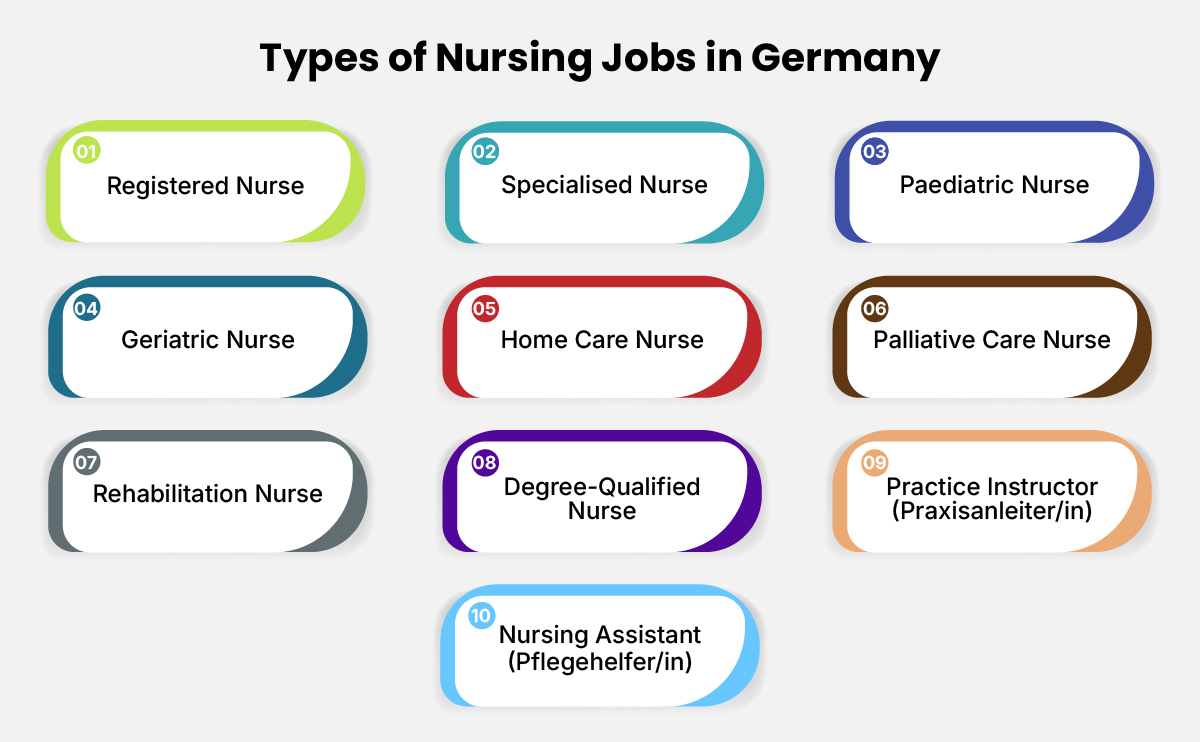
Nurse jobs in Germany cover many roles across hospitals, care homes and community settings. Registered Nurse Jobs in Germany are the most common route for international candidates, and most other roles build on that qualification.
1. Registered Nurse (Pflegefachfrau / Pflegefachmann / Pflegefachperson)
The main qualified role. This single title now covers general, paediatric and geriatric nursing.
- Key duties: Independent patient care, giving medication, assisting in medical procedures and keeping patient records.
- Where they work: Hospitals, nursing homes, ambulatory care and rehabilitation centres.
- Requirement: Recognised nursing qualification and B2 German.
2. Specialised Nurse
A registered nurse who focuses on one clinical area after additional training.
- Key duties: Monitoring critically ill patients, operating machines such as ventilators, and assisting in surgeries.
- Where they work: Intensive care units, operating theatres, emergency departments and oncology wards.
- Requirement: Registered nurse recognition plus specialist training or relevant experience.
3. Paediatric Nurse
Cares for babies, children and teenagers at different stages of growth.
- Key duties: Child health checks, medication, vaccinations and supporting parents with care guidance.
- Where they work: Children’s hospitals, paediatric wards and neonatal units.
- Requirement: Recognised nursing qualification, with paediatric experience preferred.
4. Geriatric Nurse
Supports elderly patients who need regular medical and personal care.
- Key duties: Daily care, medication management, mobility support and care for chronic conditions.
- Where they work: Nursing homes, assisted living facilities and long-term care centres.
- Requirement: Recognised nursing qualification. Demand is high due to Germany’s ageing population.
5. Home Care Nurse
Delivers nursing care to patients in their own homes.
- Key duties: Wound care, injections, medication support and health monitoring.
- Where they work: Ambulatory care services and community nursing providers.
- Requirement: Recognised qualification and good German, since you work independently and talk to patients directly.
6. Palliative Care Nurse
Provides comfort-focused care to patients with serious or terminal illness.
- Key duties: Pain and symptom management, emotional support and guidance for families.
- Where they work: Hospices, palliative wards and home-based palliative services.
- Requirement: Recognised qualification, with palliative training or experience valued.
7. Rehabilitation Nurse
Helps patients regain independence after surgery, stroke or injury.
- Key duties: Supporting therapy routines, assisting mobility and teaching patients self-care.
- Where they work: Medical rehabilitation centres and specialist clinics.
- Requirement: Recognised qualification, with rehabilitation experience as an advantage.
8. Degree-Qualified Nurse
Holds an academic nursing degree and often takes on wider responsibilities.
- Key duties: Clinical leadership, care planning, research and quality improvement.
- Where they work: University hospitals, large clinics and healthcare management.
- Requirement: Nursing degree recognised as equivalent in Germany.
9. Practice Instructor (Praxisanleiter/in)
An experienced nurse who trains and guides others on the ward.
- Key duties: Mentoring nursing students, assessing practical skills and supporting new colleagues.
- Where they work: Hospitals and care facilities with nursing training programmes.
- Requirement: Registered nurse status, work experience and additional instructor training.
10. Nursing Assistant (Pflegehelfer/in)
Provides basic care under the guidance of qualified nurses.
- Key duties: Help with washing, dressing, feeding and mobility, and assisting with simple care tasks.
- Where they work: Hospitals, nursing homes and home care services.
- Requirement: Usually a shorter training. This can be an entry route if a nursing qualification is not recognised in full.
Eligibility Requirements for Registered Nurse Jobs
These are the core Germany nurse job requirements for international applicants, along with what each one involves.
- Recognised nursing qualification: Your diploma or degree must be recognised as equivalent to the German standard through a process called Anerkennung. It is handled by the state authority, not a central body.
- German language skills: B2 level is needed for full recognition. Details are covered in the next section.
- Health fitness: A medical certificate confirming you are fit to work as a nurse.
- Good character: An official certificate of good conduct or police clearance from your home country.
- Job offer or employer support: Most nurses secure a German employer first. A contract is also required for the recognition partnership route.
- Valid visa or residence permit: The EU Blue Card does not apply to nurses, so you will need a skilled worker visa or a recognition-based route.
German Language Requirements for Nurses
German language skills are one of the most important parts of Registered Nurse Jobs in Germany. Here is what you need, point by point.
- Level required: B2 German is needed for full recognition and a licence to practise.
- Accepted certificates: Goethe-Institut, telc or ÖSD. The certificate must be from a recognised provider.
- Professional language exam: Many states also require the Fachsprachprüfung, a test of medical German. It covers patient talks, doctor handovers and documentation.
- Recognition partnership route: A2 is enough to enter Germany and begin. You must reach B2 later to complete recognition.
- Employer requirements: Some employers hire at B1 and support your language training while you work.
- Why it matters: You will handle patient records and speak with doctors and families every day, so strong German is essential.
Work Experience Requirements
Germany nursing jobs do not follow a single fixed rule on years of experience. Recognition focuses mainly on your training, but experience still plays an important role.
How Experience Is Viewed
- Training comes first: The authority compares your education with the German three-year nursing standard.
- No fixed minimum: There is no general rule that says you need a set number of years before applying for recognition.
- Employers prefer experience: German hospitals and care homes value hands-on clinical experience.
- Fresh graduates can apply: Recognition is based on your training, but employers may prefer candidates with some experience.
When Your Training Has Gaps
- Compensation measures: If your training differs from the German standard, you may need an adaptation course or a knowledge test.
- Experience may help: Relevant work experience may be considered when gaps are assessed.
- If you decline the measure: Your qualification will not be recognised, and you cannot work as a registered nurse.
Experience for Specialised Roles
- Higher-demand areas: Experience in ICU, operating theatre, emergency care or oncology strengthens your application.
- Specialist training: Some specialised roles may need extra training, even with strong experience.
Proof of Experience
- Experience letters: Get letters from past employers that show your job title, department, duties and dates of employment.
- Certified translations: All experience documents must be translated by a certified translator if they are not in German.
Documents Required for Nursing Jobs in Germany
Having your paperwork ready early makes recognition faster for Registered Nurse Jobs in Germany, so prepare the following documents before you apply.
- Valid passport.
- Nursing diploma or degree certificate.
- Academic transcripts with subjects and training hours.
- Nursing registration or licence from your home country.
- Work experience certificates.
- German language certificate (B2, or A2 for the recognition partnership).
- CV, preferably in German.
- Medical fitness certificate.
- Certificate of good conduct or police clearance.
- Signed employment contract or job offer.
- Certified translations of all foreign-language documents.
How to Apply for Registered Nurse Jobs in Germany
Here is how most international nurses in Germany complete the process, from first step to first shift.
- Check your qualification: Confirm that your nursing training can be assessed for equivalence with the German standard.
- Start learning German: Begin language classes early and aim for B2.
- Find an employer: Apply to hospitals and care providers that recruit international nurses and support recognition.
- Apply for recognition: Submit your application and documents to the competent state authority, by post or online.
- Receive your decision: You will get either full recognition or a notice listing what is missing.
- Complete compensation measures if needed: This may be an adaptation course or a knowledge test.
- Apply for your visa: Choose the route that fits your case, such as a skilled worker visa or a recognition partnership.
- Move and start work: Finish any pending steps in Germany and receive permission to use the professional nursing title.
Career Growth for Registered Nurses in Germany
A nursing career in Germany offers stable work and clear paths to move up once you are fully recognised.
- Specialisation: Build expertise in intensive care, anaesthesia, paediatrics, palliative care or other fields through further training.
- Practice Instructor: Mentor nursing students and new colleagues on the ward.
- Leadership: Progress to team lead, ward manager or nursing director roles.
- Further Education: Study for a nursing degree to open management, teaching or advanced practice positions.
- Job Security: Many employers offer permanent contracts after recognition is complete.
- European Mobility: German nursing training is recognised across the EU, which can support future moves.
Conclusion
Registered Nurse Jobs in Germany offer strong demand, stable careers and room to grow, but success depends on meeting the recognition, language and documentation requirements step by step. Start early, keep your documents organised and choose the route that suits your profile. For official guidance, visit the Make it in Germany nursing professionals page.
If you want expert help with recognition, documents and visa planning, CanApprove UAE is a trusted Germany immigration Consultancy. As an experienced Immigration Consultancy in Dubai, our team guides nurses at every stage of the process.
Frequently Asked Questions
Yes. An ageing population means hospitals, nursing homes and home care services need more qualified nurses every year, and many recruit from abroad.
You need a recognised nursing qualification (Anerkennung), B2 German, a medical fitness certificate, a certificate of good conduct and a valid visa.
B2 is required for full recognition. B1 may be enough to start with some employers, and A2 for the recognition partnership route.
Yes. You work with patients, doctors and medical records in German. Many states also require a professional language exam (Fachsprachprüfung).
Entry-level nurses in public hospitals typically earn around €2,900 to €3,200 gross per month. This can rise to €3,600 to €4,200 with experience.
Yes. Skilled workers can apply for a settlement permit after 3 years, with 36 months of pension contributions and other conditions met.
Geriatric, home care and palliative nursing are in high demand. ICU, operating theatre, emergency and paediatric roles also have steady openings.
The authority usually decides within about 4 months, though it can take longer. An adaptation course or knowledge test adds more time.





 WHATSAPP