

Canada PR for Physiotherapist applicants is a popular choice for healthcare professionals in the UAE and around the world, as Canada continues to invite physiotherapists through Express Entry healthcare category draws and provincial nominee programs. This blog explains the PR pathways, eligibility requirements, credential assessment, documents, and step-by-step application process, along with the best provinces and common challenges, to help you plan your move.
Table of Content
- Canada PR Pathways for Physiotherapists
- Eligibility Requirements for Physiotherapists
- Best Canadian Provinces for Physiotherapists
- Physiotherapy Credential Assessment in Canada
- Documents Required for Physiotherapists
- How to Apply for Canada PR as a Physiotherapist?
- Common Challenges for International Physiotherapists
- Frequently Asked Questions
Canada PR Pathways for Physiotherapists
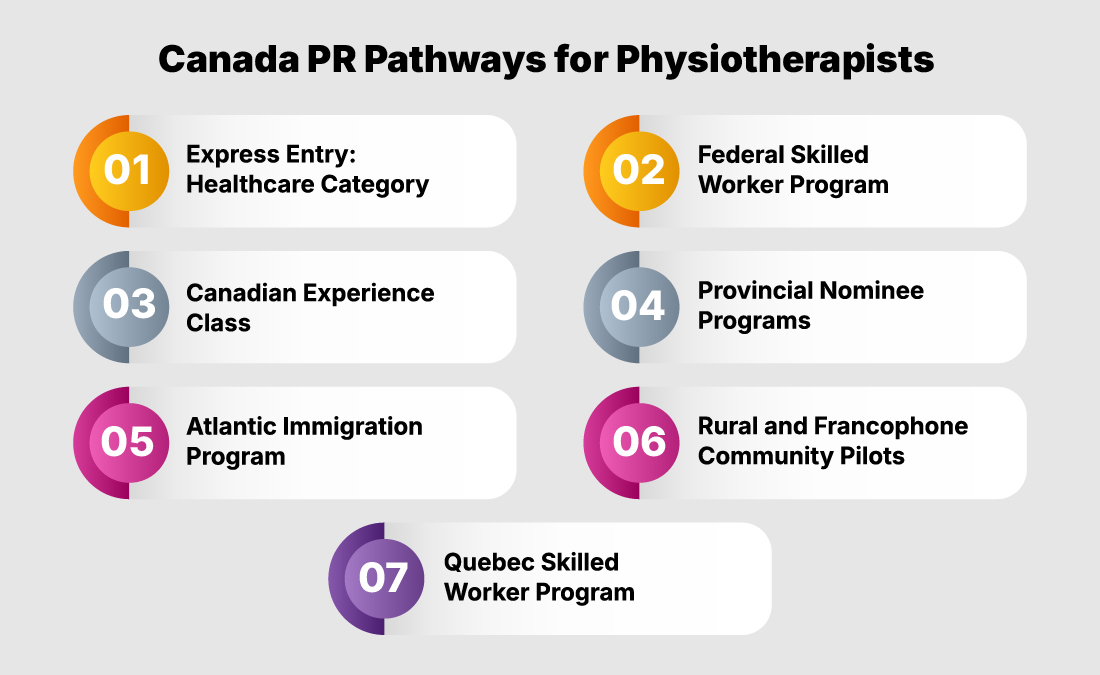
Physiotherapists (NOC 31202, TEER 1) are on the list of occupations eligible for Express Entry healthcare category draws. The main pathways are:
1. Express Entry: Healthcare Category
IRCC invites candidates by occupation, so physiotherapists can be selected even with a lower CRS score. You need an active Express Entry profile and recent work experience as a physiotherapist.
2. Federal Skilled Worker Program
Suited to applicants abroad. It requires 1 year of skilled work experience, CLB 7 language level, and an Educational Credential Assessment.
3. Canadian Experience Class
For physiotherapists already working in Canada. It requires 1 year of Canadian skilled work experience in the last 3 years and CLB 7.
4. Provincial Nominee Programs
Provinces such as Alberta, British Columbia, Ontario, and Saskatchewan nominate healthcare professionals. A nomination adds 600 CRS points. Criteria vary by province.
5. Atlantic Immigration Program
Requires a job offer from a designated employer in an Atlantic province. A good option for candidates with a lower CRS score.
6. Rural and Francophone Community Pilots
Requires a job offer from an employer in a participating community. Physiotherapists are in demand in many smaller towns.
7. Quebec Skilled Worker Program
Quebec runs its own selection process, and French language ability is important.
Eligibility Requirements for Physiotherapists
To qualify for Canada PR for Physiotherapist applicants, you generally need to meet the following requirements.
1. Education
A bachelor’s or master’s degree in physiotherapy. Foreign degrees need an Educational Credential Assessment (ECA) from an IRCC-designated organisation.
2. Work Experience
At least 1 year of continuous skilled work experience as a physiotherapist (NOC 31202) in the last 10 years. For healthcare category draws, recent experience (usually 6 months within the last 3 years) is required.
3. Language Proficiency
CLB 7 or higher in English (IELTS General Training or CELPIP) or French (TEF or TCF). Higher scores earn more CRS points.
4. Age
There is no age limit, but CRS points are highest for candidates aged 20 to 29 and decrease with age.
5. Proof of Funds
Required for applicants outside Canada, unless they hold a valid job offer or are already working in Canada. The amount depends on family size.
6. Admissibility
A medical examination and police clearance certificates are required.
7. Professional Licensing
You must register with the provincial physiotherapy regulator to practise. This usually involves a credential assessment and the Physiotherapy Competency Examination.
Best Canadian Provinces for Physiotherapists
| Province | Median Hourly Wage (CAD) | Why It Suits Physiotherapists | Main PR Route |
| British Columbia | $50.00 | Highest median wage and strong demand in both cities and smaller communities | BC PNP healthcare streams |
| Quebec | $48.08 | High wages and strong benefits, but French is important | Quebec Skilled Worker Program |
| Alberta | $46.00 | Competitive pay and a wide range of public and private clinic jobs | Alberta Advantage Immigration Program |
| Ontario | $46.00 | Largest job market and many clinics across big cities and smaller towns | Ontario Human Capital Priorities (Express Entry) |
| Nova Scotia | $42.00 | Lower cost of living and a priority for healthcare recruitment | Nova Scotia Labour Market Priorities, Atlantic Immigration Program |
| Manitoba | $39.93 | Affordable living and a strong provincial focus on skilled workers | Manitoba PNP |
The national median wage for physiotherapists is $46.15 per hour. Wages are median figures from Canada’s Job Bank and vary by city, employer, and experience. Provincial immigration streams change often, so applicants should check the current criteria before applying.
Physiotherapy Credential Assessment in Canada
Canada PR for Physiotherapist applicants does not allow you to practise straight away, as physiotherapists must be licensed by the regulatory college in each province or territory. The Canadian Alliance of Physiotherapy Regulators (CAPR) reviews the education and qualifications of applicants trained outside Canada on behalf of these colleges. The main steps are below.
1. Credentialling by CAPR
CAPR compares your education and credentials with those of a Canadian-educated physiotherapist to check for substantial differences that would stop you from taking the Physiotherapy Competency Examination (PCE). You submit your identity documents, transcripts, and proof of licensure, and all documents are verified.
2. Language Testing
Most internationally trained applicants must take a language test from a CAPR-approved testing organisation.
3. Physiotherapy Competency Examination (PCE)
You must pass the PCE, which CAPR administers, to become eligible for licensure. The exam format is being updated, so check CAPR’s website for the current structure.
4. Provincial Licence
After the PCE, you apply for registration with the physiotherapy regulator in the province where you plan to work. Quebec has its own separate process.
5. Pre-approved Credentialling Pathway
CAPR offers a Pre-approved Credentialing Pathway for applicants who are licensed in designated countries or jurisdictions. Holding a licence there without being educated there does not qualify you for it.
Immigration and Credentialling Are Separate
The FSWP education assessment is an immigration process and is entirely independent from CAPR’s credential assessment. You can apply to CAPR before, during, or after your FSWP assessment. Applicants can start the CAPR process early, so they are ready to practise soon after landing in Canada.
Documents Required for Physiotherapists
The exact list depends on the pathway, but physiotherapists generally need the following.
Identity and Civil Documents
- Valid passport.
- Birth certificate.
- Marriage certificate (if applicable).
- Passport-size photographs.
Education Documents
- Degree certificates and transcripts in physiotherapy.
- Educational Credential Assessment (ECA) report from an IRCC-designated organisation.
Language Test Results
- IELTS General Training or CELPIP for English, or TEF/TCF for French.
- Results must be valid at the time of applying (usually 2 years).
Work Experience Documents
- Experience letters from employers stating job title, duties, dates, hours, and salary.
- Payslips, bank statements, or tax records as supporting proof.
- Offer letter, if applying through an employer-linked route.
Professional Documents
- Current licence or registration as a physiotherapist from your home country or the UAE.
- CAPR credentialling results and PCE results (for provincial registration).
Financial Documents
- Proof of funds, such as bank statements or a fund letter (not required with a valid job offer or if already working in Canada).
Admissibility Documents
- Police clearance certificates from every country where you lived for 6 months or more.
- Medical examination by an IRCC-approved panel physician.
Additional Documents (if applicable)
- Provincial nomination certificate (for PNP applicants).
- Proof of Canadian work experience (for CEC applicants).
- Spouse’s education, language, and identity documents.
How to Apply for Canada PR as a Physiotherapist?
Canada PR for Physiotherapist applicants follow a step-by-step process that involves meeting the eligibility requirements, choosing the right pathway, and preparing the required documents. The key steps are below.
Step 1: Check Your Eligibility
Confirm that your work experience matches NOC 31202 (Physiotherapists). You need at least 1 year of skilled work experience, a physiotherapy degree, and CLB 7 in English or French.
Step 2: Choose Your Pathway
- Experience outside Canada: Federal Skilled Worker Program (Express Entry).
- Experience in Canada: Canadian Experience Class (Express Entry).
- Lower CRS score: Provincial Nominee Program.
- Job offer in Atlantic Canada: Atlantic Immigration Program.
- French speaker or planning to settle in Quebec: Quebec Skilled Worker Program.
Step 3: Take a Language Test
Take IELTS General Training or CELPIP for English, or TEF/TCF for French. Higher scores add CRS points.
Step 4: Get Your Educational Credential Assessment (ECA)
Have your physiotherapy degree assessed by an IRCC-designated organisation. This is required for foreign degrees.
Step 5: Start CAPR Credentialling
This process is separate from immigration, and you can begin it before, during, or after your PR application. Starting early prepares you for licensing in Canada.
Step 6: Create Your Express Entry Profile
Submit your details and receive your CRS score. If you qualify, your profile is also flagged for healthcare category draws.
Step 7: Improve Your CRS Score
You can raise your score through higher language results, more work experience, a Canadian job offer, or a provincial nomination.
Step 8: Apply to a Provincial Nominee Program (Optional)
Provinces nominate healthcare professionals. A nomination adds 600 CRS points and virtually guarantees an invitation.
Step 9: Receive an Invitation to Apply (ITA)
IRCC sends invitations through general and healthcare category draws. You have 60 days to submit your application after receiving an ITA.
Step 10: Submit Your PR Application
Upload all required documents:
- Passport and civil documents.
- ECA report and education documents.
- Language test results.
- Work experience letters.
- Proof of funds.
- Police clearance certificates.
- Medical examination result.
Then pay the application fees.
Step 11: Wait for Processing
IRCC reviews your application and may request additional documents or biometrics. Processing times vary.
Step 12: Receive Your Confirmation of Permanent Residence (COPR)
If approved, you receive your COPR.
Step 13: Move to Canada
Land in Canada before your COPR expires to confirm your PR status.
Step 14: Complete Provincial Licensing
Pass the Physiotherapy Competency Examination (PCE) and register with the provincial physiotherapy regulator to begin practising.
Common Challenges for International Physiotherapists
International physiotherapists looking for physiotherapy jobs in Canada often face challenges beyond PR approval, from credentialling and licensing to meeting language and score requirements.
- Licensing delays after PR approval.
- Credential gaps found during CAPR assessment.
- Preparing for the PCE.
- Meeting language score requirements.
- Competitive CRS scores.
- Document verification delays.
- Application, exam, and settlement costs.
- Frequent changes in immigration rules.
Frequently Asked Questions
Yes. Physiotherapists (NOC 31202) are eligible for Express Entry, including healthcare category draws, as well as provincial nominee programs and other pathways.
Yes. You must be licensed by the regulatory college in the province or territory where you plan to practise before you can work or use the title physiotherapist.
You need a degree in physiotherapy, CAPR credentialling for internationally educated applicants, a pass in the Physiotherapy Competency Examination (PCE), and registration with the provincial regulator. You must also meet the language requirements.
Not necessarily. IRCC accepts several approved tests, such as IELTS General Training or CELPIP for English and TEF or TCF for French. You need at least CLB 7 for Express Entry.
No. CAPR credentialling is separate from immigration and is needed for licensing, not PR approval. You can start it before, during, or after your PR application.
The main pathways are Express Entry (including the healthcare category), the Federal Skilled Worker Program, the Canadian Experience Class, Provincial Nominee Programs, the Atlantic Immigration Program, Rural and Francophone Community Pilots, and the Quebec Skilled Worker Program.





 WHATSAPP