


Canada’s labour market continues to evolve, and 2026 is expected to bring strong demand for skilled professionals across multiple sectors. From healthcare and technology to skilled trades and transportation, employers across the country are actively seeking qualified talent to address growing labour shortages.
For aspiring immigrants, understanding which occupations are in demand can make a significant difference when planning a move to Canada. In demand jobs often play a key role in immigration pathways such as Express Entry, Provincial Nominee Programs (PNPs), work permits, and permanent residency applications.
In this blog, we’ll explore the top 10 most in-demand jobs in Canada for 2026, why skilled workers are choosing Canada, and how these occupations can support your immigration and career goals.
Table of Content
- Why Canada Needs Skilled Workers in 2026
- How In-Demand Occupations Increase Your PR Chances
- Top 10 Most In-Demand Jobs in Canada for 2026
- Highest Paying Jobs in Canada for Skilled Immigrants
- Best Provinces in Canada for Skilled Worker
- How to Apply for Skilled Worker Jobs in Canada?
- Skills That Will Be Most Valuable in Canada in 2026
- Common Mistakes Skilled Workers Should Avoid
- Conclusion
- Frequently Asked Questions
Why Canada Needs Skilled Workers in 2026
Canada needs skilled workers in 2026 due to a tight labour market, an ageing population, and growing shortages across multiple industries. As baby boomers retire, domestic training can’t fill the gap quickly enough, making foreign talent essential for sustaining productivity. Among these opportunities, many of the highest paying jobs in Canada require specialized skills and experience that international workers bring. Government immigration targets are expanding to support economic growth, making skilled workers crucial for filling regional gaps and maintaining competitiveness.
How In-Demand Occupations Increase Your PR Chances
Working in an in-demand occupation significantly boosts your PR chances because Canada’s immigration system prioritizes candidates who fill labour shortages.
Key Facts:
- As little as 6 months of work experience in certain occupations can increase your chances of receiving an Express Entry Invitation to Apply (ITA) for PR.
- Category-based Express Entry draws target workers in healthcare, STEM, skilled trades, transportation, and education, offering lower CRS cut-offs.
- A valid LMIA-supported job offer adds 50–200 points to your CRS score, moving you from the waiting pool to the invited list.
- Provincial Nominee Programs (PNPs) regularly target specific NOC codes, Ontario, British Columbia, Alberta, and Saskatchewan prioritize in-demand professionals, and a provincial nomination gives 600 additional CRS points.
- Targeted draws may result in priority invitations even with lower CRS scores if your job matches Canada’s top-needed roles.
- Faster Work Permit-to-PR pathways exist for coveted jobs under programs like Global Talent Stream, Atlantic Immigration Program, and Rural & Northern Immigration Pilot.
Working in an in-demand occupation signals economic contribution, job stability, and long-term employability, making you a priority candidate for Canada PR.
Top 10 Most In-Demand Jobs in Canada for 2026
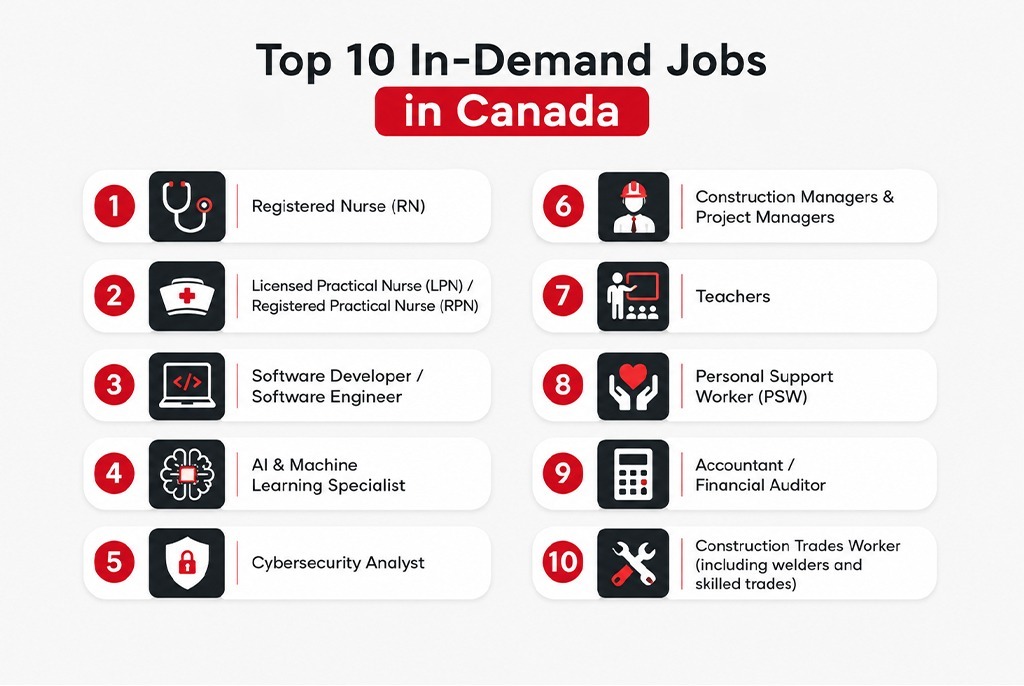
1. Registered Nurse (RN)
Registered nurses face urgent shortages due to Canada’s ageing population and healthcare system strain. RNs are prioritized under Express Entry’s healthcare category, with CRS cut-offs of 462–510 and multiple draws held in 2025.
2. Licensed Practical Nurse (LPN) / Registered Practical Nurse (RPN)
LPNs and RPNs deliver essential frontline care and rank in Randstad’s Top 15 Most In-Demand Jobs for 2026. Healthcare support roles remain critical across hospitals and long-term care facilities.
3. Software Developer / Software Engineer
Software developers and engineers are among the highest-demand tech roles. Robert Half reports 48% of tech hiring managers plan to increase hiring in 2026, with strong demand for developers across industries.
4. AI & Machine Learning Specialist
AI adoption drives urgent need for machine learning engineers and AI specialists. These STEM roles fall under Express Entry’s technology category with CRS cut-offs of 486–491, supporting Canada’s digital competitiveness.
5. Cybersecurity Analyst
Cyber threats and digital security needs create high demand for cybersecurity analysts. These roles are critical for protecting business infrastructure and fall under STEM-focused immigration draws.
6. Construction Managers & Project Managers
Welders, construction trades workers, and skilled trades professionals are essential for infrastructure development. More than 256,000 new journeypersons are needed over the next decade, with trades as a priority Express Entry category.
7. Teachers
Teachers (including elementary, secondary, and specialized educators) are in high demand due to education expansion. Education is a new priority category in Express Entry with CRS cut-offs of 462–479, supporting Canada’s growing school system needs.
8. Personal Support Worker (PSW)
PSWs provide essential care for seniors and those with disabilities, facing urgent shortages. PSWs rank in healthcare support roles with demand above pre-pandemic levels, making them critical for long-term care facilities.
9. Accountant / Financial Auditor
Accountants and financial auditors support business growth and regulatory compliance. These finance professionals are in demand across sectors and eligible under Express Entry and PNP programs.
10. Construction Trades Worker (including welders and skilled trades)
Welders, construction trades workers, and skilled trades professionals are essential for infrastructure development. More than 256,000 new journeypersons are needed over the next decade, with trades as a priority Express Entry category.
Highest Paying Jobs in Canada for Skilled Immigrants
| Occupation | Average Annual Salary (CAD) | Key Requirements for Immigrants |
| Anesthesiologist | $380,000 – $420,000 | Canadian medical license, provincial certification required |
| Surgeons / Specialist Physicians | $250,000 – $500,000+ | Medical degree, licensing, residency in Canada |
| Cardiologist | $340,000 – $400,000 | Canadian license, shortages across provinces |
| Orthodontist | $150,000 – $350,000 (up to $400,000) | Dental license, provincial certification |
| Dentist | $140,000 – $200,000 | Dental license, strong in suburban clinics |
| Corporate Lawyer | $160,000 – $240,000 | Law licensing, bar admission required |
| Finance Manager | $110,000 – $150,000 | CPA/CFA preferred, Toronto finance dominant |
| IT Project Manager | $100,000 – $145,000 | Tech experience, PMP certification valued |
| Software Engineer / Developer | $95,000 – $130,000 | Tech hubs in Toronto/Vancouver, STEM draws |
| Data Scientist / AI Specialist | $90,000 – $180,000 | Senior/lead roles pay higher, STEM category |
| IT Manager / Software Engineering Manager | $115,000 – $220,000+ | Senior tech leadership, CTO roles |
| Civil Engineer | $85,000 – $125,000 | Infrastructure programs expanding, P.Eng |
| Corporate Executive / VP (Senior Management) | $130,000 – $300,000+ | Sector varies, Director/VP level |
| Pharmacist | $90,000 – $160,000 | Pharmacy license, specialized healthcare |
Best Provinces in Canada for Skilled Worker
| Province | Best For |
| Ontario | Skilled Trades, Engineers, Tech Professionals, Healthcare Workers, Finance Professionals |
| Alberta | Skilled Trades, Engineers, Oil & Gas Professionals, Hospitality Workers, IT Professionals |
| Saskatchewan | Skilled Workers, Healthcare Professionals, Agriculture Workers, Tradespeople, IT Workers |
| British Columbia | Tech Professionals, Healthcare Workers, Engineers, Skilled Trades |
| Nova Scotia | Healthcare Workers, Truck Drivers, Skilled Trades, Early Childhood Educators |
| Manitoba | Family Connections, International Students, Skilled Workers, Tradespeople |
| New Brunswick | Skilled Workers, Transport Professionals, Manufacturing Workers, French Speakers |
How to Apply for Skilled Worker Jobs in Canada?
Step 1: Identify In-Demand Occupations
Research occupations that match your education, skills, and work experience.
Step 2: Check Eligibility Requirements
Review the qualifications, certifications, language requirements, and work experience needed for your occupation.
Step 3: Prepare a Canadian-Style Resume
Create a professional resume and cover letter tailored to Canadian employers.
Step 4: Improve Your Language Scores
Take an approved English or French language test (IELTS, CELPIP, or TEF).
Step 5: Get Your Educational Credentials Assessed
Obtain an Educational Credential Assessment (ECA) to verify that your qualifications meet Canadian standards.
Step 6: Search and Apply for Jobs
Apply through:
- Job Bank Canada
- Indeed Canada
- Company Career Pages
- Recruitment Agencies
Step 7: Attend Interviews
Prepare for virtual or in-person interviews with Canadian employers.
Step 8: Secure a Job Offer
Receive a valid job offer from a Canadian employer.
Step 9: Apply for Immigration or Work Permit
Choose the appropriate pathway:
- Express Entry
- Provincial Nominee Program (PNP)
- Employer-Specific Work Permit
Step 10: Move to Canada and Start Your Career
Complete visa formalities, arrive in Canada, and begin your new job.
Skills That Will Be Most Valuable in Canada in 2026
- AI & Automation Skills – Ability to work with AI tools, automation platforms, and emerging technologies.
- Digital Literacy – Proficiency in digital tools, software applications, and online collaboration platforms.
- Communication Skills – Strong verbal and written communication for effective teamwork and client interactions.
- Trade Certifications – Credentials in fields such as electrical work, plumbing, welding, and construction trades.
- Healthcare Specialization – Expertise in nursing, caregiving, therapy, and other healthcare disciplines.
- Cybersecurity Skills – Knowledge of protecting systems, networks, and data from cyber threats.
- Data Analysis Skills – Ability to interpret data, generate insights, and support business decision-making.
- Project Management – Skills in planning, coordinating, and delivering projects across industries.
- Adaptability & Problem-Solving – Capacity to learn new technologies and respond effectively to workplace challenges.
- Leadership & Team Management – Ability to guide teams, manage people, and drive organizational success.
Common Mistakes Skilled Workers Should Avoid
Before starting your Canada immigration or job search journey, it’s important to avoid common mistakes that can delay your success. Here are some key pitfalls skilled workers should watch out for:
- Ignoring language test requirements
- Using a non-Canadian resume format
- Skipping credential assessments (ECA)
- Applying for the wrong jobs
- Submitting incomplete documents
- Overlooking licensing requirements
- Not researching provincial opportunities
- Neglecting professional networking
- Failing to upgrade skills
- Missing immigration deadlines
Conclusion
Canada continues to face labour shortages across healthcare, technology, skilled trades, education, and transportation, making 2026 an excellent time for skilled professionals to explore opportunities. By developing in-demand skills, understanding Canada immigration pathways, and avoiding common application mistakes, you can improve your chances of building a successful future in Canada. For the latest immigration policies, eligibility requirements, and official updates, visit the Government of Canada’s immigration website.
Frequently Asked Questions
Registered Nurses (RNs) are among the most in-demand professionals in Canada, alongside software developers, skilled trades workers, truck drivers, and healthcare support workers.
Ontario offers the highest number of job opportunities due to its strong economy and diverse industries, including technology, healthcare, finance, and manufacturing.
The average salary for skilled workers in Canada generally ranges from CAD 60,000 to CAD 90,000 per year, depending on the occupation, experience level, and location.
Software Developers, Cybersecurity Analysts, AI & Machine Learning Specialists, Data Analysts, Cloud Engineers, and DevOps Engineers are among the most sought-after IT professionals in Canada.
Yes. Engineers continue to be in demand across Canada, particularly in civil, mechanical, electrical, software, and industrial engineering fields.
Registered Nurses, Licensed Practical Nurses, Personal Support Workers, Physiotherapists, Occupational Therapists, and Medical Laboratory Technologists are among the most in-demand healthcare professionals.
Yes. Nurses remain one of Canada’s most in-demand occupations due to ongoing healthcare workforce shortages and the growing healthcare needs of an aging population.
Registered Nurses (RNs) are currently the most in-demand, with particularly strong demand for Critical Care Nurses, Emergency Room Nurses, Mental Health Nurses, and Nurse Practitioners.





 WHATSAPP