

Every year, thousands of nurses pack their bags, leave behind familiar hospitals, and start over in a country that badly needs their skills. Canada is at the top of that list. Behind every successful move is one critical piece of paperwork: the Canada Nurses Work Permit. It’s more than a visa; it’s the gateway to Canadian licensure, a stable career, and eventually, a life built from the ground up in a new country. This guide unpacks the entire process, from the fine print of eligibility to the realities of processing times, so your move to Canada starts on solid ground.
Table of Content
- What is a Canada Nurses Work Permit?
- Who is Eligible for a Canada Nurses Work Permit?
- Types of Nurses Eligible to Work in Canada
- Best Provinces for Nursing Jobs in Canada
- Average Salary for Nurses in Canada
- Step-by-Step Process to Get a Canada Nurse Work Permit
- Documents Required for Canada Nurse Work Permit
- Canada Nursing Licensing Process
- Canada Nurse Work Permit Processing Time
- Can Nurses Bring Their Family to Canada?
- Pathway from Canada Work Permit to Permanent Residency
- Conclusion
- Frequently Asked Questions
What is a Canada Nurses Work Permit?
A Canada Nurses Work Permit is an official document issued by Immigration, Refugees and Citizenship Canada (IRCC) authorizing an internationally educated nurse to work legally in Canada for a set period, and it comes in two main forms: an employer-specific (closed) permit, which ties the nurse to one named employer, role, and location and usually requires a positive Labour Market Impact Assessment (LMIA) or an LMIA exemption; and an open work permit, which is not tied to any single employer and lets the holder work for almost any Canadian employer, typically available to nurses through pathways like a spousal open work permit, a Bridging Open Work Permit, or a Post-Graduation Work Permit. Importantly, a work permit is only a temporary authorization with an expiry date and does not grant permanent status — permanent residency (PR) is a separate process, usually pursued through Express Entry or a Provincial Nominee Program, with nurses often using their work permit period to build Canadian experience that strengthens a future PR application.
Who is Eligible for a Canada Nurses Work Permit?
Eligibility hinges on six core areas, meeting all of them is what makes an application solid.
1. Educational Qualifications
- A recognized nursing degree or diploma (BScN, diploma in nursing, or equivalent) from an accredited institution.
- Credentials must be verified through the National Nursing Assessment Service (NNAS), which evaluates foreign nursing education against Canadian standards.
- An Educational Credential Assessment (ECA) may also be required for Express Entry purposes.
2. Nursing Experience Requirements
- Typically a minimum of 1 year of full-time (or equivalent part-time) nursing work experience within the last 3 years.
- Experience must align with the duties described under NOC 31301 (Registered Nurses/Registered Psychiatric Nurses) or NOC 32101 (Licensed Practical Nurses).
- For Canadian Experience Class eligibility later, at least 1 year of Canadian work experience is needed.
3. Language Requirements (IELTS/CELPIP)
| Test | Regulatory standard (NNAS/provincial colleges) |
| IELTS Academic | 7.0 Speaking & Writing, 6.5 Listening & Reading |
| CELPIP General | Accepted by most provincial colleges; must meet equivalent CLB 7+ |
| CELBAN | Canada-specific nursing test; benchmarks align with NNAS standards |
Note: individual provinces can set the bar higher than the national baseline, always confirm with the relevant provincial nursing college.
4. Job Offer Requirements
- Not mandatory for an Express Entry Canada PR application, but a valid job offer strengthens CRS score and can support an employer-specific work permit.
- If pursuing a Canada Nurses work permit route, the employer typically needs a positive LMIA, unless the position qualifies for an LMIA exemption.
- Job offers must be genuine, full-time, and match the applicant’s nursing qualifications.
5. Medical Examination
- A mandatory Immigration Medical Exam (IME) with an IRCC-approved panel physician is required.
- Completing this upfront matters for nurses in particular, without it, the permit can be issued with a condition excluding public-health occupations.
6. Police Clearance Certificate
- Applicants must submit police clearance certificates from every country they’ve lived in for 6+ months since age 18.
- Required to confirm admissibility to Canada; used in both Canada Nurses work permit and PR applications.
Types of Nurses Eligible to Work in Canada
Registered Nurse (RN) — NOC 31301
- Provides direct nursing care, patient education, and consultative services.
- Most common, highest-demand nursing category in Canada.
- Works in hospitals, clinics, long-term care, community health.
- Can specialize: surgery, pediatrics, oncology, critical care.
Registered Psychiatric Nurse (RPN) — NOC 31301
- Specializes in holistic care for complex mental health, addictions, and physical needs.
- Separately regulated only in BC, Alberta, Saskatchewan, and Manitoba.
- In other provinces, RNs handle psychiatric nursing without a distinct RPN license.
Licensed Practical Nurse (LPN) — NOC 32101
- Provides nursing care under direction of physicians, RNs, or other health professionals.
- Called “Registered Practical Nurse” in Ontario, different from the psychiatric RPN above, easy to confuse.
- Very high demand, especially in long-term care.
Nurse Practitioner (NP) — NOC 31301
- RN with additional graduate-level education and expanded scope.
- Can diagnose, prescribe, and manage care independently or alongside physicians.
- Most advanced nursing role; typically requires the strongest credentials.
Personal Support Worker (PSW) — NOC 33102
- Assists with bathing, dressing, mobility, feeding, vital signs.
- Works alongside regulated nurses, not independently.
- Not a regulated profession, no NNAS assessment or provincial license needed.
- Common entry point for internationally trained caregivers not yet licensed as nurses.
Nursing Coordinators and Supervisors — NOC 31300
- Experienced RNs, RPNs, or LPNs who supervise staff and coordinate patient care.
- Distinct NOC code, appears in some province-specific healthcare draws.
- Relevant for senior nurses targeting leadership-track PR pathways.
Best Provinces for Nursing Jobs in Canada
Ontario
Ontario has the highest overall demand for nursing jobs in canada in Canada, the province needs tens of thousands more registered nurses. It offers “as-of-right” supervised practice registration for internationally educated nurses, letting them work while completing licensing requirements. The Ontario Immigrant Nominee Program (OINP) has dedicated healthcare streams. Downside: higher cost of living, especially in and around Toronto.
British Columbia
BC faces severe shortages from major urban hospitals to rural and Northern communities, with health authorities like Fraser Health and Vancouver Coastal Health actively recruiting internationally. The BC PNP’s Healthcare Professional category prioritizes nursing occupations. A strong pick for nurses who also want scenic, lifestyle-driven locations.
Alberta
Alberta combines high demand with strong salaries and a dedicated Health Care Pathway under its PNP, nominating nurses across a range of CRS scores. Cost of living is generally lower than Ontario or BC, making it attractive for take-home value.
Saskatchewan
Saskatchewan offers a lower cost of living alongside competitive nursing pay and a PNP Health Talent Pathway with continuous, year-round intake, useful for nurses who want a steadier, less competitive application window.
Manitoba
Manitoba pairs affordable living with its own PNP healthcare stream targeted at addressing local shortages. Winnipeg Regional Health Authority is a major employer for internationally trained nurses.
Nova Scotia
Nova Scotia actively recruits nurses through its PNP, welcoming both recent graduates needing Canadian experience and seasoned healthcare workers.
New Brunswick
As a bilingual province, New Brunswick has strong demand for RNs, LPNs, and PSWs, with job opportunities in both English and French. Some French proficiency is a practical advantage for settling here long-term.
Average Salary for Nurses in Canada
Nurses in Canada earn an average of roughly $75,000 to $95,000 per year overall, though this varies widely depending on the specific role, province, and experience level, here’s the breakdown by job title.
| Role | Hourly Rate (avg) | Annual Salary (approx.) |
| Registered Nurse (RN) | $37–$45+ | $75,000 – $125,000 |
| Nurse Practitioner (NP) | $50+ | $100,000 – $130,000+ |
| Licensed Practical Nurse (LPN) | $28–$35 | $50,000 – $78,000 |
| Registered Practical Nurse (RPN, Ontario term) | $28–$45 | $60,000 – $75,000 |
| Personal Support Worker (PSW) | $18–$28 | $40,000 – $58,000 |
Registered Nurse (RN)
RNs average roughly $37–$45+ per hour, with total annual earnings landing between $75,000 and $125,000 once overtime and shift premiums are included. Unionized wage grids mean pay climbs steadily with experience, often peaking around 12–15 years in.
Nurse Practitioner (NP)
As the most advanced nursing role, NPs earn the highest in the profession, typically $100,000 to $125,000+ annually, with some provinces pushing past $130,000.
Licensed Practical Nurse (LPN)
LPNs earn a national median of roughly $30/hour, with annual pay ranging from about $50,000 for new grads to $78,000+ for senior or specialized LPNs.
Registered Practical Nurse (RPN)
Ontario’s equivalent to the LPN designation, RPNs earn between $36–$45/hour in many regions, translating to roughly $60,000–$75,000 a year depending on sector and specialization.
Personal Support Worker (PSW)
As an unregulated role, PSW pay is more modest, generally $18–$28/hour, or about $40,000–$58,000 annually, with higher rates for specialized care (like dementia support) or overtime-heavy shifts.
Step-by-Step Process to Get a Canada Nurse Work Permit
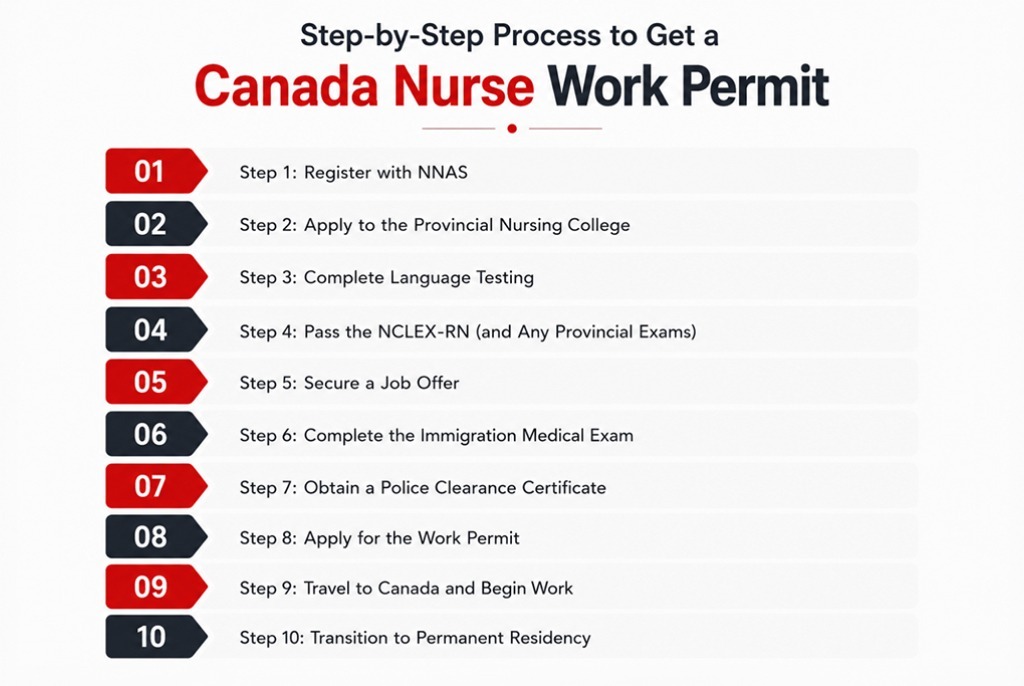
Getting a Canada Nurses work permit means running two tracks at once, immigration paperwork and nursing licensure, since neither one substitutes for the other.
Step 1: Register with NNAS
Start your National Nursing Assessment Service (NNAS) application immediately, it’s the mandatory first step for internationally educated nurses outside Quebec and typically the slowest part of the process. NNAS verifies your education and issues an Advisory Report to your target provincial regulator.
Step 2: Apply to the Provincial Nursing College
Once you have your NNAS Advisory Report, apply to the nursing college in your target province (e.g., College of Nurses of Ontario, BC College of Nurses and Midwives, College of Registered Nurses of Alberta). Each province has its own timelines and specific document requirements.
Step 3: Complete Language Testing
Take IELTS Academic, CELPIP, or CELBAN and meet the required scores for both provincial licensing and, if pursuing PR, Express Entry’s Canadian Language Benchmark thresholds.
Step 4: Pass the NCLEX-RN (and Any Provincial Exams)
Write the NCLEX-RN licensing exam, plus any jurisprudence or competency exams your target province requires. Some provinces may also require a bridging or supervised practice period if there are gaps between your foreign training and Canadian standards.
Step 5: Secure a Job Offer
Look for a genuine job offer from a Canadian employer. If going the work-permit route, the employer generally needs a positive Labour Market Impact Assessment (LMIA) proving no Canadian citizen or permanent resident is available, unless the role qualifies for an LMIA exemption.
Step 6: Complete the Immigration Medical Exam
Book your Immigration Medical Exam (IME) with an IRCC-approved panel physician early — doing this upfront avoids the permit being issued with a condition excluding public-health occupations.
Step 7: Obtain a Police Clearance Certificate
Get police clearance certificates from every country you’ve lived in for 6+ months since age 18, to confirm admissibility.
Step 8: Apply for the Work Permit
Submit your Canada Nurses work permit application online through IRCC, using the personalized document checklist tool, which factors in your job offer, LMIA/exemption status, and whether you’re applying from inside or outside Canada.
Step 9: Travel to Canada and Begin Work
Once approved, travel to Canada on your work permit. Depending on your province, some nurses can begin supervised practice while completing final licensing steps (Ontario’s “as-of-right” registration is a notable example).
Step 10 : Transition to Permanent Residency
Many nurses use their work permit period to build Canadian experience, then apply for PR through Express Entry (often via healthcare-targeted category draws) or a Provincial Nominee Program healthcare stream.
Documents Required for Canada Nurse Work Permit
Here’s the full checklist of documents required for canada nurse work permit:
- Valid passport (with sufficient validity beyond intended stay).
- NNAS Advisory Report.
- Provincial nursing license/registration confirmation (or proof of application).
- Nursing degree/diploma and academic transcripts.
- Proof of nursing work experience (reference letters, employment records).
- Language test results (IELTS, CELPIP, or CELBAN).
- Valid job offer letter from a Canadian employer.
- LMIA number or LMIA exemption confirmation (if applicable).
- Immigration Medical Exam (IME) confirmation from an IRCC-approved panel physician.
- Police clearance certificates from all countries lived in for 6+ months since age 18.
- Proof of funds (to show ability to support yourself, especially if family is accompanying).
- Digital photo meeting IRCC specifications.
- Completed work permit application form (IMM 1295 or relevant form based on application type).
- Application fees (work permit processing fee + any applicable open work permit holder fee).
- Custodianship declaration (if applicable, for accompanying minor children).
- Family information form (if bringing dependents).
Canada Nursing Licensing Process
Licensing runs separately from your immigration paperwork, here’s the core of it.
What Is NNAS?
The National Nursing Assessment Service evaluates your foreign nursing credentials against Canadian standards and issues an Advisory Report for your target province. Start this early — it’s usually the slowest step.
Provincial Nursing Regulatory Bodies
Nursing is regulated provincially, not federally. You apply directly to the college where you plan to work — e.g., College of Nurses of Ontario (CNO), BC College of Nurses and Midwives (BCCNM), College of Registered Nurses of Alberta (CRNA).
NCLEX-RN Requirements
Canada uses the NCLEX-RN as its official licensing exam. Most provinces also require a jurisprudence exam, and possibly a competency assessment or supervised practice if there are gaps in your training.
Credential Recognition
Your NNAS Advisory Report is used by the provincial college to assess your credentials. An Educational Credential Assessment (ECA) may also be needed separately for Express Entry. Any gaps found can mean extra coursework or supervised practice before full licensure.
Canada Nurse Work Permit Processing Time
As of 2026, Canada Nurses work permit processing times generally range from about 5 to 19 weeks, depending on whether the application is LMIA-based, filed from inside or outside Canada, and the applicant’s country of residence. LMIA-based (closed) work permits typically take 7 to 19 weeks since IRCC must first confirm the employer’s positive Labour Market Impact Assessment, which adds extra processing time. Open work permits tend to move faster, often in the 4–12 week range, while in-Canada work permit applications and extensions were sitting at 186 days as of June 10, 2026, though that later dropped to a 2026 low of 144 days by late June. It’s worth noting these are averages, not guarantees, incomplete documents, biometrics delays, or enhanced background checks for certain countries can push timelines longer, so always check IRCC’s live processing times before setting client expectations.
Can Nurses Bring Their Family to Canada?
Yes, nurses can bring family members to Canada, but eligibility varies depending on who it is and the nurse’s immigration status at the time.
Spouse or Common-Law Partner
- Nursing roles (RN, LPN, NP) fall under TEER 1, one of the job categories that still qualifies a partner for a Spousal Open Work Permit (SOWP).
- The nurse’s own work permit must have at least 16 months of validity remaining when the spouse applies.
- Proof of a genuine relationship is required, a marriage certificate or evidence of common-law status.
- Once approved, the spouse gets an open work permit and can work for almost any Canadian employer.
Dependent Children
- Since January 2025, dependent children no longer qualify for their own open work permit under the family-of-worker measure.
- They can still accompany the nurse on a visitor record.
- School-age children can apply for a study permit to attend Canadian schools.
Parents (While on a Work Permit)
- A nurse on a temporary work permit cannot sponsor or host parents through the Super Visa or Parents and Grandparents Program (PGP) both require the host to be a Canadian citizen or permanent resident.
- Parents can still visit as regular visitors on a standard Temporary Resident Visa (TRV) or eTA, subject to normal visitor rules.
Parents (Once the Nurse Becomes a PR)
- Super Visa: allows parents/grandparents to stay up to 5 years per entry (visa valid up to 10 years), with an invitation letter, proof of financial support, and Canadian medical insurance required. Income requirement rules were eased starting March 31, 2026, giving sponsors more flexible ways to qualify.
- PGP: a full permanent residence pathway for parents/grandparents, though intake is currently paused in 2026, so sponsors are advised to prepare documents in advance for when it reopens.
Pathway from Canada Work Permit to Permanent Residency
Once you’ve worked in Canada for a while, there are a few main routes to turn your Canada Nurses work permit into permanent residency.
Express Entry
A points-based system where nurses often qualify through special healthcare draws, which usually ask for lower scores than the general pool.
Provincial Nominee Program (PNP)
Provinces can directly nominate nurses for PR through their own healthcare-specific streams, giving a big boost to your application.
Canadian Experience Class (CEC)
If you’ve already worked in Canada for about a year on your work permit, this pathway lets you apply for PR using that Canadian work experience.
Rural and Community Immigration Pathways
A newer route where smaller Canadian communities offer PR to workers, including nurses, who take a job offer outside major cities like Toronto or Vancouver.
Conclusion
A Canada Nurses Work Permit is your entry point into one of the country’s most in demand jobs in Canada, but success depends on running your immigration paperwork and provincial licensing (NNAS, NCLEX-RN) side by side. With dedicated Express Entry healthcare draws, provincial nomination streams, and rural pathways, nurses have a genuinely strong route to permanent residency. For the latest official requirements, always check IRCC’s official website.
Frequently Asked Questions
It’s an official document issued by IRCC that authorizes an internationally educated nurse to work legally in Canada for a set period, through either an employer-specific (closed) permit or an open work permit.
Usually yes, if applying through an employer-specific work permit, the employer needs a positive Labour Market Impact Assessment (LMIA), unless the position qualifies for an LMIA exemption.
For an employer-specific work permit, yes, a genuine job offer is required. For an open work permit (spousal, PGWP, or bridging), no job offer is needed.
As of 2026, processing generally ranges from about 5 to 19 weeks depending on the permit type and application location, though LMIA-based permits can take longer since employer approval must happen first.
Yes, spouses in TEER 1 nursing roles can qualify for a Spousal Open Work Permit, and dependent children can accompany on a visitor record or study permit, though children no longer get their own open work permit as of 2025.
Yes, through Express Entry (including healthcare category draws), Provincial Nominee Programs, the Canadian Experience Class, or Rural and Community Immigration Pathways.
Ontario, British Columbia, Alberta, Saskatchewan, Manitoba, Nova Scotia, and New Brunswick all report strong nursing demand.
Not always before applying, but you’ll need to register with NNAS and get licensed with your target province’s nursing college before you can legally practice.
Generally at least 1 year of full-time (or equivalent) nursing experience within the last 3 years, though specific employer and PR pathway requirements can vary.





 WHATSAPP