


Thinking about taking your engineering career and your life to Australia? You’re in good company. Australia PR for engineers and Australia work visa for engineers are now among the most popular routes for skilled professionals, thanks to strong demand, competitive salaries and well‑defined visa pathways. In this blog, we’ll break down visa options, the points system, skills assessment, salary trends and common pitfalls in a simple, step‑by‑step way, so you can plan confidently instead of feeling overwhelmed. Whether you’re a civil, electrical, mechanical or software engineer, consider this your friendly, interactive guide to turning the idea of Australia into a realistic migration plan.
Table of Content
- Why Engineers Are in High Demand in Australia?
- Top Engineering Fields in Demand
- Best Australia Work Visa Options for Engineers
- Skills Assessment for Engineers in Australia
- Points System for Engineers Moving to Australia
- Ways Engineers Can Increase Points
- Top Engineering Jobs in Australia with Salary
- How to Apply for an Australia Work Visa as an Engineer
- Common Mistakes Engineers Should Avoid
- Why Choose Professional Migration Assistance?
- Conclusion
- Frequently Asked Questions
Why Engineers Are in High Demand in Australia?
Engineers are in high demand in Australia because the country is investing heavily in infrastructure, renewable energy, mining, and technology, sectors that rely on engineering skills. Chronic skills shortages in regional areas and an ageing workforce increase demand for qualified overseas engineers. Australia’s focus on large-scale projects (transport, water, power, and digital networks) and a competitive tech/startup scene further drive employers to recruit internationally, making engineers among the most sought-after skilled migrants.
Top Engineering Fields in Demand
The top engineering fields in demand in Australia right now include:
- Civil engineering (infrastructure, transport, water, urban development).
- Electrical engineering (power systems, renewables, grid modernisation, telecommunications.
- Mechanical engineering (mining, manufacturing, defence, advanced/automated production).
- Software engineering (digital transformation, AI, cybersecurity, cloud and enterprise systems).
- Environmental engineering (sustainability, waste management, water quality, climate resilience projects).
- Mining and petroleum engineering (resources sector, battery minerals, oil and gas projects).
- Telecommunications and data engineering (5G rollout, network expansion, big data infrastructure).
Best Australia Work Visa Options for Engineers
Skilled Independent Visa (Subclass 189)
- Subclass 189 visa for engineers is a Permanent residence visa for points-tested skilled workers with no need for employer or state sponsorship.
- Key requirements: occupation on the MLTSSL, positive skills assessment (e.g., Engineers Australia), age under 45 at invitation, minimum 65 points, competent English, and an invited EOI in SkillSelect.
- Best for engineers who want full freedom to live and work anywhere in Australia and can be competitive on points without relying on a job offer.
Skilled Nominated Visa (Subclass 190)
- Subclass 190 visa for engineers is a Permanent residence visa for skilled workers nominated by an Australian state or territory government.
- Requirements: occupation on the state’s list, positive skills assessment, state nomination, under 45, competent/proficient English, minimum 65 points including 5 points from nomination, plus health and character checks.
- Ideal for engineers whose occupation is in demand in a specific state and who are willing to live and work in that state for a set period after grant.
Skilled Work Regional Visa (Subclass 491)
- Subclass 491 visa for engineers is a Provisional (temporary) points-tested visa for skilled workers sponsored by a state/territory or eligible relative in a designated regional area.
- Typical requirements: occupation on the regional/state list, positive skills assessment, age under 45, minimum 65 points, English test, and nomination or sponsorship plus health and character checks.
- Suits engineers ready to live and work in regional Australia with a pathway to permanent residence via a later regional PR visa after meeting stay, work, and income conditions.
Employer Sponsored Visa (Subclass 482 – Skills in Demand / TSS)
- Temporary employer-sponsored work visa that lets Australian employers sponsor overseas engineers when they can’t find suitably skilled local workers.
- Core conditions: approved sponsoring employer, genuine job offer in an eligible occupation, skills and experience matching the role, English proficiency, and standard health/character checks.
- Good option for engineers who have a confirmed job offer and want to enter Australia quickly, with potential routes to PR later through employer nomination or regional pathways.
Employer Nomination Scheme (Subclass 186)
- Permanent residence visa for skilled workers nominated by an Australian employer (including a Direct Entry stream for overseas engineers).
- Requirements typically include: eligible occupation, genuine full-time job offer, relevant qualifications and work experience, age under 45 (with some exemptions), English test, and health/character clearances.
- Ideal for engineers already working for an Australian employer (or recruited from overseas) who want direct PR based on a long-term, permanent role rather than points alone.
Skills Assessment for Engineers in Australia
For engineers, skills assessment is a mandatory step before applying for most skilled visas to Australia, because the government needs formal proof that your qualifications and experience meet Australian standards. Engineers Australia is the main assessing authority for professional engineers and engineering technologists; they check your degree, transcripts, and work experience through pathways such as accredited qualifications (Washington/Sydney Accord) or a detailed Competency Demonstration Report (CDR) for non‑accredited degrees. A positive skills assessment outcome letter is then used in your Expression of Interest and visa application (189, 190, 491, 482, 186), and without it you generally cannot claim points or be granted a skilled migration visa as an engineer.
Points System for Engineers Moving to Australia
Engineers move to Australia through a points-tested system where you must usually score at least 65 points, and competitive engineers often sit closer to 80+ points overall. You earn points for age, English, qualifications, skilled work experience, partner skills, and sometimes state nomination or regional sponsorship.
| Factor | Example for Engineers | Typical Points Range |
| Age | 25–32 years gives highest points for most engineers. | Up to 30 |
| English language | IELTS 7/PTE 65 (Proficient) or IELTS 8/PTE 79+ (Superior) | 0–20 |
| Overseas engineering experience | 3–8+ years in your ANZSCO engineering occupation | 0–15 |
| Australian engineering experience | 1–8+ years in Australia in your field | 0–20 |
| Qualifications | Bachelor/Master/PhD in engineering or related field | 10–20 |
| Australian study / Professional Year | Extra points for Australian study or EA Professional Year | 5–10 |
| Partner skills | Skilled engineer or qualified partner with good English | 0–10 |
| State / regional nomination | 190 or 491 nomination adds bonus points | 5–15 |
Ways Engineers Can Increase Points
Engineers can boost their Australia PR points by focusing on a few high-impact areas that are mostly under their control. Here are some important ones you can use:
- Aim for Superior English (IELTS 8/PTE 79+) to gain the maximum language points.
- Add NAATI CCL for your language to gain an extra 5 points quickly.
- Gain more years of relevant engineering work experience to move into higher experience brackets.
- Consider Australian study (especially in a regional area) to unlock extra study and regional points.
- Use state nomination (190) or regional nomination (491) for 5–15 bonus points.
- Strengthen partner points by ensuring your spouse has competent English and, where possible, a positive skills assessment in an eligible occupation.
Top Engineering Jobs in Australia with Salary
- Petroleum Engineer – around AUD 170,000–200,000 per year, with senior roles and FIFO packages often exceeding AUD 200,000–250,000.
- Mining Engineer – typically AUD 150,000–180,000, higher in Western Australia and Queensland due to resources demand and site allowances.
- Engineering Manager – often above AUD 160,000 per year in mining, construction, energy and large infrastructure projects.
- Senior Software Engineer – about AUD 120,000–160,000, with top tech roles in Sydney/Melbourne reaching ~AUD 200,000+ including bonuses or stock.
- Electrical Engineer (specialist in power/renewables) – roughly AUD 110,000–145,000, with higher pay in major infrastructure and energy projects.
- Senior Civil Engineer – usually AUD 95,000–140,000+, driven by transport, bridges, and urban development work.
- Mechanical Engineer – about AUD 90,000–130,000, rising for specialists in robotics, mining equipment and renewables.
How to Apply for an Australia Work Visa as an Engineer
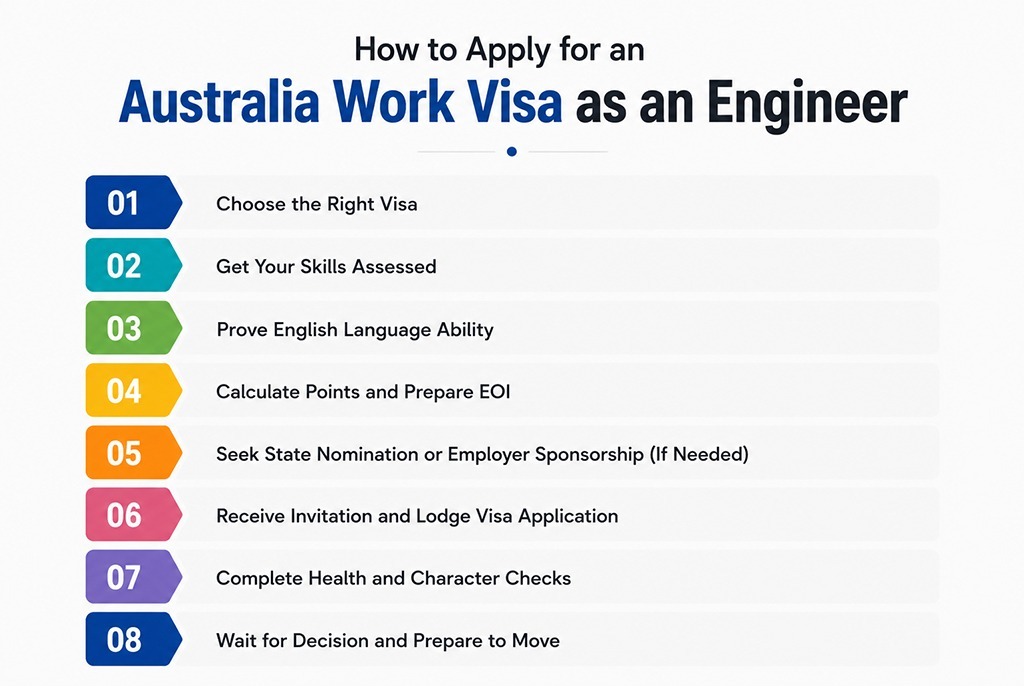
Step 1: Choose the Right Visa
- Decide whether you will apply for a points‑tested visa (189, 190, 491) or an employer‑sponsored visa (482, 186), based on your profile and job offers.
- Check basic eligibility: age (usually under 45), occupation on the skilled list, English level, health and character requirements.
Step 2: Get Your Skills Assessed
- Apply for a migration skills assessment with Engineers Australia (or the relevant authority for your occupation).
- Prepare documents like degree certificates, transcripts, CV, employment references and, if needed, a Competency Demonstration Report (CDR).
Step 3: Prove English Language Ability
- Sit an accepted English test (IELTS, PTE, TOEFL etc.) and meet at least the “competent” level; aim higher to increase points.
- Keep your test report valid and ready to upload with your Expression of Interest and visa application.
Step 4: Calculate Points and Prepare EOI
- Use the points table to estimate your score for age, English, qualifications, work experience, partner skills and nomination.immi.homeaffairs+2.
- Create and submit an Expression of Interest (EOI) in SkillSelect, selecting the visa subclasses you want (189/190/491) and entering accurate details.linkedin+3.
Step 5: Seek State Nomination or Employer Sponsorship (If Needed)
- For 190 or 491 visas, apply to a state/territory for nomination based on their occupation list and criteria.
- For 482 or 186 visas, secure a job offer and ensure your employer lodges the nomination application before or alongside your visa application.
Step 6: Receive Invitation and Lodge Visa Application
- Wait for an Invitation to Apply (ITA) if you are in the points‑tested pool; invited candidates usually have competitive scores.
- Once invited, lodge your online visa application within the specified time (often 60 days), attaching all required documents and paying the visa fee.
Step 7: Complete Health and Character Checks
- Arrange medical examinations with panel physicians and obtain police clearance certificates for all relevant countries.
- Upload results and certificates through ImmiAccount as requested by the Department of Home Affairs.
Step 8: Wait for Decision and Prepare to Move
- Monitor your ImmiAccount for updates, respond to any requests for more information, and wait for the final visa decision.
- Once approved, note your visa grant number, conditions and start date, then plan your move and job search or start with your sponsoring employer.
Common Mistakes Engineers Should Avoid
Here are some key mistakes engineers should avoid when applying for an Australia PR:
- Submitting a weak or plagiarised CDR to Engineers Australia, or using generic career episodes that don’t clearly show engineering-level responsibilities.
- Choosing the wrong ANZSCO code or engineering occupation, so your duties don’t match the code and the skills assessment or visa is refused.
- Overclaiming points for work experience or qualifications (e.g., counting non‑skilled roles, internships, or degrees that are not closely related), which leads to refusal when DHA recalculates your points.
- Using incomplete or poor-quality documents, such as reference letters without detailed duties, missing dates, no salary proof, or inconsistent employment timelines across CV, EOI and LinkedIn.
- Relying on expired or inadequate English test scores and not checking that results meet both skills‑assessment and visa requirements.
- Lodging an EOI with optimistic points instead of verified points, or not updating it after a new skills assessment or English test result.
Why Choose Professional Migration Assistance?
Professional migration assistance from the Best Australia immigration consultants helps engineers avoid costly mistakes, save time, and maximise their chances of visa approval. Experienced consultants understand complex rules for skills assessment, ANZSCO codes, points calculation, and changing state nomination criteria, so they can design the right pathway (189, 190, 491, 482, 186) for your profile. They also review your documents, CDR, work experience and English scores, ensuring everything is accurate and consistent before you lodge your application. For busy engineers, working with trusted, licensed experts means less stress, fewer refusals, and a smoother journey from first eligibility check to visa grant.
Conclusion
Australia work visa for engineers remains one of the most structured and rewarding pathways for skilled professionals seeking global careers, high salaries and long‑term stability. By carefully selecting the right visa stream, securing a robust skills assessment, optimising your points score, and avoiding the common pitfalls that lead to refusals, engineers can transform their Australian dream into a clear, achievable migration strategy.
Working with the Best Australia immigration consultants adds an extra layer of confidence, as experienced professionals can align your profile with the most suitable visa option, guide you through documentation and CDR preparation, and keep you updated on policy changes. For the latest requirements and official updates, engineers should always cross‑check information with the Department of Home Affairs skilled visa pages.
Frequently Asked Questions
The “best” option depends on your profile, but for many independent, high‑points engineers the Skilled Independent Visa (Subclass 189) is preferred because it gives direct PR without needing a job offer or state/territory sponsor.
Yes. Engineers can migrate through points‑tested visas like Subclass 189, 190 or 491, which do not require an employer sponsorship but do need enough points and a positive skills assessment.
Yes. Engineering is consistently listed as a high‑demand profession across infrastructure, energy, mining, construction and technology, and many engineering occupations appear on Australia’s skilled occupation lists.
Generally, engineers need at least IELTS 6.0 in each band to meet “Competent English” for skills assessment and skilled migration; higher scores (7.0 or 8.0) are recommended to gain extra points.
Yes. Most skilled visas require a positive skills assessment, and for engineers this is usually done through Engineers Australia or another approved assessing authority for your specific occupation.
In most skilled migration pathways, engineers must be under 45 years of age at the time of invitation; above this age, options become very limited.
The minimum is 65 points, but engineers are more competitive when they reach 75–85+ points, especially in popular states or crowded invitation rounds.
Civil, electrical, mechanical, mining, petroleum, software, and environmental engineering are among the most in‑demand fields, particularly in infrastructure, resources and renewable energy projects.
States like New South Wales, Victoria, Queensland and Western Australia tend to offer strong opportunities due to large infrastructure and resources projects, while regional areas also provide good prospects with added migration benefits.
State nomination is not mandatory for all engineers, but it is often very helpful; it is required for Subclass 190 and 491 visas and can add valuable points and clearer invitation prospects.





 WHATSAPP