

The Germany Opportunity Card has become one of the most talked-about pathways for skilled professionals looking to build a career in Europe. Unlike traditional work visas that require a job offer before you even set foot in the country, this permit flips the process, letting qualified candidates move to Germany first and search for the right role once they’re there. With the country facing a persistent shortage of skilled workers across sectors like IT, engineering, healthcare, and skilled trades, the Opportunity Card has opened a practical door for international talent to step in and build a future. This blog breaks down everything you need to know: who’s eligible, how the points system works, where the best opportunities lie, and how to make the most of your job search once you land.
Table of Content
- What Is the Germany Opportunity Card?
- Who Can Apply for the Germany Opportunity Card?
- Germany Opportunity Card Points System
- Career Opportunities After Getting the Germany Opportunity Card
- Top In-Demand Careers in Germany for Opportunity Card Holders
- Best German Cities for Career Opportunities
- How to Find a Job in Germany with the Opportunity Card
- Germany Opportunity Card Application Process
- Conclusion
- Frequently Asked Questions
What Is the Germany Opportunity Card?
The Germany Opportunity Card, known as the Chancenkarte, is a 1-year visa that lets skilled professionals from outside the EU move to Germany to search for a job, without needing a job offer in hand first. It was introduced on June 1, 2024, under Section 20a of the German Residence Act, and is designed for non-EU nationals who want to search for qualified employment in Germany without lining up a position beforehand. The permit is valid for one year and can be extended, and holders can work up to 20 hours a week while job hunting. Applicants can qualify either through a fully recognised degree or vocational qualification, or by scoring at least 6 points based on factors such as qualifications, work experience, language skills, age, and ties to Germany for those whose credentials aren’t yet fully recognised. Applicants also need to show financial self-sufficiency.
Who Can Apply for the Germany Opportunity Card?
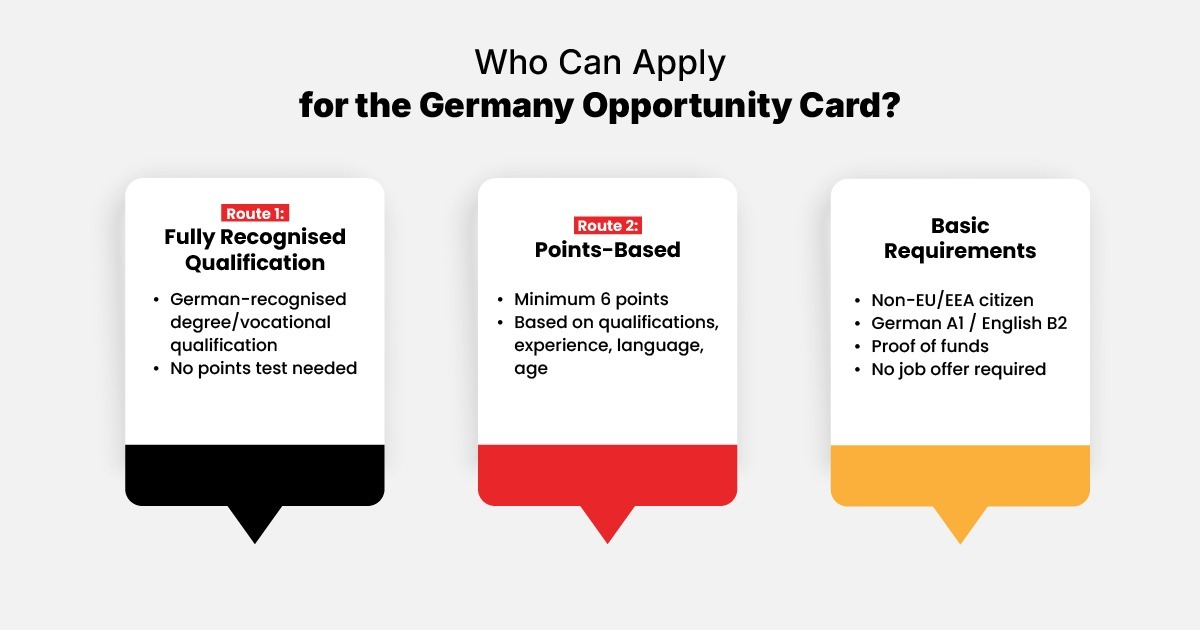
The Germany Opportunity Card is aimed at skilled non-EU/EEA professionals who want to move to Germany without a prior job offer. Applicants can qualify through one of two routes.
Route 1: Recognised Qualification
- Holds a German-recognised vocational qualification or academic degree.
- Qualification must be assessed and confirmed as comparable to a German equivalent through the recognition process.
- No points test required if recognition is already in place.
Route 2: Points-Based Eligibility
- For applicants whose qualification isn’t yet fully recognised in Germany.
- Eligibility is assessed through the points system, with a minimum of 6 points required.
- Points are earned across qualifications, work experience, language skills, age, and prior stays in Germany.
Both routes also require basic eligibility conditions to be met, including language proficiency and financial self-sufficiency.
| Criteria | Requirement |
| Nationality | Non-EU/EEA citizen |
| Language | German (A1) or English (B2) |
| Financial proof | Sufficient funds to support the stay |
| Age | No fixed cap, but younger applicants score higher on the points system |
| Job offer | Not required at the time of application |
Germany Opportunity Card Points System
Applicants who don’t yet have a fully recognised qualification can still qualify by scoring at least 6 points across the following factors.
| Factor | Points |
| Qualifications | Up to 4 points |
| Recent professional experience | 2–3 points |
| Language skills (German or English) | 1–3 points |
| Age (under 35) | 2 points |
| Age (35–40) | 1 point |
| Previous stays in Germany (6+ months in last 5 years) | 1 point |
| Shortage occupation (Engpassberuf) | 1 point |
Career Opportunities After Getting the Germany Opportunity Card
The Germany Opportunity Card isn’t a work permit, it’s a gateway that gives candidates time and legal standing in Germany to find one. Here’s what that access actually opens up:
Full-time employment opportunities
- Once a candidate finds an employer willing to hire them, they can move into a full-time role.
- This is usually the end goal of the job search year, and once secured, it becomes the basis for switching to a longer-term permit.
- Employers in Germany are often more willing to commit to full-time hires after seeing a candidate work locally first.
Part-time work while searching for employment
- Holders can work up to 20 hours a week in any sector while they continue their job search.
- This helps cover living costs during the search period and shows initiative to future employers.
- Part-time roles can sometimes turn into full-time offers if the fit works out.
Trial employment
- Candidates can take up short trial jobs with prospective employers before either side commits.
- This gives employers a low-risk way to assess a candidate’s skills and fit within the workplace.
- It also helps candidates confirm whether a role or company is the right match for them.
Skilled employment based on qualifications
- The Opportunity Card aka Germany Job Seeker Visa is designed to lead toward roles that match the candidate’s actual qualification or professional background, not just any available job.
- This keeps the visa aligned with Germany’s broader goal of filling skilled labour shortages.
- Candidates are expected to use the year to pursue positions relevant to their training and experience.
Opportunities to transition to another residence permit
- Once a candidate secures a job offer that fits their qualifications, the Opportunity Card can be converted into a Skilled Worker Residence Permit or an EU Blue Card.
- This conversion is what turns the job search visa into a long-term stay in Germany.
- From there, holders are on a path that can eventually lead to permanent residency.
Top In-Demand Careers in Germany for Opportunity Card Holders
Germany’s Federal Employment Agency publishes an official shortage occupation list (Engpassberufe) each year, and these fields offer the strongest chances for Germany Opportunity Card for skilled workers to convert their job search into a full-time offer.
IT & Technology
- Full-stack developers.
- Cybersecurity specialists.
- Data scientists and AI/ML engineers.
- Cloud architects and DevOps engineers.
Engineering
- Electrical engineers.
- Mechanical and automotive engineers.
- Civil engineers.
- Industrial and production engineers.
Healthcare
- Nurses.
- Doctors and specialist physicians.
- Care workers and geriatric nursing staff.
Skilled Trades
- Industrial mechanics.
- Electricians.
- Plumbers and HVAC technicians.
Other Growing Sectors
- Renewable energy technicians.
- Teachers (in select subject areas).
- Logistics and supply chain professionals.
Roles that appear on the official shortage list also come with added benefits, such as a lower salary threshold for the EU Blue Card and faster visa processing once a job offer is secured.
Best German Cities for Career Opportunities
Where a candidate settles can shape how quickly the job search pays off. Each city tends to lead in different industries.
Berlin
- Largest English-speaking job market, strong for tech and startups.
- Key industries: IT, chemical and pharmaceutical, electrical and mechanical engineering, rail technology.
Munich
- Highest average salaries, home to BMW and other major players.
- Key industries: STEM, automotive, engineering, trades and construction.
Frankfurt
- Germany’s finance hub, most English-friendly job market alongside Berlin.
- Key industries: Banking, finance, logistics and mobility.
Hamburg
- Germany’s second-largest city and a major port and trading centre.
- Key industries: Civil aviation, wind energy, port logistics, media.
Stuttgart
- Known as Germany’s automotive capital.
- Key industries: Automotive, mechanical engineering, IT, manufacturing (home to Mercedes-Benz, Porsche, Bosch).
Emerging Options: Leipzig, Dresden, Würzburg
- More affordable living costs than the major hubs.
- Growing sectors include data centers, digital media, AI research, and life sciences.
How to Find a Job in Germany with the Opportunity Card
Step 1: Start your job search before arriving
- Begin browsing job portals and building your profile while still in your home country.
- Some Germany Opportunity Card holders secure interviews or even offers before they land in Germany, which speeds up the process significantly.
Step 2: Set up on official job portals
- Register on government-backed platforms like BA Jobsuche and Make it in Germany, which list verified openings across all sectors.
- These help you understand how German job listings and requirements are structured before you branch out further.
Step 3: Expand to other job platforms
- Once familiar with the format, move on to platforms like LinkedIn, StepStone, Indeed, and XING.
- Pick a couple that suit your field and use them consistently rather than spreading applications too thin.
Step 4: Tailor applications to each role
- Customise your CV and cover letter for every position rather than sending a generic application.
- Applications matched closely to the job description tend to get better response rates.
Step 5: Register your residence on arrival
- Once in Germany, register your address at the local Bürgeramt.
- This step is required before you can access most administrative and job-related services.
Step 6: Network and attend job fairs
- Attend industry job fairs and networking events to connect directly with potential employers.
- Local integration offices and city job centres in cities like Berlin, Hamburg, and Munich also share openings suited to Opportunity Card holders.
Step 7: Take on part-time work or trial employment
- Work part-time (up to 20 hours a week) while your search continues.
- Use trial employment periods with prospective employers to demonstrate your skills in person.
Step 8: Secure a job offer that matches your qualifications
- Aim for a role aligned with your training or professional background.
- A matching offer strengthens your case when applying for a long-term residence permit.
Germany Opportunity Card Application Process
Step 1: Check your eligibility
- Confirm whether you qualify through a recognised qualification or the points system.
- Calculate your score across qualifications, experience, language, age, and shortage occupation to make sure you meet the minimum 6 points, if applicable.
Step 2: Prepare your documents
- Gather your valid passport, academic and vocational certificates, language test results, CV, and work experience proof.
- If applying through the points system, include your points assessment report.
Step 3: Arrange financial proof
- Open a blocked account (Sperrkonto) or provide equivalent proof of funds.
- The account must cover the required monthly amount for the full 12 months, currently around €1,091 per month.
Step 4: Arrange health insurance
- Take out valid health insurance coverage for the duration of your stay in Germany.
- This is a mandatory document for the application.
Step 5: Apply online
- Create an account and complete the application form through the relevant portal (such as the Consular Services Portal or VIDEX, depending on your country).
- Enter personal details, travel plans, and upload all required documents in the accepted format.
Step 6: Book and attend your appointment
- Book a slot with the German embassy, consulate, or an authorised service provider such as VFS Global.
- Attend in person to submit biometric data, verify your documents, and pay the visa fee.
Step 7: Wait for processing
- Processing times vary depending on the country and completeness of the application.
- Submitting a complete, accurate set of documents helps avoid unnecessary delays.
Step 8: Receive your decision
- Once processed, you’ll be notified of the outcome.
- If approved, you can travel to Germany and begin your one-year job search under the Opportunity Card.
Conclusion
The Germany Opportunity Card offers a practical, flexible route for skilled professionals to build a career in Germany, even without a job offer lined up in advance. From meeting the eligibility criteria and scoring the required points, to job hunting on the ground and converting to a long-term residence permit, the process is designed to give candidates real time and access to Germany’s labour market. For the latest official information and to check your eligibility, visit the Make it in Germany portal.
Frequently Asked Questions
It’s a residence permit that lets skilled non-EU professionals move to Germany for up to a year to search for a job, without needing a job offer in advance.
Non-EU/EEA nationals with a recognised degree or vocational qualification, or those who score at least 6 points on the points system, along with meeting language and financial requirements.
A minimum of 6 points, based on factors like qualifications, work experience, language skills, age, and prior stays in Germany.
It’s valid for one year and can be extended once you get a full time job offer.
Roles in shortage sectors like IT, engineering, healthcare, skilled trades, and renewable energy offer the strongest opportunities.





 WHATSAPP